


The National Communications Commission (NCC) yesterday denied blocking imports of telecoms equipment from China, saying it applies the same certification standards to all imported equipment.
The remarks came in the wake of a report by the Chinese-language Commercial Times that some telecoms carriers were unable to import mobile base stations from China-based Huawei Technologies Co (華為技術) and ZTE Corp (中興通訊).
Liang Wen-hsing (梁溫馨), a specialist at the NCC’s operational management department, said the commission only focused on issues relating to information security and regulation of personnel access to the control room, and asked the carriers to supply additional information. He said this should not be interpreted as “blocking.”
The commission said carriers must take action to prevent hackers from access via a remote control system, including monitoring abnormalities in communication traffic caused by the Trojan malware, said Lo Chin-hsien (羅金賢), deputy director of the NCC’s technologies administration department.
The commissioners are scheduled to hear a report from NCC staffers on how telecoms carriers address the issue of information security next week, a source within the commission said.
The commission is also likely to review Asia Pacific Telecom Co’s (亞太電信) planned purchase of mobile base stations and private branch exchanges made by Huawei, the source said.
A resolution made on the case will serve as a general principle when ruling on similar cases in the future, he said.

ENERGY ISSUES: The TSIA urged the government to increase natural gas and helium reserves to reduce the impact of the Middle East war on semiconductor supply stability Chip testing and packaging service provider ASE Technology Holding Co (日月光投控) yesterday said it planned to invest more than NT$100 billion (US$3.15 billion) in building a new advanced chip testing facility in Kaohsiung to keep up with customer demand driven by the artificial intelligence (AI) boom. That would be included in the company’s capital expenditure budget next year, ASE said. There is also room to raise this year’s capital spending budget from a record-high US$7 billion estimated three months ago, it added. ASE would have six factories under construction this year, another record-breaking number, ASE chief operating officer Tien Wu

The EU and US are nearing an agreement to coordinate on producing and securing critical minerals, part of a push to break reliance on Chinese supplies. The potential deal would create incentives, such as minimum prices, that could advantage non-Chinese suppliers, according to a draft of an “action plan” seen by Bloomberg. The EU and US would also cooperate on standards, investments and joint projects, as well as coordinate on any supply disruptions by countries like China. The two sides are additionally seeking other “like-minded partners” to join a multicountry accord to help create these new critical mineral supply chains, which feed into

For weeks now, the global tech industry has been waiting for a major artificial intelligence (AI) launch from DeepSeek (深度求索), seen as a benchmark for China’s progress in the fast-moving field. More than a year has passed since the start-up put Chinese AI on the map in early last year with a low-cost chatbot that performed at a similar level to US rivals. However, despite reports and rumors about its imminent release, DeepSeek’s next-generation “V4” model is nowhere in sight. Speculation is also swirling over the geopolitical implications of which computer chips were chosen to train and power the new
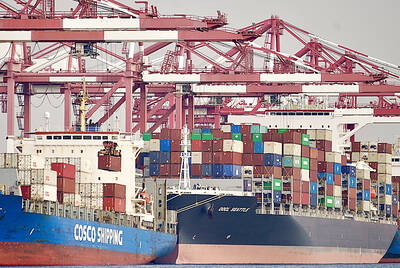
TECH WINNERS: Taiwan and South Korea reported robust trade, which suggests that they have critical advantages in the rapidly expanding AI supply chain, an official said Exports last month surged to a new high, as booming demand tied to artificial intelligence (AI) infrastructure fueled shipments of advanced technology components, underscoring the nation’s pivotal role in the global semiconductor supply chain. Outbound shipments climbed to US$80.18 billion, the highest ever for a single month, rising 61.8 percent from a year earlier and marking the 29th consecutive month of growth, the Ministry of Finance said yesterday. “The surge was driven primarily by global investment in AI infrastructure,” Department of Statistics Director-General Beatrice Tsai (蔡美娜) said. The mass production of next-generation AI computing systems has accelerated procurement across the semiconductor supply


 RSS
RSS