


Taipei Times: Hanvon Technology Co (漢王科技) enjoys a strong presence in the Chinese e-reader market and you aim to become the world’s top brand. How do you plan to do that and what is your timeline?
Liu Yingjian (劉迎建): We are currently the world’s No. 2 e-reader brand [after Amazon], and we will become No. 1 next year, or in 2012 at the latest. China has the biggest e-reader market. With our huge scale in shipments, we have advantages in lower costs and product functionality with our proprietary Mandarin-character recognition software.
Our goal was to ship 500,000 e-readers in China last year, but we sold only 266,000 units, as our upstream suppliers weren’t able to supply the volumes we requested. In the first quarter, we shipped 180,000 e-readers, and the total volume for the year will definitely surpass 1 million.
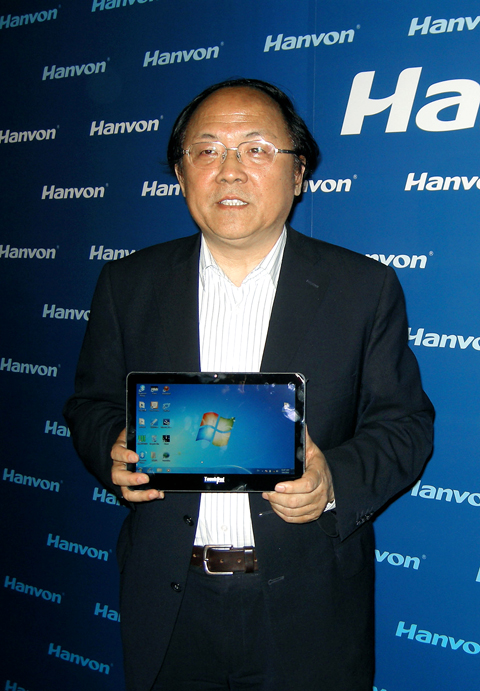
PHOTO: CNA
TT: The iPad is now taking the world by storm and Acer Inc (宏碁) last week announced that it would join hands with China’s Founder Group (北大方正集團) to move into China’s PC and e-reader market. How do you view the competition?
Liu: I regard [Apple co-founder] Steve Jobs as a hero and Apple itself is an outstanding company. Tablet PCs have been in the market for so long, but just didn’t take off. The launch of the iPad revived consumers’ interest. Apple’s business model, applications, stylish gadgets and the enjoyment these devices bring to consumers are amazing.
But this doesn’t mean that Apple products will also receive overwhelming response in China. The cultural essence is the part Western firms fail to offer. Hanvon has created computerized Mandarin-character handwriting recognition solutions, which allow the elderly and kids to enjoy technology by just scribbling on the panels.
[Liu developed the world’s first computerized Mandarin-character handwriting recognition technology in 1985, then founded Hanvon in 1998 and the company became the first Chinese IT firm to license technology to Microsoft Corp the same year.]
The market in China is huge and there won’t be only one player. We have over 40 e-reader brands and the competition helps us stay competitive. What Acer lacks in digital content is complemented by Founder’s resources.
TT: The market is now split into two segments: e-readers and tablet devices. Some say tablets will cannibalize the e-reader segment. What is your take on this, especially since Hanvon just debuted its first tablet — the TouchPad — late last month?
Liu: These two products share a similarity: They are both tablet devices, but use different panels. The major difference is that an e-reader is more for stationary use, such as flipping through newspapers and magazines, and uses less battery power. Tablets consume more power, but have color screens with more PC-like features. In the future, e-paper displays will be in color, while TFT panels used in tablets will consume less battery power. Both could merge into a single device over the next three years.
We plan to introduce a color e-reader in the fourth quarter and will see what types of clients are keen on using this product. The current monochrome e-readers have been in the market for three to five years, but only took off in bulk volumes last year.
TT: The availability of mass digital content is pivotal in the uptake of e-readers. How do you work with the content providers?
Liu: In China, we used to have only digital copyrights for B2B [business-to-business] publications, such as those for libraries, but not for B2C [business-to-consumer]. But this has changed with the invention of e-readers. There are proven successful business models for profit sharing between the content providers and device makers, such as with Apple and Amazon.
Hanvon’s business model is based on four principles: the first is that publishing firms have a say in determining the pricing of their e-books. All their e-books will also be encrypted to protect copyright. The third is that the content providers earn 80 percent of the profit and we earn the rest. The fourth is that we will be in charge of digitizing books into the database. This business model attracts a lot of publishing firms to work with us.
The total value of printed books in China averaged more than 60 billion yuan [US$8.8 billion] a year for the past five years. Half of these were textbooks. If downloading digital content is a piece of cake, and the price is affordable, this will spur more consumers to download e-books.
TT: How would you define your relationship with Taiwanese manufacturers?
Liu: We realized that when it comes product design, Taiwanese manufacturers are the cream of the crop. Hanvon isn’t strong in manufacturing and if we want to churn out products that have world-class quality, then we need to work with world-class companies. I started to pay aggressive visits to Taiwanese manufacturers in the second half of last year, looking for suitable partners. There are a slew of sleek products that we will introduce later this year and they are designed by Taiwanese firms. Also, we are currently talking to Book11.com for e-content and plan to bring in our e-reader and TouchPad to Taiwan in the second half.

Taichung reported the steepest fall in completed home prices among the six special municipalities in the first quarter of this year, data compiled by Taiwan Realty Co (台灣房屋) showed yesterday. From January through last month, the average transaction price for completed homes in Taichung fell 8 percent from a year earlier to NT$299,000 (US$9,483) per ping (3.3m²), said Taiwan Realty, which compiled the data based on the government’s price registration platform. The decline could be attributed to many home buyers choosing relatively affordable used homes to live in themselves, instead of newly built homes in the city’s prime property market, Taiwan Realty
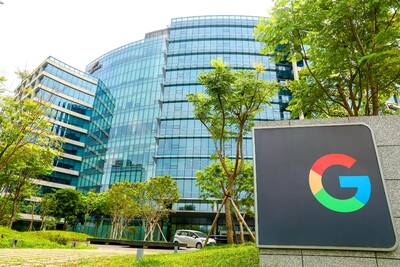
The government yesterday approved applications by Alphabet Inc’s Google to invest NT$27.08 billion (US$859.98 million) in Taiwan, the Ministry of Economic Affairs said in a statement. The Department of Investment Review approved two investments proposed by Google, with much of the funds to be used for data processing and electronic information supply services, as well as inventory procurement businesses in the semiconductor field, the ministry said. It marks the second consecutive year that Google has applied to increase its investment in Taiwan. Google plans to infuse NT$25.34 billion into Charter Investments Ltd (特許投資顧問) through its Singapore-based subsidiary Fructan Holdings Singapore Pte Ltd, and

JET JUICE: The war on Iran’s secondary effects have seen fuel prices skyrocket, knocking flight schedules down to earth in return as airlines struggle with costs Airline passengers should brace for more irritation in the next few months as carriers worldwide cancel flights and ground planes to cope with stratospheric increases in jet-fuel prices. Dutch flag carrier KLM is the latest company to cut its schedule, saying on Thursday that it would scrap 80 return flights at Amsterdam’s Schiphol Airport in the coming month. That puts it in the same league as United Airlines Holdings Inc, Deutsche Lufthansa AG and Cathay Pacific Airways Ltd, which have all pruned itineraries to mitigate costs. Global capacity for next month has been reduced by about 3 percentage points, with all

The US said it plans to help build a first-of-its-kind industrial hub in the Philippines to boost production of inputs crucial to US supply chains. The 4,000-acre hub is intended to be “a purpose-built platform for allied manufacturing” and “an investment acceleration hub where the specific industrial activities are shaped by market demand,” the US Department of State said on Thursday. The project — touted as an “economic security zone” — would be within the Luzon Economic Corridor, a flagship economic project backed by the US and Japan on the main Philippine island. The project was also described as “the first artificial intelligence


 RSS
RSS