


Four Singaporean firms are planning to list on Taiwan’s stock exchange by issuing Taiwan Depositary Receipts or through an initial public offering (IPO), Taiwan Stock Exchange Corp (台灣證交所) chairman Schive Chi (薛琦) said.
However, Schive was reluctant to reveal the companies’ names, saying only that they were “highly interested in doing so” during a telephone interview with Singapore’s Lianhe Zaobao on Tuesday.
“Medium-sized companies from Singapore in the environmental protection, technology, green energy and service sectors should be welcome in the Taiwanese market,” the newspaper quoted him as saying.
“Most of the local firms listed on Taiwan’s bourse are high-tech and information companies, of which many are small but profitable enterprises,” he said, according to the newspaper.
Schive predicted that more foreign enterprises would apply for listings on the local bourse in the second half of this year, citing market statistics showing that 56 companies plan to list sometime this year.
Silicon Valley-based Integrated Memory Logic Ltd, a TFT-LCD maker, will list in Taiwan next week, he said.
Encouraging Singaporean companies that feel they are undervalued to follow suit, Schive said listing in a secondary market would make sense because a strong performance could drive up the company’s share prices in the original market.
COMING BACK
In the past, Singapore’s stock market was more attractive to Taiwanese businessmen, but in recent years, a growing number of Taiwan’s entrepreneurs with investments overseas have returned home to list, attracted by the market’s high price-earnings (P/E) ratios and strong liquidity, Schive said.
Since 2000, shares listed on the Taiwan Stock Exchange have averaged a P/E ratio of 20, higher than Singapore’s average of 16 to 17 and Hong Kong’s 15.6, he said.
Another strength is the market’s high cash dividends, Schive said.
In 2008, companies listed on Taiwan’s bourse distributed NT$1 trillion (US$31.5 billion), or about 8.5 percent of the country’s GDP, in cash dividends to shareholders.
Asked whether Taiwan’s stock exchange is willing to sign an agreement with Singapore’s bourse that would encourage firms of both countries to cross-list, Schive cautioned that because it involved currency settlement issues, it would have to be handled carefully and on a step-by-step basis.
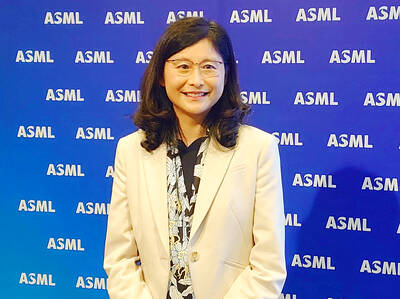
Netherlands-based semiconductor equipment supplier ASML Holding NV yesterday said that it is planning to hire an additional 1,000 people in Taiwan this year in response to growing demand from clients. ASML had previously planned to recruit 600 people this year, but that the plan has been adjusted upward, ASML vice president and ASML Taiwan general manager Grace Wang (汪佳慧) told reporters. ASML has a workforce of more than 4,500 in Taiwan, accounting for about 10 percent of its global total, Wang said. This year’s recruitment campaign would focus on adding people in the customer support, manufacturing and supply chain domains to assist ASML
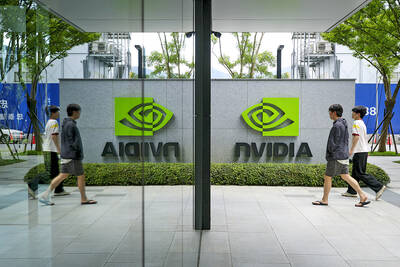
UNDER MICROSCOPE: Taiwan detained three people who allegedly conspired to buy servers in Taiwan and export them using fraudulent documentation, prosecutors said Nvidia Corp chief executive officer Jensen Huang (黃仁勳) on Saturday urged Super Micro Computer Inc to tighten up on compliance after Taiwan detained three people this week for allegedly making fraudulent declarations about artificial intelligence (AI) servers made by its US partner. The development marked the nation’s first crackdown on semiconductor smuggling, which grew after the US slapped restrictions on exports of high-end chips such as Nvidia AI accelerators to China. Nvidia is “rigorous” in explaining regulations to all of its partners, Huang told reporters after arriving in Taipei. “Ultimately Super Micro has to run their own company,” he said in response to
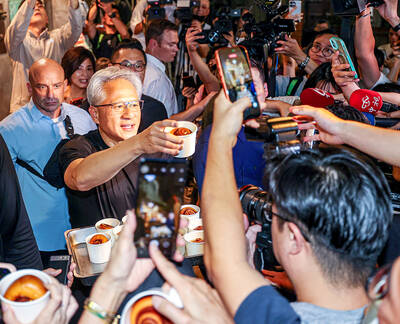
Nvidia Corp yesterday announced that CEO Jensen Huang (黃仁勳) would attend an employee meeting in Taipei tomorrow to celebrate the launch of the company’s Taiwan headquarters project. Huang would attend a gathering at the site of Nvidia’s planned headquarters in Beitou Shilin Technology Park (北投士林科技園區), the company said in a statement. After arriving in Taiwan on Saturday last week, Huang told reporters that he plans to meet with Quanta Computer Inc (廣達) chairman Barry Lam (林百里) and Taiwan Semiconductor Manufacturing Co (TSMC, 台積電) chairman C.C. Wei (魏哲家), and would attend the groundbreaking ceremony for Nvidia’s Taiwan headquarters tomorrow. Nvidia has not yet applied
Huawei Technologies Co (華為) said it has come up with a new pathway to shorten its gap with industry leader Taiwan Semiconductor Manufacturing Co (TSMC, 台積電), potentially achieving a breakthrough in making advanced semiconductors without cutting-edge equipment. Right now there is about a five-year gap between what TSMC is capable of and what Huawei, together with its manufacturing partner Semiconductor Manufacturing International Corp (中芯), can produce. Huawei is to start making 1.4-nanometer chips by 2031 with its own “LogicFolding” technology, Huawei semiconductor chief He Tingbo (何庭波) said in a rare public appearance during a chip conference yesterday, while TSMC has


 RSS
RSS