


More than two decades since the last Barbie rolled off the assembly line in Taiwan, nostalgic former factory workers are preserving her memory by tailoring exquisite dresses for the iconic doll.
For these women, making the outfits is a labor of love, recalling the days when the plant run by US toymaker Mattel was a major employer in the northern town of Taishan (泰山), near Taipei.
Chou Su-chin smiles as she thinks about her first job. She left the country's impoverished southern countryside to sign up at the factory when she was 18.
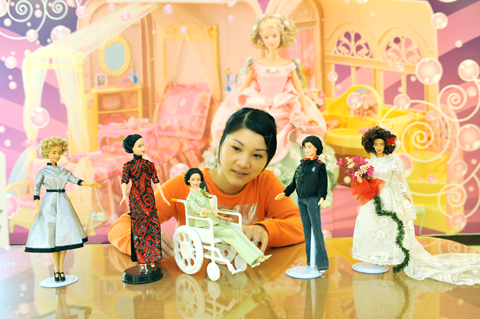
PHOTO: SAM YEH, AFP
"I'd never seen anything as beautiful as Barbie. I loved the dolls so much," the 59-year-old said, adding with a hint of sadness: "I really miss my job."
In its heyday the factory supported one in every three Taishan residents and during the 1960s and 1970s the community prospered as exports soared. The era coincided with Taiwan's transformation from a rural society into a rich industrialized one.
Today, the Meining Workshop set up by the former workers close to the original factory displays around 100 hand-sewn dresses modeled by Barbie dolls, for which the dressmakers have drawn inspiration from Taiwanese and Chinese culture.
The dresses, which are for sale, include a regal gown inspired by Wu Zetian (武則天), a woman who ruled China about 700AD, as well as a range of outfits based on Taiwan*s five first ladies.
※For us, making a doll*s dress is like creating a piece of art and it*s how we pay tribute to Taishan*s history as a Barbie-producing town,§ workshop manager Ku Chai-ra said.
※We were practically raised by Barbie and it has become a part of our lives. It's a beautiful memory for all of us in Taishan,§ said Ku, a former Mattel worker like her mother.
The doll-sized wardrobes of clothes for Taiwan*s first ladies feature a suit for Wu Shu-jen, together with miniature jewelry and a wheelchair.
Wu, the disabled wife of former president Chen Shui-bian (陳水扁) faces a life sentence for corruption, as does her husband, who ruled Taiwan from 2000 to 2008.
Ku's staff also made mini qipao, the figure-hugging Chinese dress, based on those worn in pictures by Soong Meiling (宋美齡), the elegant wife of dictator Chiang Kai-shek (蔣介石), who fled to Taiwan in 1949 after losing a civil war to the 〝communists in China.
"The five first ladies are from different eras and represent Taiwan's history and its fashion trends," Ku said.
Many brides-to-be still come to the workshop to order miniature versions of their wedding gowns as souvenirs, she said.
Mattel began producing Barbie in 1959, and immediately struck gold with a product that appealed to the daughters of middle-class families throughout the increasingly wealthy Western world.
Eight years later, Mattel opened the Taishan facility, one of its first factories in Asia, attracted to the country by its then-cheap labor force and plastic manufacturing know-how.
But the dolls were out of the price range of the workers who produced them.
"Barbie was so precious at that time since it was for export only. Besides, we couldn't possibly afford a doll that cost more than our salary," Chou said.
A Mattel worker earned NT$900 Taiwan a month in the late 1960s while a Barbie doll purchased in Japan cost about NT$1,200.
But NT$900 was only slightly below the average income at the time and for a teenage peasant girl it seemed a fortune, Chou said.
Like her, many Taishan residents spent the best years of their lives in the factory until it closed in 1987 when Mattel relocated its production lines to China and elsewhere because of cheaper labor and material costs.
Many in Taishan now hope that their efforts to promote the town*s Barbie connection will encourage the company to open a museum or a flagship store there, Ku said.
※It would be very meaningful as Taishan is practically a home town to Barbie,§ she said.

The domestic unit of the Chinese-owned, Dutch-headquartered chipmaker Nexperia BV will soon be able to produce semiconductors locally within China, according to two company sources. Nexperia is at the center of a global tug-of-war over critical semiconductor technology, with a Dutch court in February ordering a probe into alleged mismanagement at the company. The geopolitical tussle has disrupted supply chains, with some carmakers reportedly forced to cut production due to chip shortages. Local production would allow Nexperia’s domestic arm, Nexperia Semiconductors (China) Ltd (安世半導體中國), to bypass restrictions in place since October on the supply of silicon wafers — etched with tiny components to

Singapore-based ride-hailing and delivery giant Grab Holdings Ltd has applied for regulatory approval to acquire the Taiwan operations of Germany-based Delivery Hero SE's Foodpanda in a deal valued at about US$600 million. Grab submitted the filing to the Fair Trade Commission on Friday last week, with the transaction subject to regulatory review and approval, the company said in a statement yesterday. Its independent governance structure would help foster a healthy and competitive market in Taiwan if the deal is approved, Grab said. Grab, which is listed on the NASDAQ, said in the filing that US-based Uber Technologies Inc holds about 13 percent of

Taiwan Semiconductor Manufacturing Co (TSMC, 台積電) yesterday received government approval to deploy its advanced 3-nanometer (3nm) process at its second fab currently under construction in Japan, the Ministry of Economic Affairs said in a news release. The ministry green-lit the plan for the facility in Kumamoto, which is scheduled to start installing equipment and come online in 2028 with a monthly production capacity of 15,000 12-inch wafers, the ministry said. The Department of Investment Review in June 2024 authorized a US$5.26 billion investment for the facility, slated to manufacture 6- to 12nm chips, significantly less advanced than 3nm process. At a meeting with

Taiwan is open to joining a global liquefied natural gas (LNG) program if one is created, but on the condition that countries provide delivery even in a scenario where there is a conflict with China, an energy department official said yesterday. While Taiwan’s priority is to have enough LNG at home, the nation is open to exploring potential strategic reserves in other countries such as Japan or South Korea, Energy Administration Deputy Director-General Chen Chung-hsien (陳崇憲) said. While the LNG market does not have a global reserve for emergencies like that of oil, the concept has been raised a few times —


 RSS
RSS