


Hong Kong-listed Global Sweeteners Holdings Ltd (大成糖業控股) has gained approval from Taiwan to seek a secondary listing on the local bourse by issuing Taiwan Depository Receipts (TDRs).
After making its Taipei debut sometime next month, the Cayman Islands-registered company will become the third firm to list TDRs on the local bourse this year following Hwa Fong Rubber Co’s (華豐橡膠) Thailand subsidiary and Hong Kong’s Kith Holdings Ltd (僑威集團).
The Financial Supervisory Commission’s Securities and Futures Bureau said on its Web site on Friday that it gave the green light to Global Sweeteners to raise NT$1.5 billion (US$46.8 million) in funds via TDR sales.
Global Sweeteners plans to issue up to 100 million units of TDR, with each TDR representing two of its common shares. That was halved from the planned 200 million units the company announced on Dec. 8, when it first applied to Taiwan Stock Exchange Corp (TWSE, 台灣證交所) and the nation’s central bank for the TDR offering.
Global Sweeteners, which focuses mainly on corn-refined and corn sweeteners, is one of the largest corn sweetener producers in China, with an annual production capacity of 600,000 tonnes of upstream corn-refined products and 1,260,000 tonnes of corn sweeteners.
The company said earlier it planned to use the TDR proceeds to branch into the new beef products business, which it deems a new growth driver.
“The net proceeds from the TDR issue will provide us with additional financial resources to develop our latest venture in cattle fattening operations,” chairman Kong Zhanpeng (孔展鵬) said in the Dec. 8 statement.
“The TDR issue will increase the public awareness of Global Sweeteners as well as promote the company’s corporate image in Taiwan,” Kong said.
Separately, the TWSE has amended its operating rules because it intends to cancel the trading of companies’ TDRs on the local bourse if the number of shares in circulation has been lower than 10 million units for three consecutive months.
In a Friday statement, TWSE said it decided to delist companies from the main bourse mainly because TDRs would easily fall victim to price manipulation if there is very low daily turnover.
To safeguard investors’ interest, the issuers of TDRs will be required to buy back all units in circulation after the delisting, the exchange said.
A total of 16 overseas companies are currently trading TDRs in Taiwan, including 10 that started selling shares to local investors last year, such as Want Want China Holdings Ltd (中國旺旺控股) and Tingyi Holding (Cayman Islands) Corp (康師傅控股), TWSE data showed.

In Italy’s storied gold-making hubs, jewelers are reworking their designs to trim gold content as they race to blunt the effect of record prices and appeal to shoppers watching their budgets. Gold prices hit a record high on Thursday, surging near US$5,600 an ounce, more than double a year ago as geopolitical concerns and jitters over trade pushed investors toward the safe-haven asset. The rally is putting undue pressure on small artisans as they face mounting demands from customers, including international brands, to produce cheaper items, from signature pieces to wedding rings, according to interviews with four independent jewelers in Italy’s main

Japanese Prime Minister Sanae Takaichi has talked up the benefits of a weaker yen in a campaign speech, adopting a tone at odds with her finance ministry, which has refused to rule out any options to counter excessive foreign exchange volatility. Takaichi later softened her stance, saying she did not have a preference for the yen’s direction. “People say the weak yen is bad right now, but for export industries, it’s a major opportunity,” Takaichi said on Saturday at a rally for Liberal Democratic Party candidate Daishiro Yamagiwa in Kanagawa Prefecture ahead of a snap election on Sunday. “Whether it’s selling food or

CONCERNS: Tech companies investing in AI businesses that purchase their products have raised questions among investors that they are artificially propping up demand Nvidia Corp chief executive officer Jensen Huang (黃仁勳) on Saturday said that the company would be participating in OpenAI’s latest funding round, describing it as potentially “the largest investment we’ve ever made.” “We will invest a great deal of money,” Huang told reporters while visiting Taipei. “I believe in OpenAI. The work that they do is incredible. They’re one of the most consequential companies of our time.” Huang did not say exactly how much Nvidia might contribute, but described the investment as “huge.” “Let Sam announce how much he’s going to raise — it’s for him to decide,” Huang said, referring to OpenAI
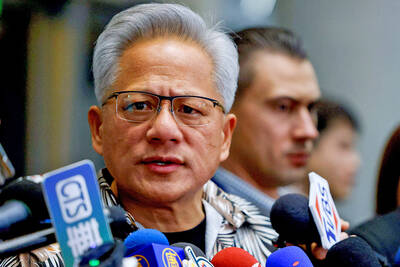
Nvidia Corp’s negotiations to invest as much as US$100 billion in OpenAI have broken down, the Wall Street Journal (WSJ) reported, exposing a potential rift between two of the most powerful companies in the artificial intelligence (AI) industry. The discussions stalled after some inside Nvidia expressed concerns about the transaction, the WSJ reported, citing unidentified people familiar with the deliberations. OpenAI makes the popular chatbot ChatGPT, while Nvidia dominates the market for AI processors that help develop such software. The companies announced the agreement in September last year, saying at the time that they had signed a letter of intent for a strategic


 RSS
RSS