


Hopes for a quick US economic rebound were dashed on Friday as data showed US employers cut 85,000 jobs last month while the unemployment rate held at 10 percent.
Analysts said the report highlighted a slow and painful recovery from recession, while US President Barack Obama said it shows “that the road to recovery is never straight.”
The Labor Department report on nonfarm payrolls was far worse than the consensus expectation for no change in overall employment levels.
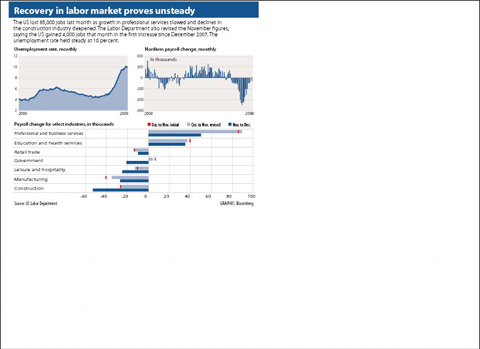
The unemployment rate meanwhile was in line with expectations, remaining near its highest level since the 1980s, but also reflected a large number of people dropping out of the workforce.
In revising data for prior months, the data showed a net gain of 4,000 jobs in November instead of a loss of 11,000 previously reported, the first positive month after 22 months of losses.
Obama said the report highlights the need for more efforts to create jobs.
The figures “are a reminder that the road to recovery is never straight and that we have to continue to work every single day to get our economy moving again,” Obama said as he unveiled plans for tax credits for “green jobs.”
Still, he said the employment picture is better than when he began as president, when the economy was shedding some 700,000 jobs per month.
“The overall trend of job loss is still pointing in the right direction,” he said.
Economists said the news was disappointing but consistent with a gradually healing economy.
“We’re getting a steady but very slow improvement in the job market,” said Robert MacIntosh, economist at Eaton Vance. “We are going to have to get used to a frustratingly high unemployment rate.”
Cary Leahey, senior economist at the research firm Decision Economics, called the data consistent with a still-sluggish economy.
“The labor market is struggling and is stuck in the water,” he said. “You are seeing gains in output and manufacturing because of liquidation of inventories ... but we haven’t seen a decisive turn in the labor market.”
The world’s biggest economy expanded at a 2.2 percent pace in the third quarter after four quarters of decline in the worst recession in decades.
Most analysts expect continued growth for the fourth quarter and this year, but say recovery could be held back by unemployment, which hurts consumer spending and confidence.
“It is starting to look like those in the U-shaped recovery camp are in better shape than those in the V-shaped recovery camp,” said Ian Pollick, economics strategist at TD Securities. “While the worst of the recession is likely over, the fact that the duration of unemployment remains rigid is a concern, though a silver lining is that we are likely to see net job creation assisted by census hiring in the first quarter of 2010.”
The December report showed the goods-producing sector shed 81,000 jobs including 27,000 in manufacturing and 53,000 in construction.
The services sector lost a modest 4,000 jobs, with a loss of 10,000 in retail offset by gains in education, health care and professional services. Government sector employment fell by 21,000.
Average hours worked, sometimes seen as a proxy for economic activity, was unchanged last month. Average hourly earnings meanwhile rose 0.2 percent.
The civilian labor force fell by 661,000 in the month, suggesting that more people are stopping their search for employment.
“The unchanged unemployment rate of 10 percent understates labor market slack, since labor force participation fell sharply,” said Sophia Koropeckyj at Moody’s Economy.com. “Accordingly, the broader measure [of unemployment] increased to 17.3 percent,” she said.
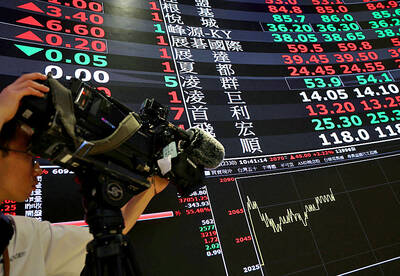
After several years flying high as Asia’s best Nvidia Corp proxy, Taiwan Semiconductor Manufacturing Co (TSMC, 台積電) is increasingly vying with other artificial intelligence (AI) stocks for investor attention. Stock traders are chasing a wider array of beneficiaries as mainstream usage of AI creates demand for hardware beyond the most-advanced chips TSMC makes for Nvidia. Subthemes from the deepening memory crunch to advances in robotics are also luring bids. At the same time, investment caps on single stocks are pushing funds to diversify, while retail investors long familiar with TSMC through its US depositary receipts are being offered a broader set of
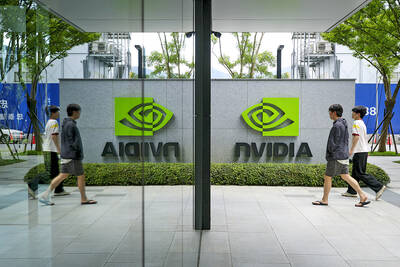
UNDER MICROSCOPE: Taiwan detained three people who allegedly conspired to buy servers in Taiwan and export them using fraudulent documentation, prosecutors said Nvidia Corp chief executive officer Jensen Huang (黃仁勳) on Saturday urged Super Micro Computer Inc to tighten up on compliance after Taiwan detained three people this week for allegedly making fraudulent declarations about artificial intelligence (AI) servers made by its US partner. The development marked the nation’s first crackdown on semiconductor smuggling, which grew after the US slapped restrictions on exports of high-end chips such as Nvidia AI accelerators to China. Nvidia is “rigorous” in explaining regulations to all of its partners, Huang told reporters after arriving in Taipei. “Ultimately Super Micro has to run their own company,” he said in response to
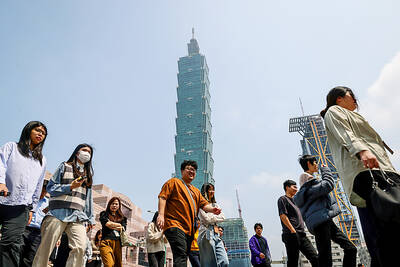
TECH RELIANCE: Growth is increasingly reflecting an unequal K-shaped distribution, where technology sectors outperform and other industries struggle, an expert said Standard Chartered Bank has significantly raised its forecast for Taiwan’s economic growth to 9.5 percent this year, up from 7.6 percent previously, citing surging artificial intelligence (AI) demand driving exports, semiconductor production and investment. The upgrade reflects a sustained AI supercycle that continues to fuel demand for advanced chips and technology infrastructure, which form the backbone of Taiwan’s exports, the bank said in a report this week. “We raise our 2026 growth forecast to reflect a much stronger-than-expected first-quarter GDP figure,” Standard Chartered senior economist for greater China and Asia Tommy Wu (胡東安) said in the report. Driven largely by a 35.3 percent

Netherlands-based semiconductor equipment supplier ASML Holding NV yesterday said that it is planning to hire an additional 1,000 people in Taiwan this year in response to growing demand from clients. ASML had previously planned to recruit 600 people this year, but that the plan has been adjusted upward, ASML vice president and ASML Taiwan general manager Grace Wang (汪佳慧) told reporters. ASML has a workforce of more than 4,500 in Taiwan, accounting for about 10 percent of its global total, Wang said. This year’s recruitment campaign would focus on adding people in the customer support, manufacturing and supply chain domains to assist ASML


 RSS
RSS