


Council of Labor Affairs Minister Jennifer Wang (王如玄) yesterday reiterated that signing an economic cooperation framework agreement (ECFA) with China would not increase unemployment in Taiwan.
“It [an ECFA] will ultimately have a positive impact on the overall employment population in Taiwan based on various assessment reports, although some industries will certainly be adversely affected,” she told a forum at the Chung-Hua Institution for Economic Research (CIER, 中經院) in Taipei.
The minister said the government was working on measures to help vulnerable industries transform and expressed regret that the political debate has turned the matter into a zero-sum game.
Economists and government officials gathered to discuss the impact of trade liberalization on the workforce and how the government plans to cope with its implications.
“In the face of cross-strait trade liberalization, however, we should not ignore the fact that China has had a magnetic effect on Taiwan’s human resources because of its strong economic development,” said Cheng Chih-yu (成之約), a professor at National Chengchi University’s Institute for Labor Research.
Citing a survey by the Ministry of Education on the plans of high school graduates, Cheng said that 47 percent of parents wanted their children to attend school in China regardless of whether the government recognized Chinese education credentials.
Meanwhile, the demand for foreign workers in Taiwan, especially from China, will continue to grow, he said, because the nation’s low birth rate and ageing population mean Taiwan’s younger workforce is dwindling.
“I think the magnetic effect will be greater if the government does not sign an ECFA, because the cross-strait trade barriers will encourage Taiwanese industries to move to China and ASEAN countries,” Chen said.
Wang Jien-ping (王劍平), chief secretary of the Bureau of Foreign Trade, said China had long attracted Taiwanese talent because it is one of the biggest economies in the world. Taiwan is not the only country to be affected, Wang said.
“Though China has lured Taiwanese investment, at the same time, Taiwan can try to attract investment from China,” Wang said.
Meanwhile, China Credit Information Service Ltd (中華徵信所) yesterday estimated that Taiwanese electronics firms based across the strait will pay out 345 billion yuan (US$50.52 billion) in tax levies a year to China unless the ECFA talks cut their tax rate from 25 percent to 15 percent.
The agency issued a statement urging the government to negotiate preferential treatment for Taiwanese businesses including China-based ones, which have made a great contribution to the Chinese economy.
Out of 10,747 electronics makers in China with 5 million yuan in annual revenues, those founded or invested in by Taiwanese account for about 36 percent of revenues.
China-based Taiwanese electronics makers accounted for 1.2 trillion yuan in exports, or 45 percent of the total, the agency said.
ADDITIONAL REPORTING BY STAFF WRITER
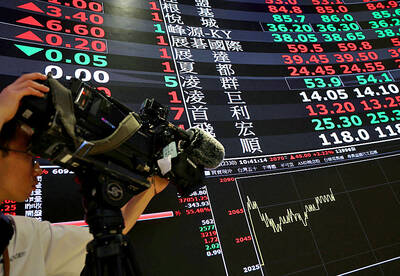
After several years flying high as Asia’s best Nvidia Corp proxy, Taiwan Semiconductor Manufacturing Co (TSMC, 台積電) is increasingly vying with other artificial intelligence (AI) stocks for investor attention. Stock traders are chasing a wider array of beneficiaries as mainstream usage of AI creates demand for hardware beyond the most-advanced chips TSMC makes for Nvidia. Subthemes from the deepening memory crunch to advances in robotics are also luring bids. At the same time, investment caps on single stocks are pushing funds to diversify, while retail investors long familiar with TSMC through its US depositary receipts are being offered a broader set of

UNDER MICROSCOPE: Taiwan detained three people who allegedly conspired to buy servers in Taiwan and export them using fraudulent documentation, prosecutors said Nvidia Corp chief executive officer Jensen Huang (黃仁勳) on Saturday urged Super Micro Computer Inc to tighten up on compliance after Taiwan detained three people this week for allegedly making fraudulent declarations about artificial intelligence (AI) servers made by its US partner. The development marked the nation’s first crackdown on semiconductor smuggling, which grew after the US slapped restrictions on exports of high-end chips such as Nvidia AI accelerators to China. Nvidia is “rigorous” in explaining regulations to all of its partners, Huang told reporters after arriving in Taipei. “Ultimately Super Micro has to run their own company,” he said in response to
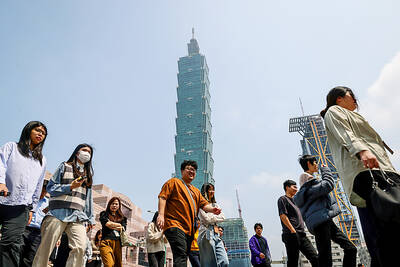
TECH RELIANCE: Growth is increasingly reflecting an unequal K-shaped distribution, where technology sectors outperform and other industries struggle, an expert said Standard Chartered Bank has significantly raised its forecast for Taiwan’s economic growth to 9.5 percent this year, up from 7.6 percent previously, citing surging artificial intelligence (AI) demand driving exports, semiconductor production and investment. The upgrade reflects a sustained AI supercycle that continues to fuel demand for advanced chips and technology infrastructure, which form the backbone of Taiwan’s exports, the bank said in a report this week. “We raise our 2026 growth forecast to reflect a much stronger-than-expected first-quarter GDP figure,” Standard Chartered senior economist for greater China and Asia Tommy Wu (胡東安) said in the report. Driven largely by a 35.3 percent
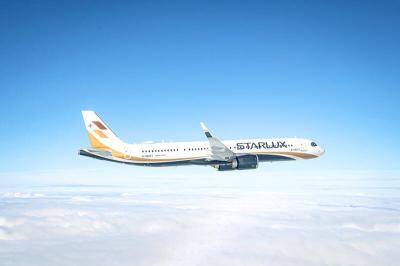
Two of Taiwan’s international carriers, Starlux Airlines Co (星宇航空) and EVA Airways Corp (長榮航空), have retained the five-star airline rating awarded by international airline review organization Skytrax. Starlux was awarded the distinction for a second consecutive year, while EVA Air received it for the 11th straight year, Skytrax said in statements released yesterday and on Thursday last week, respectively. The five-star rating is considered one of the airline industry's highest honors and is awarded following professional audits of airline product and frontline service standards, Skytrax said. The ratings are based on in-depth assessments using unified global quality standards rather than customer review scores


 RSS
RSS