

Third-generation (3G) mobile service provider Vibo Telecom Inc (威寶電信) said yesterday it hoped to turn a profit in the middle of next year, 10 years after it received a license to operate the 3G service.
Increases in subscribers and revenues per user (ARPU) would be the key factors behind the turnaround, Vibo chief executive Chang Feng-hsiung (張豐雄) told a media briefing.
Vibo, which holds about 7 percent share of Taiwan’s mobile market, hopes to boost revenues by 50 percent to NT$12 billion (US$371.6 million) next year from NT$8 billion this year and to expand its customer base from 1.5 million at the moment to more than 2 million, Chang said.
Last year, Vibo had 800,000 subscribers.
“After expanding our customer base to reach an economy of scale, we now intend to increase our ARPU,” Chang said. “We hope to break even in July next year and could become profitable for the full year next year.”
Vibo losses diminished to NT$2.38 billion for the first half of this year, compared with losses of NT$2.46 billion a year earlier. Revenues more than doubled to NT$3.61 billion from NT$1.67 billion during the same period, the company’s financial statements showed.
As part of its turnaround efforts, Vibo hopes to boost ARPU to NT$600 next year from NT$560 this year through more data services and increasing business customers, Chang said. He did not provide detailed figures about the company’s business clients.
To keep pace with growing demand for wider bandwidth and higher speed, Vibo said it would accelerate its upgrade of base stations to 3.5G and 3.9G, Chang said.
Vibo could spend as much as NT$3 billion on network upgrades next year, from the NT$2.4 billion budgeted for this year.


INFRINGEMENT: The investigation comes after a complaint from Vicor Corp, with the company seeking a limited exclusion order as well as cease-and-desist orders, the ITA said The US International Trade Commission (USITC) has launched a Section 337 investigation naming Taiwanese technology companies, including Hon Hai Precision Industry Co (鴻海), Delta Electronics Inc (台達電) and Quanta Computer Inc (廣達), as respondents. The Ministry of Economic Affairs (MOEA) pledged assistance if needed. The USITC said on Friday in a statement that it had voted to institute an investigation under Section 337 of the US Tariff Act of 1930 into certain vertical power delivery systems, related components and computing devices incorporating such systems. The investigation covers 20 companies from Taiwan, China, Germany and the US, the commission said, adding that it
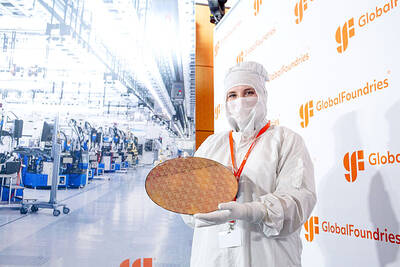
PACKAGING PUSH: The chipmaker said that it would begin ramping up silicon interposer production in New York in the first half of 2028 to support AI systems GlobalFoundries Inc shares gained as much as 7 percent after the chip manufacturer announced a five-year, US$2 billion deal to provide US production capacity to Taiwan Semiconductor Manufacturing Co (TSMC, 台積電). Under the agreement, announced on Thursday, GlobalFoundries is to help supply components known as silicon interposers. The US company is to rely on manufacturing at its facility in Malta, New York, and said it has the option to expand capacity “as customer demand grows.” An interposer is a small layer of silicon that sits between a chip and its packaging. It is home to the wires that carry electronic signals and
A man charged along with Super Micro Computer Inc co-founder Yih-Shyan “Wally” Liaw (廖益賢) of conspiring to send cutting-edge chips to China in violation of US export controls pleaded guilty, court documents said. Ting-Wei “Willy” Sun (孫廷瑋), a former outside contractor described by US authorities as a “fixer” who allegedly aided in the sales, pleaded guilty on Thursday at a hearing in federal court in New York as part of an agreement with prosecutors, court filings showed. Prosecutors claimed the men were part of a scheme to send Nvidia Corp-powered servers to an unnamed Southeast Asian company and then divert them to
SECOND-TOP MONTH: September revenue was 0.6 percent lower month-on-month, but despite the drop, it was the firm’s highest-ever sales report for the month Taiwan Semiconductor Manufacturing Co (TSMC, 台積電) yesterday reported record quarterly revenue for last quarter, after sales last month hit the second-highest monthly level in the company’s history. Revenue in the quarter ended last month was NT$1.49 trillion (US$46.75 billion), up 17 percent from NT$1.27 trillion in the second quarter and exceeding the combined prediction of 19 LSEG SmartEstimate analysts of NT$1.46 trillion. Last quarter’s figure — which was up 12 percent from the midpoint of last year — also surpassed the company’s July estimates of US$44.6 billion to US$45.8 billion amid surging demand for the ramp-up of its advanced 2-nanometer technology, artificial


 RSS
RSS