


The financial crisis has taken a toll on the profits of the nation’s top 500 large companies last year, which declined by NT$1.4 trillion (US$42.4 billion), or 88.3 percent year-on-year, to a record low of NT$184.7 billion.
“That was horribly low, accounting for only half of what was generated [by the top 500 companies] in 2001,” Liu Jen (劉任), editor-in-chief of the business information service department at China Credit Information Service Ltd (中華徵信所), said in a presentation yesterday to unveil the company’s survey on the top 5,000 domestic companies.
Collective revenues generated by the top 500 companies, which had average minimum revenues of NT$7.4 billion each, grew a meager 1.9 percent to NT$24 trillion last year, Liu said.
A huge drag from 115 loss-making companies on the list, up from 47 in 2007, was another reason behind last year’s record-low profits.
The 20 most unprofitable companies were in sectors such as state-run enterprises, life insurance, airlines, semiconductor and optoelectronics, which had a combined NT$63 billion in losses, most of which were incurred in the second half of last year as the nation’s export performance was robust in the first half, he said.
Looking ahead, Liu said that he couldn’t help but feel pessimistic about corporate earnings this year, “although the worst is over,” saying that the nation’s listed companies reported NT$12 billion in first-quarter revenues, a 90 percent drop year-on-year.
The survey showed that Hon Hai Precision Industry Co (鴻海精密) continued to top all counterparts for the fourth consecutive year and reported the highest revenue of NT$1.4 trillion last year, followed by CPC Corp, Taiwan (CPC, 台灣中油) with NT$957.6 billion, Cathay Life Insurance Co (國泰人壽) at NT$935 billion, Formosa Petrochemical Corp (台塑石化) at NT$875.6 billion and Quanta Computer Inc (廣達電腦) with NT$763 billion.
Asustek Computer Inc (華碩電腦), AU Optronics Corp (友達光電) and Compal Electronics Inc (仁寶電腦) were edged out of the top 10 list this year, replaced by the state-owned Bureau of Labor Insurance under the Council of Labor Affairs and Chunghwa Post Co (中華郵政), both of which the survey treats as companies, along with Shin Kong Life Insurance Co (新光人壽).
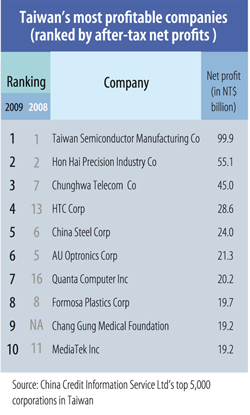
In terms of net income, Taiwan Semiconductor Manufacturing Co (TSMC, 台積電), the world’s biggest contract chipmaker topped all companies to report NT$99.9 billion in profits last year, followed by Hon Hai’s NT$55 billion, Chunghwa Telecom Co’s (中華電信) NT$45 billion and HTC Corp’s (宏達電) NT$28.6 billion.
China Credit Information, in addition, singled out nine outperforming companies — which it called “gold brick companies” — that had NT$500 million in revenues and NT$100 million in net profit with NT$4 earning per share, 20 percent revenue growth and 10 percent net profit margin last year.
Apex Robot Systems Inc (台灣精銳) topped all nine promising companies, followed by QNAP Systems Inc (威聯通) and Pu Jen Construction (�?堻]), the survey said.
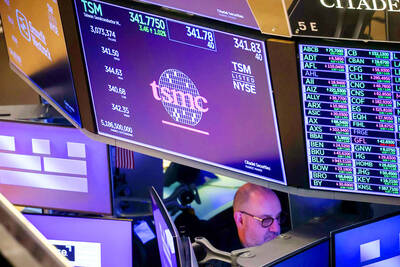
STRONG INTEREST: Analysts have pointed to optimism in TSMC’s growth prospects in the artificial intelligence era as the cause of the rising number of shareholders The number of people holding shares of chipmaker Taiwan Semiconductor Manufacturing Co (TSMC, 台積電) hit a new high last week despite a decline in its stock price, the Taiwan Depository and Clearing Corp (TDCC, 台灣集保) said. The number of TSMC shareholders rose to 2.46 million as of Friday, up 75,536 from a week earlier, TDCC data showed. The stock price fell 1.34 percent during the same week to close at NT$1,840 (US$57.55). The decline in TSMC’s share price resulted from volatility in global tech stocks, driven by rising international crude oil prices as the war against Iran continues. Dealers said
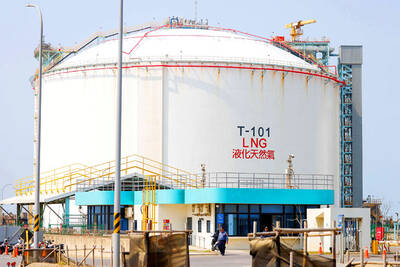
Taiwan’s natural gas supply remains stable through the end of May, despite rising concerns about potential disruptions to Qatari liquefied natural gas (LNG) supplies due to escalating conflicts in the Middle East, the Ministry of Economic Affairs said yesterday. The ministry in a statement said that Taiwan has completed preparations for natural gas supply and shipping schedules through the end of May. It has also made plans to increase natural gas imports from regions outside the Middle East in June to ensure a stable supply, it added. Taiwan sources natural gas from 14 countries and is not solely dependent on the Middle East,
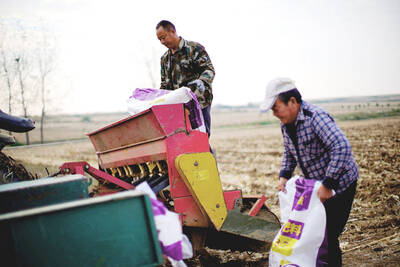
China is clamping down on fertilizer exports to protect its domestic market, industry sources said, putting an additional strain on global markets that were already grappling with shortages caused by the US-Israeli war on Iran. China is among the largest fertilizer exporters — shipping more than US$13 billion of it last year — and it has a history of controlling exports to keep prices low for farmers. Shipments through the war-blocked Strait of Hormuz account for about one-third of the sea-borne supply. This month, Beijing banned exports of nitrogen-potassium fertilizer blends and certain phosphate varieties, sources said. The ban, which has not
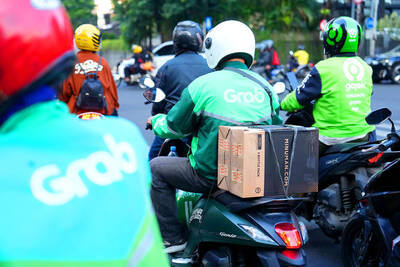
Grab Holdings Ltd agreed to buy Delivery Hero SE’s Foodpanda operations in Taiwan for US$600 million, a deal that marks its first foray outside of its Southeast Asian base. The cash acquisition will allow Grab to expand into 21 cities across Taiwan, the Singapore-based ride-hailing and delivery company said in a statement yesterday. Grab expects the transaction to be completed in the second half, subject to regulatory approvals. The purchase will give Grab a presence on the island of about 23 million people, helping it to expand beyond its intensely competitive home market. Grab has seen growth slow dramatically as it takes


 RSS
RSS