


Sollink Inc (高強光電), a display manufacturing subsidiary of electronic component maker Cheng Uei Precision Industry Co (Foxlink, 正崴), said yesterday it would soon make its first shipment of next-generation handset displays using Qualcomm Inc technologies.
Foxlink invested NT$500 million (US$15.18 million) to set up Sollink last year.
It plans to invest NT$30 billion on building plants, with the first being a 4.5-generation (4.5G) plant, the Science Park Administration in Hsinchu said.
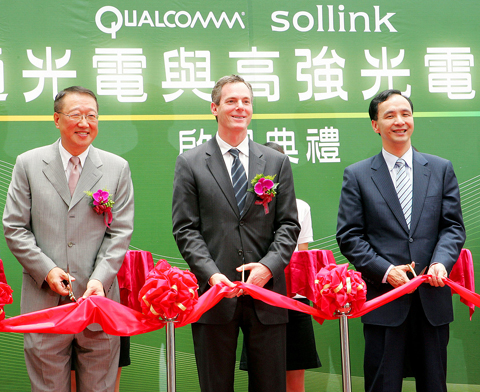
PHOTO: MAURICE TSAI, BLOOMBERG
In March, Sollink produced the first display using the so-called mirasol technology from Qualcomm MEMS, a fully owned display subsidiary of US handset chipmaker Qualcomm.
The display’s nature-based design results in low energy consumption and high reflectivity, offering consumers extended battery life and superior outdoor visibility, Sollink said.
A mirasol display consumes 40 percent less energy than a comparable liquid-crystal display, it said.
The potential market for such energy-efficient displays could be as high as US$11 billion a year, Qualcomm chief executive Paul Jacobs has said.
Mirasol and similar displays would be suitable for mobile devices including handsets, portable navigation devices and portable multimedia players as well as electronic readers, he said.
“We just started a test run of the plant. We don’t expect the plant will have significant contribution [to our revenues] until we reach economic scale by building our second, or third plants,” Foxlink and Sollink chairman Gou Tai-chiang (郭台強) said.
Foxlink wants to form a long-term partnership with Qualcomm and Sollink was the first step, Gou said.
Foxlink wants to become an electronic component supplier to Qualcomm in several areas, including communications products and smartbooks, he said.
Chinese electronics maker Hisense Group (海信集團) and local mobile phone makers Cal-Comp Electronics (Thailand) Pub Co Ltd (泰金寶) — a subsidiary of local electronics group Kinpo Group (金仁寶集團) — and Inventec Corp (英業達) are planning to use mirasol displays for their mobile devices, Sollink said.
“We expect the new mirasol displays to be shipped with Foxlink’s products in the near term,” James Lee (李政), a Foxlink board member, told a press briefing yesterday. “That will be a 1.43-inch display for ultra-slim mobile phones with thickness of 7mm.”
Shares of Foxlink declined 4.26 percent to NT$48.4 yesterday, underperforming the benchmark TAIEX, which fell 3.45 percent.

HORMUZ ISSUE: The US president said he expected crude prices to drop at the end of the war, which he called a ‘minor excursion’ that could continue ‘for a little while’ The United Arab Emirates (UAE) and Kuwait started reducing oil production, as the near-closure of the crucial Strait of Hormuz ripples through energy markets and affects global supply. Abu Dhabi National Oil Co (ADNOC) is “managing offshore production levels to address storage requirements,” the company said in a statement, without giving details. Kuwait Petroleum Corp said it was lowering production at its oil fields and refineries after “Iranian threats against safe passage of ships through the Strait of Hormuz.” The war in the Middle East has all but closed Hormuz, the narrow waterway linking the Persian Gulf to the open seas,

Nanya Technology Corp (南亞科技) yesterday said the DRAM supply crunch could extend through 2028, as the artificial intelligence (AI) boom has led the world’s major memory makers to dramatically reduce production of standard DRAM and allocate a significant portion of their capacity for high-bandwidth memory (HBM) chips. The most severe supply constraints would stretch to the first half of next year due to “very limited” increases in new DRAM capacity worldwide, Nanya Technology president Lee Pei-ing (李培瑛) told a news briefing. The company plans to increase monthly 12-inch wafer capacity to 20,000 in the first half of 2028 after a
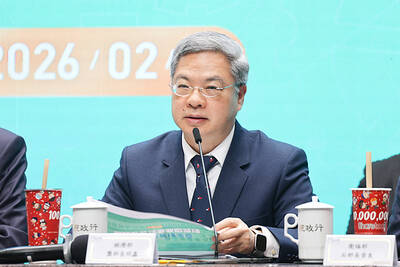
Taiwan has enough crude oil reserves for more than 100 days and sufficient natural gas reserves for more than 11 days, both above the regulatory safety requirement, Minister of Economic Affairs Kung Ming-hsin (龔明鑫) said yesterday, adding that the government would prioritize domestic price stability as conflicts in the Middle East continue. Overall, energy supply for this month is secure, and the government is continuing efforts to ensure sufficient supply for next month, Kung told reporters after meeting with representatives from business groups at the ministry in Taipei. The ministry has been holding daily cross-ministry meetings at the Executive Yuan to ensure

RATIONING: The proposal would give the Trump administration ample leverage to negotiate investments in the US as it decides how many chips to give each country US officials are debating a new regulatory framework for exporting artificial intelligence (AI) chips and are considering requiring foreign nations to invest in US AI data centers or security guarantees as a condition for granting exports of 200,000 chips or more, according to a document seen by Reuters. The rules are not yet final and could change. They would be the first attempt to regulate the flow of AI chips to US allies and partners since US President Donald Trump’s administration said it rescinded its predecessor’s so-called AI diffusion rules. Those rules sought to keep a significant amount of AI


 RSS
RSS