


US President Barack Obama offered his domestic-policy proposals as a “break from a troubled past.” But the economic outlook now is more troubled than it was even in January, despite Obama’s bold rhetoric and commitment of more trillions of dollars.
And while his personal popularity remains high, some economists and lawmakers are beginning to question whether Obama’s agenda of increased government activism is helping, or hurting, by sowing uncertainty among businesses, investors and consumers that could prolong the recession.
Although the administration likes to say it “inherited” the recession and trillion-dollar deficits, the economic wreckage has worsened on Obama’s still-young watch.
Every day, the economy is becoming more and more an Obama economy.
More than 4 million jobs have been lost since the recession began in December 2007 — roughly half in the past three months.
Stocks have tumbled to levels not seen since 1997. They are down more than 50 percent from their 2007 highs and 20 percent since Obama’s inauguration.
The president’s suggestion that it was a good time for investors with “a long-term perspective” to buy stocks may have been intended to help lift battered markets. But a big sell-off followed.
Presidents usually don’t talk about the stock market. But the dynamics are different now.
A higher percentage of people have more direct exposure to stocks — including through retirement plans — than ever.
So a tumbling stock market is adding to the national angst as households see the value of their investments and homes plunge as job losses keep rising.
Some once mighty companies such as General Motors and Citigroup are little more than penny stocks.
Many healthcare stocks are down because of fears of new government restrictions and mandates as part a health care overhaul.
Private student loan providers were pounded because of the increased government lending role proposed by Obama. Industries that use oil and other carbon-based fuels are being shunned, apparently in part because of Obama’s proposal for fees on greenhouse-gas polluters.
Makers of heavy road-building and other construction equipment have taken a hit, partly because of expectations of fewer public works jobs here and globally than first anticipated.
“We’ve got a lot of scared investors and business people. I think the uncertainty is a real killer here,” said Chris Edwards, director of fiscal policy for the libertarian Cato Institute.
Some Democrats, worried over where Obama is headed, are suggesting he has yet to match his call for “bold action and big ideas” with deeds.
In particular, they point to bumpy efforts to fix the financial system under US Treasury Secretary Timothy Geithner.
Obama may have contributed to the national anxiety by first warning of “catastrophe” if his stimulus plan was not passed and in setting high expectations for Geithner. Instead, Geithner’s public performance has been halting and he’s been challenged by lawmakers of both parties.
Republicans and even some top Democrats, including Representative Charles Rangel, chairman of the House Ways and Means Committee, have questioned the wisdom of Obama’s proposal to limit tax deductions for higher-income people on mortgage interest and charitable contributions.
Charities have strongly protested, saying times already are tough enough for them. The administration suggests it might back off that one.
Even White House claims that its policies will “create” or “save” 3.5 million jobs have been questioned by Democratic supporters.
“You created a situation where you cannot be wrong,” Senate Finance Committee Chairman Max Baucus told Geithner last week.
“If the economy loses 2 million jobs over the next few years, you can say yes, but it would’ve lost 5.5 million jobs. If we create a million jobs, you can say, well, it would have lost 2.5 million jobs,” Baucus said. “You’ve given yourself complete leverage where you cannot be wrong, because you can take any scenario and make yourself look correct.”
Republicans say that Obama’s proposals, including the “cap and trade” fees on polluters to combat global warming, would raise taxes during a recession that could touch everyone.
“Herbert Hoover tried it and we all know where that led,” House of Representatives Republican leader John Boehner said.
The administration argues its tax increases for the households earning more than US$250,000 a year and fees on carbon polluters contained in its budget won’t kick in until 2011 to 2012, when it forecasts the economy will have fully recovered.
But even those assumptions are challenged as too rosy by many private forecasters and some Democratic lawmakers.
Many deficit hawks also worry that the trillions of federal dollars being doled out by the administration, Congress and the US Federal Reserve could sow the seeds of inflation down the road, whether the measures succeed in taming the recession or not. The money includes Obama’s US$3.6 trillion budget and the US$837 billion stimulus package he signed last month.
To the notion that he favors a government-operated approach toward fixing problems, Obama says none of it started on his watch — the collapsing economy or the taxpayer-funded bailouts designed to keep matters from getting even worse.
“By the time we got here, there already had been an enormous infusion of taxpayer money into the financial system,” he said in an interview posted on Saturday on the New York Times’ Web site. “And the thing I constantly try to emphasize to people if that coming in, the market was doing fine, nobody would be happier than me to stay out of it. I have more than enough to do without having to worry the financial system.”
“I did think it might be useful to point out that it wasn’t under me that we started buying a bunch of shares of banks,” Obama said.
“It wasn’t on my watch. And it wasn’t on my watch that we passed a massive new entitlement — the prescription drug plan without a source of funding,” he said.
He said his administration has “been operating in a way that has been entirely consistent with free-market principles” and some of his critics can’t say that.
Polls show that Obama’s personal approval ratings, generally holding in the high 60s, remain greater than support for his specific policies.
“He still has a fair amount of political capital, so the public is willing to cut him some slack and go along with him for a while,” said pollster Andrew Kohut, director of the Pew Research Center. “But the public will have to get some sense that the kinds of things he’s proposing are going to work, or are showing some signs that they are working.”
Allan Sinai, chief global economist for Decision Economics, a Boston-area consulting firm, said the complexity and enormity of the crisis make it hard to solve.
“There’s no way to get it all right, regardless of which president is making policy,” Sinai said. “The problem is the sickness got too far. The actions taken, medicine applied, were mainly the wrong actions. So it’s just worse and it gets harder to deal with. At this stage, there is no easy answer, no easy way out. It’s a question of how we fumble through.”


The domestic unit of the Chinese-owned, Dutch-headquartered chipmaker Nexperia BV will soon be able to produce semiconductors locally within China, according to two company sources. Nexperia is at the center of a global tug-of-war over critical semiconductor technology, with a Dutch court in February ordering a probe into alleged mismanagement at the company. The geopolitical tussle has disrupted supply chains, with some carmakers reportedly forced to cut production due to chip shortages. Local production would allow Nexperia’s domestic arm, Nexperia Semiconductors (China) Ltd (安世半導體中國), to bypass restrictions in place since October on the supply of silicon wafers — etched with tiny components to
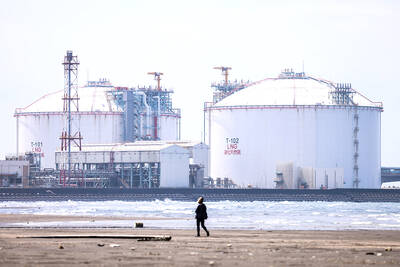
Taiwan is open to joining a global liquefied natural gas (LNG) program if one is created, but on the condition that countries provide delivery even in a scenario where there is a conflict with China, an energy department official said yesterday. While Taiwan’s priority is to have enough LNG at home, the nation is open to exploring potential strategic reserves in other countries such as Japan or South Korea, Energy Administration Deputy Director-General Chen Chung-hsien (陳崇憲) said. While the LNG market does not have a global reserve for emergencies like that of oil, the concept has been raised a few times —

Taiwan Semiconductor Manufacturing Co (TSMC, 台積電) yesterday received government approval to deploy its advanced 3-nanometer (3nm) process at its second fab currently under construction in Japan, the Ministry of Economic Affairs said in a news release. The ministry green-lit the plan for the facility in Kumamoto, which is scheduled to start installing equipment and come online in 2028 with a monthly production capacity of 15,000 12-inch wafers, the ministry said. The Department of Investment Review in June 2024 authorized a US$5.26 billion investment for the facility, slated to manufacture 6- to 12nm chips, significantly less advanced than 3nm process. At a meeting with

Standard Chartered Taiwan on March 26 announced that it has partnered with international fintech firm FinIQ to build an “Automated Structured Products Pricing Platform.” The bank is also introducing products from global issuers including Goldman Sachs Group Inc, Barclays PLC and BNP Paribas SA. The new platform enables an end-to-end process whereby it finds the most competitive pricing across multiple issuers in a matter of minutes, followed by automated documentation and transaction execution, which significantly shortens time-to-market and delivers a superior wealth management experience. Standard Chartered Bank Taiwan CEO Anthony Yu (游天立) said: “Standard Chartered is increasingly leveraging its wealth management


 RSS
RSS