


The specter of recession looms larger and darker after a local think tank yesterday lowered its GDP growth forecast to 1.24 percent next year, because of an economic downturn spanning the second half of this year and the first half of next year on falling exports and listless consumer spending.
The Chung-Hua Institution for Economic Research (CIER, 中經院), which advises the government on major policy issues, also warned of deflation and surging national debts as the government seeks to turn the economy around by cutting taxes and spending more.
“The [domestic] economic picture looks increasingly gloomy and unpredictable in the wake of the global financial storm,” Wang Lee-rong (王儷容), director of the institute’s Center for Economic Forecasting, told a media briefing.
“Amid falling exports and consumer spending, we expect the GDP growth figure to drop to 1.68 percent this year and 1.24 percent next year with four consecutive quarters posting negative growth,” Wang said.
The estimation meant the nation would be officially in recession at the end of this month and would not emerge from it until the second half of next year, Wang said, conceding that research bodies worldwide have had difficulty grasping the severity and magnitude of the current financial crisis.
“What we know is that economic indicators continue to point down,” she said.
Consumer spending is expected to contract by 0.23 percent this year and put up a meager 0.73 percent growth next year, with the upcoming distribution of consumer vouchers expected to raise GDP growth by 0.64 percentage points, the CIER report said.
The report said national investment would decline 5.72 percent this year and expand 1.78 percent next year, thanks to bigger government borrowing to fund public construction projects.
Private investment was projected to sink 7.71 percent this year and 2.15 percent next year on falling external demand, the report said.
Wang Su-wan (王素彎), a CIER researcher, said the financial, electronics, airline and shipping industries were feeling the brunt of the recession, and the credit crunch was adding to their financial strain.
While supportive of the corporate relief plan, Wang said the government should avoid subjecting lenders to indiscreet loans that may cause harm to financial stability later.
The researcher also warned of escalating national debt, saying the total amount including hidden debts had already hit NT$14 trillion (US$41.79 billion) and the government was raising more to fix the economy.
The government will need NT$2.65 trillion to fund “Intelligent Taiwan” projects alone and is cutting assorted taxes to spur private economic activity.
To that end, CIER said that the central bank would further lower interest rates next week and again next year.
Wang Lee-rong said she expected the central bank to cut the discount rate by 25 basis points to 2.5 percent on Thursday.
“The central bank will have more room for rate cuts next year with the economy overshadowed by deflation,” she said. “We expect the consumer price index to dip 0.95 percent next year.”
The CIER forecast the NT dollar would trade at an average of NT$32.98 against the greenback next year and believed it was relatively strong compared with rival currencies, notably the South Korean won.
The institute put the unemployment rate at 4.06 percent this year and 4.35 percent next year.

Taichung reported the steepest fall in completed home prices among the six special municipalities in the first quarter of this year, data compiled by Taiwan Realty Co (台灣房屋) showed yesterday. From January through last month, the average transaction price for completed homes in Taichung fell 8 percent from a year earlier to NT$299,000 (US$9,483) per ping (3.3m²), said Taiwan Realty, which compiled the data based on the government’s price registration platform. The decline could be attributed to many home buyers choosing relatively affordable used homes to live in themselves, instead of newly built homes in the city’s prime property market, Taiwan Realty
The government yesterday approved applications by Alphabet Inc’s Google to invest NT$27.08 billion (US$859.98 million) in Taiwan, the Ministry of Economic Affairs said in a statement. The Department of Investment Review approved two investments proposed by Google, with much of the funds to be used for data processing and electronic information supply services, as well as inventory procurement businesses in the semiconductor field, the ministry said. It marks the second consecutive year that Google has applied to increase its investment in Taiwan. Google plans to infuse NT$25.34 billion into Charter Investments Ltd (特許投資顧問) through its Singapore-based subsidiary Fructan Holdings Singapore Pte Ltd, and

JET JUICE: The war on Iran’s secondary effects have seen fuel prices skyrocket, knocking flight schedules down to earth in return as airlines struggle with costs Airline passengers should brace for more irritation in the next few months as carriers worldwide cancel flights and ground planes to cope with stratospheric increases in jet-fuel prices. Dutch flag carrier KLM is the latest company to cut its schedule, saying on Thursday that it would scrap 80 return flights at Amsterdam’s Schiphol Airport in the coming month. That puts it in the same league as United Airlines Holdings Inc, Deutsche Lufthansa AG and Cathay Pacific Airways Ltd, which have all pruned itineraries to mitigate costs. Global capacity for next month has been reduced by about 3 percentage points, with all
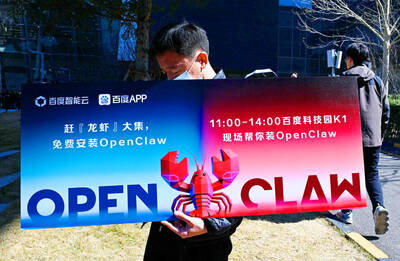
FORESEEABLE CONSEQUENCES: New technology always comes with new innovations by the iniquitous in exploiting users for financial gain or more nefarious ends Artificial intelligence (AI) “agents” say they can save users time and energy by automating tasks, but the growing power of systems such as OpenClaw is putting cybersecurity experts on edge. Powered by a wave of hype, OpenClaw today says it has more than three million users worldwide. The system allows users to create so-called agents, tools based on a large language model (LLM) such as OpenAI’s ChatGPT or Anthropic PBC’s Claude, that can carry out online tasks. “We’ve moved from an AI you could talk with via a chatbot to an agentic AI, which can take action... the threat and the risks are


 RSS
RSS