


For the past six months Wayne Hsu has been cycling 45 minutes to his office every day, which he says gets him off to an energetic start and, more importantly, slashes his monthly gasoline bill.
Hsu, an airline sales representative in Taoyuan County, is among a growing number of people here opting for bikes over cars amid rising inflation and a slowing economy.
“Cycling is an inexpensive way to exercise and I’ve encouraged my colleagues and even my boss to follow my lead,” he said.
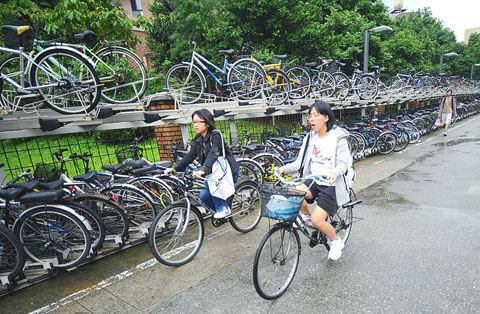
PHOTO: AFP
The new-found devotion to cycling is a great boon for bicycle manufacturers in Taiwan, which was once the world’s leading exporter but has watched business fall since the mid-1990s due to dumping charges and relocations of factories to China where production costs are much lower.
China now is the world’s major supplier of low-cost bicycles, while Taiwan retains its edge in high-end products such as racing-style, mountain and folding bikes with an average price tag of US$222, the Ministry of Economic Affairs said.
Exports reached a record high of US$$1.05 billion last year with 4.75 million bikes sold abroad, while this year looks set to break that record with the export of 2.76 million bikes totaling US$635 million in the first six months, government figures showed.
There is no official data on how many bicycles are sold locally but industry watchers estimate around 1 million were sold last year on the island of 23 million people.
“Business was booming in 2007 and this year looks to be the best,” said Jeffrey Sheu (�?�), spokesman for the world’s leading bicycle maker Giant Inc (捷安特). “Our monthly revenue hit a historical high in August and September looks like setting a new record.”
Giant’s August and last month group revenue rose 27 percent and 35 percent year-on-year to NT$3.91 billion (US$120.2 million) and NT$4.12 billion respectively while this year’s revenue is projected to increase by at least 25 percent to NT$40 billion.
“Our staff are constantly working overtime to meet the ever-growing demand,” Sheu said.
Orders have poured in for Giant products until the middle of next year, prompting the addition of a new assembly line at its central Taichung base to boost annual production to 1 million bikes from the current 600,000. It is expected to be completed by year-end.
As inflation soars and financial markets tumble, Taiwan’s bicycle manufacturers and other businesses catering to the thrifty are thriving as the public becomes increasingly eager to economize.
Pacific Cycles (太平洋自行車), a Taoyuan-based exporter, began selling its signature folding bikes at home in 2005, and since then they have become popular with city dwellers for their lightweight and convenient features.
“Our domestic sales are estimated to increase by 100 percent this year, compared with 10-30 percent in the past,” despite a 66 percent price hike to NT$50,000 per bike, marketing manager Max Yeh (葉斯偉) said.
The folding bike, fondly dubbed xiao che in Mandarin or “little foldable” by fans, weighs around 10kg.
The company, which produces 40,000 folding bikes annually in Taiwan, will soon unveil a second plant here to upgrade its product line, Yeh said.
Ed Lu, an avid fan of the folding bike in Taipei, said cycling to work helps him relax but he added that he’d prefer cleaner air for the ride.
“If more people start cycling instead of driving, we would be able to improve the air quality while reducing traffic jams,” he said.
Lu reflects a growing environmental awareness that bicycle manufacturers say has contributed to the substantial sales growth in Taiwan.
“The public realize that driving less helps reduce air pollution to protect the environment against global warming,” Sheu said.
The government has also promised to expand cycling routes and facilities, in a bid to promote cycling as part of its “green policy” aimed at saving energy and reducing carbon emissions.

In Italy’s storied gold-making hubs, jewelers are reworking their designs to trim gold content as they race to blunt the effect of record prices and appeal to shoppers watching their budgets. Gold prices hit a record high on Thursday, surging near US$5,600 an ounce, more than double a year ago as geopolitical concerns and jitters over trade pushed investors toward the safe-haven asset. The rally is putting undue pressure on small artisans as they face mounting demands from customers, including international brands, to produce cheaper items, from signature pieces to wedding rings, according to interviews with four independent jewelers in Italy’s main

Japanese Prime Minister Sanae Takaichi has talked up the benefits of a weaker yen in a campaign speech, adopting a tone at odds with her finance ministry, which has refused to rule out any options to counter excessive foreign exchange volatility. Takaichi later softened her stance, saying she did not have a preference for the yen’s direction. “People say the weak yen is bad right now, but for export industries, it’s a major opportunity,” Takaichi said on Saturday at a rally for Liberal Democratic Party candidate Daishiro Yamagiwa in Kanagawa Prefecture ahead of a snap election on Sunday. “Whether it’s selling food or

CONCERNS: Tech companies investing in AI businesses that purchase their products have raised questions among investors that they are artificially propping up demand Nvidia Corp chief executive officer Jensen Huang (黃仁勳) on Saturday said that the company would be participating in OpenAI’s latest funding round, describing it as potentially “the largest investment we’ve ever made.” “We will invest a great deal of money,” Huang told reporters while visiting Taipei. “I believe in OpenAI. The work that they do is incredible. They’re one of the most consequential companies of our time.” Huang did not say exactly how much Nvidia might contribute, but described the investment as “huge.” “Let Sam announce how much he’s going to raise — it’s for him to decide,” Huang said, referring to OpenAI

Nvidia Corp’s negotiations to invest as much as US$100 billion in OpenAI have broken down, the Wall Street Journal (WSJ) reported, exposing a potential rift between two of the most powerful companies in the artificial intelligence (AI) industry. The discussions stalled after some inside Nvidia expressed concerns about the transaction, the WSJ reported, citing unidentified people familiar with the deliberations. OpenAI makes the popular chatbot ChatGPT, while Nvidia dominates the market for AI processors that help develop such software. The companies announced the agreement in September last year, saying at the time that they had signed a letter of intent for a strategic


 RSS
RSS