


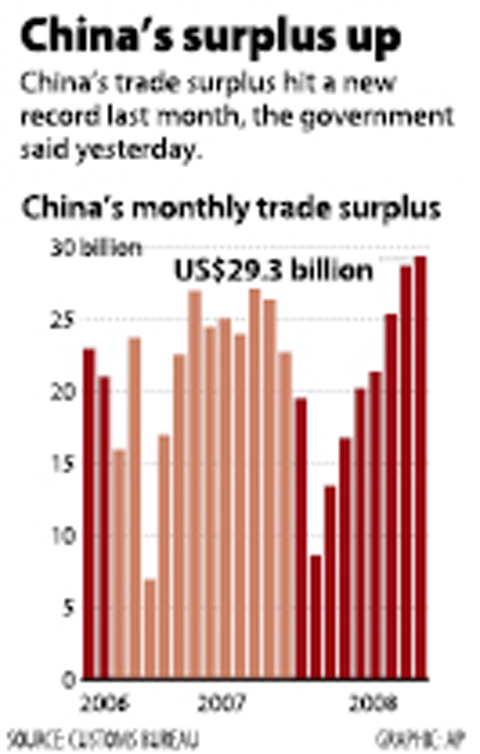
China’s trade surplus widened to a record last month as exports withstood the global economic slowdown and falling commodity prices reduced the import bill.
Exports rose 21.5 percent from a year earlier to US$136.4 billion after gaining 21.1 percent in August, the customs bureau said on its Web site. The trade surplus climbed to US$29.3 billion, a figure derived by deducting the value of imports from the number for exports.
China has stimulated the world’s fourth-biggest economy by cutting interest rates twice in a month to counter the financial crisis. The surplus swelled a record US$1.8 trillion in foreign-currency reserves, which may help the nation maintain growth of more than 9 percent as a global recession looms.
“It’s not a bad thing to have a relatively large trade surplus when there’s a global financial crisis,” said Wang Qian (王黔), an economist at J.P. Morgan in Hong Kong.
“China’s foreign-currency holdings will help the country to survive the crisis,” Wang said.
The median forecasts in a survey of 13 economists were for export growth of 20 percent and a trade surplus of US$24.5 billion. The previous record was US$28.7 billion in August.
Imports increased 21.3 percent to US$107.1 billion after climbing 23.1 percent in the previous month. Falling prices for commodities such as copper and oil have trimmed the value of inward shipments.
Export growth is down from 25.7 percent for all of last year.
“Although the numbers look like China’s exports are holding up, the volume growth of exports has slowed to below 10 percent,” Wang said.
“Export growth will continue to weaken as the economic slowdown spreads from developed economies to emerging markets,” Wang said.
Export growth to the US slowed by 4.6 percentage points from a year earlier to 11.2 percent in the first nine months, the customs bureau said.
Trade with India “surged,” it said, with imports and exports together jumping 54.9 percent in the first nine months from a year earlier.
“Maybe world demand is providing a last gasp,” said Ben Simpfendorfer, an economist with Royal Bank of Scotland Plc in Hong Kong.
“Look for a sharp slowdown in the fourth quarter. The final two months of the year will be particularly weak as electronics exports are typically shipped during this period and they are the export sector’s growth engine,” he said.
China’s latest cut in borrowing costs, which reduced the one-year lending rate to 6.93 percent, came last week as part of an emergency coordinated bid to thaw credit markets.
The US Federal Reserve, the European Central Bank and four other central banks also lowered borrowing costs.
Taiwan Semiconductor Manufacturing Co (TSMC, 台積電) has approved a capital budget of US$31.28 billion for production expansion to meet long-term development needs during the artificial intelligence (AI) boom. The company’s board meeting yesterday approved the capital appropriation plan for purposes such as the installation of advanced technology capacity and fab construction, the world’s largest contract chipmaker said in a statement. At an earnings conference last month, TSMC forecast that its capital expenditure for this year would be at the higher end of the US$52 billion to US$56 billion range it forecast in January in response to robust demand for 5G, AI and
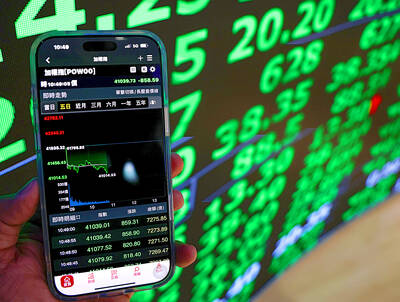
PORTFOLIO REBALANCING: The adjustments in three global equity indices reflect rising investor appetite for semiconductor and artificial intelligence-related stocks Taiwan’s weighting in major global equity indices compiled by MSCI Inc is to rise modestly following the latest quarterly review, underscoring the market’s expanding role in emerging-market portfolios, as global investors continue to favor the nation’s technology sector. Taiwan’s weighting in the MSCI Emerging Markets Index is to increase by 0.30 percentage points to 23.76 percent, after the changes take effect at the close of the May 29 session. Its weighting in the MSCI All-Country Asia ex-Japan Index is to rise 0.37 percentage points to 27.16 percent, while that in the MSCI All Country World Index is to edge up slightly to
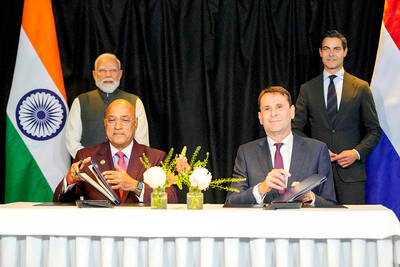
NEW MARKET: The partnership opens up India to the Dutch company, which already has a strong hold in the semiconductor market of South Korea, Taiwan and China ASML Holding NV entered into a partnership agreement with Tata Electronics Pvt Ltd aimed at ramping up India’s goal to develop domestic chip-manufacturing capabilities. The Dutch company’s technology would help power Tata Electronics’ planned 300 millimeter (mm) semiconductor foundry in Gujarat, according to a joint statement from the two companies on Saturday. The signing of a memorandum of understanding coincides with a visit by Indian Prime Minister Narendra Modi to the Netherlands, which is looking to deepen bilateral relations with New Delhi. ASML, whose top customers include Taiwan Semiconductor Manufacturing Co (台積電) and Samsung Electronics Co, makes lithography machines that can print
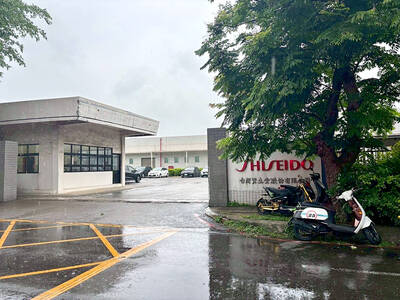
The Hsinchu County Government’s Labor Affairs Department yesterday said that it has received a plan from cosmetics brand Taiwan Shiseido Co (台灣資生堂) detailing mass layoffs at its plant in Hukou Township (湖口). While the labor authorities did not disclose the number of employees to be laid off, Japanese news media earlier in the day reported that the closure of the company’s factory in Hukou would result in 170 employees losing their jobs. Shiseido followed the law by reporting its layoff plan, the department said, adding that authorities would closely monitor negotiations between the management and affected employees and step in if any


 RSS
RSS