


Huaku Development Co (華固建設), which led local construction firms for the first six months at NT$6.29 earnings per share, plans to develop a NT$10 billion (US$312 million) project in Taipei’s Neihu District (內湖), a company executive said yesterday.
Scheduled to be completed by 2011, the development project on a 3,800-ping (1.2 hectares) plot of land would comprise two 12-story corporate office buildings, one building designed for small office and home office workers and two residential buildings, said Carson Hung (洪嘉昇), general manager of Huaku’s sales department.
The project is part of the Taipei City Government’s urban development plan and Huaku will submit its proposal next year for a two-week review and final approval, he said.
Huaku is also offering to pay for an artistically designed bridge worth approximately NT$100 million to connect the project and a nearby park, in return for the city relaxing regulations to allow the company to maximize the floor space it can sell, Hung said.
“Given the city’s tight supply of office space, we’re pretty confident about the project,” Hung said yesterday by telephone.
Upon completion, the project will release more than 20,000 ping of floor space in Taipei, 70 percent of which will be used for offices and retail, at an estimated price of NT$400,000 to NT$450,000 per ping, he said.
Huaku bought the plot of land in Neihu for NT$2 billion earlier this year.
The project will be the fourth application to the city government after Chinatrust Financial Holding Co (中信金控) and Yihwa International Corp (宜華國際), a subsidiary of The Sherwood Taipei, received approval to build a headquarters in Nangang (南港) and a 31-story five-star hotel with a shopping mall in Dazhi (大直) respectively, according to city government official Chen Hsin-liang (陳信良).
Details of the third application, from Shihlin Paper Corp (士林紙業), have not been released as the proposal is being revised, Chen said.
Huaku has seen sales of residential properties slow in recent months and Hung said the company was “cautiously optimistic” about the local real-estate market because “the global housing market is just going through a correction period.”
On Thursday, Huaku chairman Chung Jung-chang (鍾榮昌) said the downturn in the local market would extend into next year and said the company would reduce its housing projects and hold more cash.
To boost the real estate market, the Cabinet on Thursday said it would provide NT$200 billion in preferential loans and raise the government’s mortgage subsidy rate from 0.125 percent to 0.7 percent.
This announcement, however, failed to improve market sentiment, with the building material and construction sub-index — which reflects the performance of the real estate sector — falling 2.34 percent yesterday, compared with an increase of 0.94 percent on the benchmark TAIEX.
Hung said yesterday he was not very optimistic about the Cabinet’s preferential loans plan and its impact on the Taipei market.
“Such loans are of limited help, since new homes in Taipei cost at least NT$15 million each,” he said.
Hung urged the Cabinet to draw up a plan and said banks should relax their loan-to-value ratio to more than 80 percent when granting mortgages, which he said would offer a strong incentive to home buyers.
Shares of Huaku dropped 6.85 percent to close at NT$48.25 yesterday.
The firm’s stocks have retreated by 65.9 percent from this year’s intraday high, when they traded at NT$141.5 on April 16, Taiwan Stock Exchange data showed.
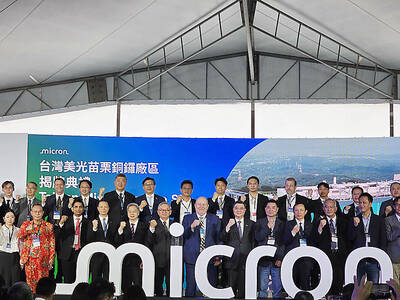
UNPRECEDENTED PACE: Micron Technology has announced plans to expand manufacturing capabilities with the acquisition of a new chip plant in Miaoli Micron Technology Inc unveiled a newly acquired chip plant in Miaoli County yesterday, as the company expands capacity to meet growing demand for advanced DRAM chips, including high-bandwidth memory chips amid the artificial intelligence boom. The plant in Miaoli County’s Tongluo Township (銅鑼), which Micron acquired from Powerchip Semiconductor Manufacturing Corp (力積電) for US$1.8 billion, is expected to make a sizeable capacity contribution to the company from fiscal 2028, the company said in a statement. It would be an extended production site of Micron’s large-scale manufacturing hub in Taichung, the company said. As the global semiconductor industry is racing to reach US$1 trillion
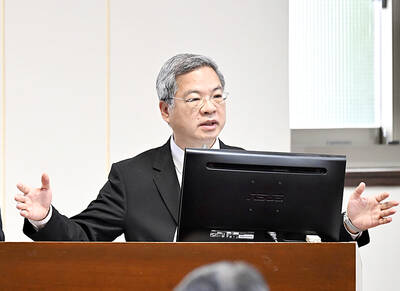
ABOVE LEGAL REQUIREMENT: The Ministry of Economic Affairs is prepared if LNG supply is disrupted, with more than the legal requirement of 11 days of inventory Taiwan has largely secured liquefied natural gas (LNG) supplies through May and arranged about half of June’s supply, Minister of Economic Affairs Kung Ming-hsin (龔明鑫) said yesterday. Since the Middle East conflict began on Feb. 28, Taiwan’s LNG inventories have remained more than 12 days, exceeding the legal requirement of 11 days, indicating no major supply concerns for domestic gas and electricity, Kung said at a meeting of the legislature’s Economics Committee in Taipei. The ministry aims to increase the figure to 14 days by the end of next year, he said. While one or two LNG or crude oil shipments for May

Taiwan’s food delivery market could undergo a major shift if Singapore-based Grab Holdings Ltd completes its planned acquisition of Delivery Hero SE’s Foodpanda business in Taiwan, industry experts said. Grab on Monday last week announced it would acquire Foodpanda’s Taiwan operations for US$600 million. The deal is expected to be finalized in the second half of this year, with Grab aiming to complete user migration to its platform by the first half of next year. A duopoly between Uber Eats and Foodpanda dominates Taiwan’s delivery market, a structure that has remained intact since the Fair Trade Commission (FTC) blocked Uber Technologies Inc’s

Memory chip stocks extended their losses yesterday after Alphabet Inc’s Google publicized research that could allow more efficient use of the storage needed for artificial intelligence (AI) development. SK Hynix Inc and Samsung Electronics Co, South Korean leaders in the market, fell more than 6 percent and about 5 percent respectively in Seoul. In the US, Micron Technology Inc, Western Digital Corp and Sandisk Corp slid more than 2 percent in pre-market trading, after they all closed lower on Wednesday. Memory companies have been on a tear in recent months as the rapid development of AI infrastructure triggered a spike in chip


 RSS
RSS