


China’s massive earthquake is expected to bring down the nation’s soaring economic growth this year by at least 0.2 percentage points, state media said yesterday.
The May 12 earthquake will lead to a one-month production stoppage and curb consumption in worst-hit Sichuan and some neighboring areas, the China Securities Journal reported, citing domestic economists.
But the impact is likely to be short-lived and the quake could eventually boost investment, a major driver of China’s economic growth, through reconstruction efforts, it said.
“Although the quake disaster will have a negative impact on growth in the economy and on corporate earnings in the second quarter, the impact would be a short-term one,” said Zhu Jianfang (朱建方), an economist with CITIC Securities (中信證券).
China’s economy, the world’s fourth-largest, grew 10.6 percent in the first quarter from a year earlier after expanding by 11.4 percent last year, the fifth consecutive year of double-digit economic growth.
Zhu, who expected the quake to strip 0.2 percentage points off economic growth this year, said the economy would return to normal growth in the third and fourth quarters.
Another Chinese brokerage, BOC International China (中銀國際證券), expected the quake to lower annual growth in GDP this year by 0.4 percentage points to to 0.7 percentage points, the report said.
The direct economic losses caused by the quake will be “much larger” than the fierce snowstorms that hit China in January and February, the report said, citing Fan Jianping (范劍平), economist with the State Information Center, a government think tank.
Sichuan’s GDP last year was 1.05 trillion yuan (US$150.1 billion), accounting for about 4.3 percent of the country’s economy, official figures showed.
Economists note that the financial impact of the disaster would have been much more severe had the earthquake struck the bustling eastern coastal regions, the manufacturing base for China’s lucrative exports.
But even though the overall impact on growth is seen as limited, the earthquake in the heavily agricultural region may prolong a spike in inflation.
The annual growth of the consumer price index (CPI) rebounded to 8.5 percent in last month, after hitting a near 12-year high of 8.7 percent in February but weakening to 8.3 percent in March.
“Post-earthquake reconstruction may add a further increase to investment and economic growth in coming quarters, but headline CPI inflation may also be prolonged by some of the earthquake effects”, said Wang Qian (王黔), a Hong Kong-based economist at JPMorgan Chase Bank.
“We expect monetary policy to stay nominally biased toward tightening, in order to keep inflation expectations in check,” she said in a research note yesterday.
China has raised the amount of money banks must keep in reserve four times so far this year in a bid to curb credit growth and help curb inflation.
But state media has reported that the central bank exempted banks in six quake-hit cities from the latest increase in reserve requirements, effective from today, to help keep money ample for relief work.
ON THE FARM
Meanwhile, the government said last week’s quake killed 12.5 million farm animals — mostly chickens — and wrecked vegetable crops and irrigation systems needed to grow rice.
More than 20,000 hectares of vegetables and more than 10,000 hectares of wheat were destroyed by the quake, the Agriculture Ministry said.
Damage to irrigation systems could prevent farmers from growing rice on as much as 100,000 hectares of rice paddies, the ministry said. But it said that land might be used for alternative crops while the damage is repaired.
Most of the farm animals killed were poultry, Deputy Agriculture Minister Wei Chaoan (危朝安) said in comments reported by the Xinhua news agency.
He said the losses should not affect food supplies, because they account for a small share of the 1.5 billion birds that Sichuan Province was expected to produce this year.
Sichuan usually supplies about 6 percent of China’s grain and 5 percent of its vegetables, Wei said.

DAMAGE REPORT: Global central banks are assessing war-driven inflation risks as the law of unintended consequences careens around the world, spiking oil prices Central banks from Washington to London and from Jakarta to Taipei are about to make their first assessments of economic damage after more than two weeks of conflict between the US and Iran. Decisions this week encompassing every member of the G7 and eight of the world’s 10 most-traded currency jurisdictions are likely to confirm to investors that the specter of a new inflation shock is already worrying enough to prompt heightened caution. The US Federal Reserve is widely expected to do exactly what everyone anticipated weeks ahead of its March 17-18 policy gathering: hold rates steady. The narrative surrounding that

Taiwan Semiconductor Manufacturing Co’s (TSMC, 台積電) share of the global foundry market rose to almost 70 percent last year amid booming demand for artificial intelligence (AI), market information advisory firm TrendForce Corp (集邦科技) said on Thursday. The contract chipmaker posted US$122.54 billion in revenue, up 36.1 percent from a year earlier, accounting for 69.9 percent of the global market, TrendForce said. Its share was up from 64.4 percent in 2024, it said. TSMC’s closest rival, Samsung Electronics, was a distant second, posting US$12.63 billion in sales, down 3.9 percent from a year earlier, for a 7.2 percent share of the global market. In the

HEADWINDS: The company said it expects its computer business, as well as consumer electronics and communications segments to see revenue declines due to seasonality Pegatron Corp (和碩) yesterday said it aims to grow its artificial intelligence (AI) server revenue more than 10-fold this year from last year, driven by orders from neocloud solutions clients and large cloud service providers. The electronics manufacturing service provider said AI server revenue growth would be driven primarily by the Nvidia Corp GB300 server platform. Server shipments are expected to increase each quarter this year, with the second half likely to outperform the first half, it said. The AI server market is expected to broaden this year as more inference applications emerge, which would drive demand for system-on-chip, application-specific integrated circuits
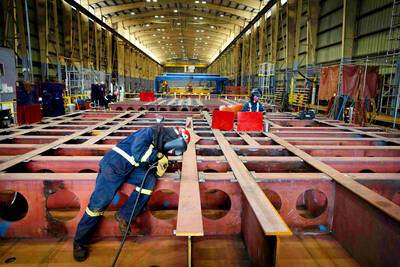
At a massive shipyard in North Vancouver, Canadian workers grind metal beams for a powerful new icebreaker crucial to cementing the country’s presence in the increasingly contested arctic. Icebreakers are specialized, expensive vessels able to navigate in the frozen far north. And “this is the crown jewel,” said Eddie Schehr, vice president of production at the Seaspan shipyard. For Canadian Prime Minister Mark Carney, who heads to Norway next Friday to observe arctic defense drills involving troops from 14 NATO states, Canada’s extreme north has emerged as a strategic priority. “Canada is and forever will be an Arctic nation,” he said ahead of


 RSS
RSS