


The world's largest consumer electronics trade show is going green, showcasing earth-friendly technology while offsetting its own carbon footprint at the massive the Las Vegas event.
The Consumer Electronics Show that officially begins tomorrow will feature for the first time a "Sustainable TechZone" dedicated to "pioneering technologies that benefit the environment and sustainability of the global economy."
Innovations in the TechZone will include voltaic solar-power generating backpacks and messenger bags made from recycled plastic soda bottles.
Solar panels embedded in bags produce four watts of power in full sunlight, pumping enough electricity into lithium battery packs in an hour to power an iPod for three hours or 90 minutes of talk time on a typical mobile telephone.
Control4 and other firms specializing in automating homes will display computerized systems that reduce the amount of energy wasted in cooling, heating or lighting residences or by televisions and other entertainment electronics.
"In short, they will address how the smart-home ecosystem is good for the world's ecosystem," a CES organizer said.
"As an ecosystem for digital home automation continues to develop, these companies are making major contributions that empower homeowners to take control of their own household environmental footprint and manage it more effectively."
US Environmental Protection Agency officials will preside over a new CES "Sustainability 101" seminar focused on greener product designs and energy efficiency.
"This session also highlights the work of companies successfully creating programs for consumers to donate or recycle technology products so hazardous materials do not end up in landfills," the CES said in a release.
To keep the environment in the minds of attendees, show workers will produce a "Greening CES" television program and broadcast it to their hotel rooms.
CES organizers vow to reduce and offset the carbon footprint made by the event, which features nearly 3,000 exhibitors and fills the cavernous Las Vegas Convention Center.
"We will do so by reducing energy consumption, increasing our recycling efforts, improving efficiency where possible, and making strides toward offsetting our unavoidable emissions," said CES chief executive Gary Shapiro.
The technology industry has "an opportunity to be a positive force for change and integral to environmental solutions that will ensure future generations inherit a healthy planet," he said.
The Consumer Electronics Association (CEA), which puts on the show, has arranged with Carbonfund.org to offset the estimated 20,000 tonnes of carbon attributable to CES.
Investing in renewable energy, reforestation and energy conservation programs will be used to offset the carbon footprint, CEA said.
Kiosks on the show floor will let attendees connect with Carbonfund to offset the greenhouse gases spewed by the jets that carried them to Las Vegas.
"Kudos to the International CES for taking positive steps to help the environment," said Carbonfund executive director Eric Carlson.
CES has gone so far as to work with vendors in Las Vegas to get them to use biodegradable food containers and utensils, donate surplus food to local charities, and use recycled paper and soy-based ink for literature.
At the request of CES, the Las Vegas Convention Center will use non-hazardous cleaning solvents and recycle light-bulbs, batteries and electronics from the event.
Cloaked in earth-friendly green, the annual show will be a stage for electronics makers large and small from around the world to show off innovations from flat-screen televisions to in-car entertainment systems.
The array of industry heavyweights attending CES includes Intel, Sony, Samsung, LG Electronics, Panasonic, Philips, Toshiba, and Sanyo.
Yahoo co-founder Jerry Yang will be among the speakers and Microsoft legend Bill Gates was to give a keynote speech today, on the eve of the official opening of the world's largest consumer electronics trade show.

Apple Inc increased iPhone production in India by about 53 percent last year and now makes a quarter of its marquee devices there, reflecting the US company’s efforts to avoid tariffs on China. The company assembled about 55 million iPhones in India last year, up from 36 million a year earlier, people familiar with the matter said, asking not to be named because the numbers aren’t public. Apple makes about 220 million to 230 million iPhones a year globally, with India’s share of the total increasing rapidly. Apple has accelerated its expansion in the world’s most populous country in recent years, bolstered
HEADWINDS: The company said it expects its computer business, as well as consumer electronics and communications segments to see revenue declines due to seasonality Pegatron Corp (和碩) yesterday said it aims to grow its artificial intelligence (AI) server revenue more than 10-fold this year from last year, driven by orders from neocloud solutions clients and large cloud service providers. The electronics manufacturing service provider said AI server revenue growth would be driven primarily by the Nvidia Corp GB300 server platform. Server shipments are expected to increase each quarter this year, with the second half likely to outperform the first half, it said. The AI server market is expected to broaden this year as more inference applications emerge, which would drive demand for system-on-chip, application-specific integrated circuits
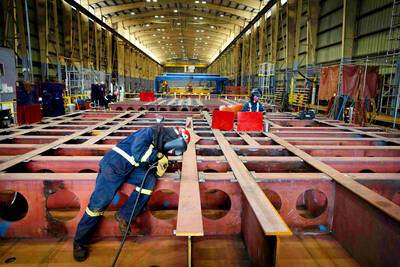
At a massive shipyard in North Vancouver, Canadian workers grind metal beams for a powerful new icebreaker crucial to cementing the country’s presence in the increasingly contested arctic. Icebreakers are specialized, expensive vessels able to navigate in the frozen far north. And “this is the crown jewel,” said Eddie Schehr, vice president of production at the Seaspan shipyard. For Canadian Prime Minister Mark Carney, who heads to Norway next Friday to observe arctic defense drills involving troops from 14 NATO states, Canada’s extreme north has emerged as a strategic priority. “Canada is and forever will be an Arctic nation,” he said ahead of

Chinese entrepreneur Frank Gao used to spend long hours running his social media accounts but now outsources the chore to artificial intelligence (AI) agent tool OpenClaw, which is taking China by storm despite official warnings over cybersecurity. OpenClaw, created in November by an Austrian coder, differs from bots such as ChatGPT because it can execute real-life tasks such as sending e-mails, organizing files or even booking flight tickets. “Since January, I’ve spent hours on the lobster every day,” Gao said in an interview, referring to OpenClaw’s red crustacean mascot. “We’re family.” After downloading OpenClaw, users connect it to artificial intelligence models of their


 RSS
RSS