


The US dollar declined against the euro and the pound on Friday as traders continued to hotly debate whether the US Federal Reserve would continue cutting interest rates amid economic uncertainty.
The euro was swapping hands at US$1.4378 in late afternoon trading in New York, up from US$1.4320 late on Thursday.
The British pound was quoted at US$1.9841, up from US$1.9830 a day earlier.
Although the pound gained ground it has dropped below two dollars of late, marking its lowest levels against the US dollar since August.
The US dollar was meanwhile trading at ¥114.09, up from ¥113.09 on Thursday.
The US currency's value has risen and fallen in the past week as traders have either bet up or discounted the odds of a fresh Fed rate cut.
The Fed has cut borrowing costs three times since September in a bid to underpin US economic momentum in the face of a prolonged housing slump, but analysts say rising inflationary pressures may soon put an end to the rate cuts.
The US Commerce Department reported earlier on Friday that a core US inflation gauge, which excludes volatile food and energy costs, bounced up an annual 2.2 percent last month, above the Fed's comfort zone of between 1 percent and 2 percent.
In late New York trading, the US dollar stood at 1.1551 Swiss francs from SF1.1581 on Thursday.
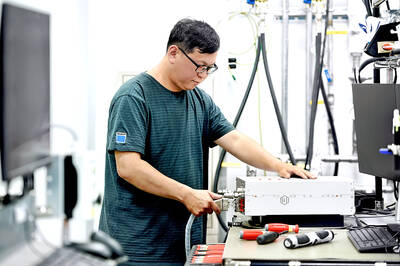
SEMICONDUCTORS: The German laser and plasma generator company will expand its local services as its specialized offerings support Taiwan’s semiconductor industries Trumpf SE + Co KG, a global leader in supplying laser technology and plasma generators used in chip production, is expanding its investments in Taiwan in an effort to deeply integrate into the global semiconductor supply chain in the pursuit of growth. The company, headquartered in Ditzingen, Germany, has invested significantly in a newly inaugurated regional technical center for plasma generators in Taoyuan, its latest expansion in Taiwan after being engaged in various industries for more than 25 years. The center, the first of its kind Trumpf built outside Germany, aims to serve customers from Taiwan, Japan, Southeast Asia and South Korea,

Nvidia Corp chief executive officer Jensen Huang (黃仁勳) on Monday introduced the company’s latest supercomputer platform, featuring six new chips made by Taiwan Semiconductor Manufacturing Co (TSMC, 台積電), saying that it is now “in full production.” “If Vera Rubin is going to be in time for this year, it must be in production by now, and so, today I can tell you that Vera Rubin is in full production,” Huang said during his keynote speech at CES in Las Vegas. The rollout of six concurrent chips for Vera Rubin — the company’s next-generation artificial intelligence (AI) computing platform — marks a strategic

Gasoline and diesel prices at domestic fuel stations are to fall NT$0.2 per liter this week, down for a second consecutive week, CPC Corp, Taiwan (台灣中油) and Formosa Petrochemical Corp (台塑石化) announced yesterday. Effective today, gasoline prices at CPC and Formosa stations are to drop to NT$26.4, NT$27.9 and NT$29.9 per liter for 92, 95 and 98-octane unleaded gasoline respectively, the companies said in separate statements. The price of premium diesel is to fall to NT$24.8 per liter at CPC stations and NT$24.6 at Formosa pumps, they said. The price adjustments came even as international crude oil prices rose last week, as traders
Taiwan Semiconductor Manufacturing Co (TSMC, 台積電), which supplies advanced chips to Nvidia Corp and Apple Inc, yesterday reported NT$1.046 trillion (US$33.1 billion) in revenue for last quarter, driven by constantly strong demand for artificial intelligence (AI) chips, falling in the upper end of its forecast. Based on TSMC’s financial guidance, revenue would expand about 22 percent sequentially to the range from US$32.2 billion to US$33.4 billion during the final quarter of 2024, it told investors in October last year. Last year in total, revenue jumped 31.61 percent to NT$3.81 trillion, compared with NT$2.89 trillion generated in the year before, according to


 RSS
RSS