


The US dollar traded mixed on Friday as the market braced for next week's Federal Reserve policy meeting and reacted to a US employment report suggesting sluggish growth ahead.
The euro rose to US$1.4656 Friday night from US$1.4633 late on Thursday in New York.
The dollar rose to &ye n111.65 from &ye n111.28.
The US Labor Department said the world's biggest economy generated 94,000 new jobs last month after 170,000 in October.
David Rodriguez, currency analyst at Forex Capital Markets, expressed surprise that the dollar failed to gain from the report even though it suggested the US economy is holding firm and the Fed may not cut rates as aggressively as anticipated.
Still, there was some trepidation ahead of Tuesday's Fed policy meeting, where traders are widely anticipating a rate cut, most likely a quarter-point.
Meanwhile, Asian currencies rose for the week.
Seven of the 10 most-actively traded currencies in Asia outside Japan gained in the five days as equities advanced for a second week, but the NT dollar declined 0.1 percent to NT$32.309, Taipei Forex Inc said.
Purchases of South Korean stocks on Friday by overseas investors exceeded sales by the most since Oct. 2. A move to slow defaults on home loans to those with poor credit histories may help prop up consumer spending and Asian exports.
"The plan to freeze rates improves investors' sentiment and stabilizes stocks, encouraging buying of regional currencies," Norifumi Yoshida, vice president of the trading section in Singapore at Mizuho Corporate Bank Ltd, said yesterday. "Concern the US economy will slow down eased and that raises optimism people will put funds into the region."
Indonesia's rupiah climbed 1 percent this week to 9,275 against the dollar, while the Malaysian ringgit rose 1.1 percent to 3.3220, according to data compiled by Bloomberg. The South Korean won gained 0.2 percent to 919.20, according to Seoul Money Brokerage Services Ltd.
"Speculation about the rate cut in the US has been supporting global stocks, which supports the case for fund inflows into the region's assets," said Hideki Hayashi, a strategist at Shinko Securities Co in Tokyo.
"Concern about the US slowdown also eased, which is good for the export sector and makes it easier to buy the won. The won and stocks will see appreciation," Hayashi said.
Malaysia's ringgit gained for a third week as the Kuala Lumpur Composite Index of equities reached a record.
"There's some offshore inflows into the stock market," said Suresh Kumar Ramanathan, a rates and currency strategist at CIMB Investment Bank Bhd in Kuala Lumpur. "Sentiment has improved on the economy, and banks are buying up the ringgit."
The ringgit strengthened to the highest since Nov. 9. It may reach 3.3 by year-end, Suresh said.
The Philippine peso completed its biggest weekly gain since August 2001, climbing 2.4 percent this week to 41.745 per US$1, according to Tullett Prebon Plc, the world's second-largest inter-dealer broker.
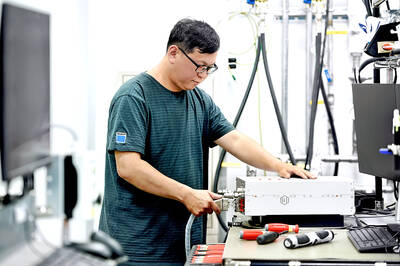
SEMICONDUCTORS: The German laser and plasma generator company will expand its local services as its specialized offerings support Taiwan’s semiconductor industries Trumpf SE + Co KG, a global leader in supplying laser technology and plasma generators used in chip production, is expanding its investments in Taiwan in an effort to deeply integrate into the global semiconductor supply chain in the pursuit of growth. The company, headquartered in Ditzingen, Germany, has invested significantly in a newly inaugurated regional technical center for plasma generators in Taoyuan, its latest expansion in Taiwan after being engaged in various industries for more than 25 years. The center, the first of its kind Trumpf built outside Germany, aims to serve customers from Taiwan, Japan, Southeast Asia and South Korea,

Nvidia Corp chief executive officer Jensen Huang (黃仁勳) on Monday introduced the company’s latest supercomputer platform, featuring six new chips made by Taiwan Semiconductor Manufacturing Co (TSMC, 台積電), saying that it is now “in full production.” “If Vera Rubin is going to be in time for this year, it must be in production by now, and so, today I can tell you that Vera Rubin is in full production,” Huang said during his keynote speech at CES in Las Vegas. The rollout of six concurrent chips for Vera Rubin — the company’s next-generation artificial intelligence (AI) computing platform — marks a strategic

Gasoline and diesel prices at domestic fuel stations are to fall NT$0.2 per liter this week, down for a second consecutive week, CPC Corp, Taiwan (台灣中油) and Formosa Petrochemical Corp (台塑石化) announced yesterday. Effective today, gasoline prices at CPC and Formosa stations are to drop to NT$26.4, NT$27.9 and NT$29.9 per liter for 92, 95 and 98-octane unleaded gasoline respectively, the companies said in separate statements. The price of premium diesel is to fall to NT$24.8 per liter at CPC stations and NT$24.6 at Formosa pumps, they said. The price adjustments came even as international crude oil prices rose last week, as traders
Taiwan Semiconductor Manufacturing Co (TSMC, 台積電), which supplies advanced chips to Nvidia Corp and Apple Inc, yesterday reported NT$1.046 trillion (US$33.1 billion) in revenue for last quarter, driven by constantly strong demand for artificial intelligence (AI) chips, falling in the upper end of its forecast. Based on TSMC’s financial guidance, revenue would expand about 22 percent sequentially to the range from US$32.2 billion to US$33.4 billion during the final quarter of 2024, it told investors in October last year. Last year in total, revenue jumped 31.61 percent to NT$3.81 trillion, compared with NT$2.89 trillion generated in the year before, according to


 RSS
RSS