


Should the nation's deregulation accelerate, Taipei has the potential to outperform Shanghai and Tokyo by 2012 to become a regional financial center, Greg Gibb, chief operations officer at Taishin Financial Holding Co (
Such a regional center would focus on the management of either pension funds or private equity funds, or as a fund-raising gateway for the world's high-tech companies, Gibb said at the speech organized by the Chung-Hua Institution for Economic Research (CIER) in Taipei.
"Taiwan must tap into the fast-growing Asian financial market in the next five years, which will be the main driver behind the nation's future economic growth," said Gibb, who was formerly a managing partner at McKinsey and Co.
As a precondition to outperforming its Asian counterparts, the nation needs to step up its efforts to make changes, including removing curbs to facilitate the free flow of tourists, talent, workers and businesspeople, he said, adding that the nation's financial market lags far behind that in Hong Kong and Singapore.
Gibb said Taiwan has to lift restrictions and allow local financial institutions, including insurers that are competitive and manage a huge amount of assets to freely set up shops around Asia to attract a larger inflow of investments from global pension funds.
Moreover, as private equity funds favor "ambiguous markets" such as Taiwan and China, Gibb believed they would certainly keep an eye on Taiwan as a stepping stone to China once cross-strait restrictions are eased.
Since the nation is also home to many leading high-tech companies, it has been playing the role of a global shaker to the world's high-tech sector and thus will no doubt be the most attractive market for global high-tech companies to go public if its market is innovative enough, Gibb said.
For example, if the local market can develop its futures and commodities market to trade high-tech products, such as DRAM chips, instead of traditional products such as gold and copper, the nation is highly likely to share the same success as the US' NASDAQ stock market, he said.
Gibb urged Taiwan to learn from the experience of the Netherlands, which may be small but has a strong economy with some of the top business players in the world.
Although Gibb shared with the audience his pleasure at living in Taipei, which he said has the best living quality in Asia, he also regretted a quote by a visiting researcher: "Taiwan is one of the most open societies in the world with the least vision of where it is going."

Cairo’s new monorail slices across the city skyline, running above the familiar chaos of blaring horns and aging buses’ exhaust fumes that mark rush hour below. The US$4.5 billion monorail, opened this month, is among Egypt’s most prominent new transport projects, part of a debt-funded infrastructure drive criticized for sapping state finances while bringing limited benefits to most of the country’s 109 million people. “It feels like you’re in a different country,” said Ramy Sayed, a restaurant manager, aboard a driverless Innovia 300 train. “No noise, no traffic, we’re not used to this.” The eastern line runs 56km from the bustling middle-class

Taiwanese firms have increased investment in the Philippines in recent years as Manila’s ties with Washington deepen and global supply chains continue to shift away from China, an expert at the Chung-Hua Institution for Economic Research (CIER, 中華經濟研究院) said yesterday. The Philippines had not been among Taiwanese investors’ top choices in Southeast Asia, CIER Taiwan ASEAN Studies Center director Kristy Hsu (徐遵慈) said at a seminar in Taipei. However, Taiwan’s investment in the country has grown significantly since the COVID-19 pandemic, reaching US $257 million last year, a high in recent years, she said. Although Taiwan’s total investment in the Philippines still lags

Intel Corp regards Taiwan Semiconductor Manufacturing Co (TSMC, 台積電) as a longstanding partner, as the US chipmaker would continue outsourcing production of advanced chips to TSMC, Intel chief executive officer Lip-Bu Tan (陳立武) said yesterday. “I don’t look at people as competitors. I look at the collaboration... Nvidia is also, you know, a good friend,” Tan told a news conference following his keynote speech at the Computex trade show in Taipei. “It’s a very trusted partnership for us... We are a big, top customer for them, and we’re going to continue doing that,” he said, referring to TSMC, the world’s largest foundry
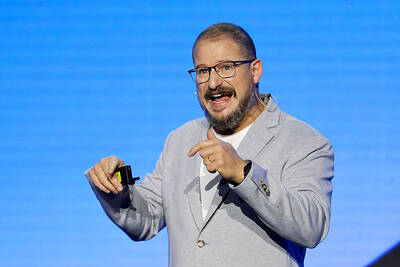
Artificial intelligence (AI) agents would supplant smartphones as the center of people’s digital lives, fundamentally reshaping personal devices and driving a major computing upgrade cycle, Qualcomm Inc CEO Cristiano Amon said yesterday. In his keynote speech for this year’s Computex trade show in Taipei, Amon said that the rise of "agentic AI" — AI systems capable of reasoning, planning and carrying out tasks autonomously — would transform how people interact with technology across phones, PCs, vehicles and wearable devices. Describing the technology as the next major evolution in computing, Amon said that "2026 is the year of agents.” For decades, smartphones have sat


 RSS
RSS