


China Rebar Co (中國力霸) yesterday admitted a delay in notifying the Taiwan Stock Exchange Corp of its insolvency claim, in response to a NT$50,000 fine imposed by the stock regulator amid speculation that the company had withheld critical information from its investors.
Both China Rebar and Chia Hsin Food & Synthetic Fiber Co (嘉新食品化纖) under the parent Rebar Asia Pacific Group (力霸亞太企業集團) were approved for insolvency protection by the Taipei District Court on Thursday to pave the way for future corporate restructuring.
"There was a two day delay as a result of our own negligence and three New Year holidays over the weekend," the company said in a filing to the stock exchange.
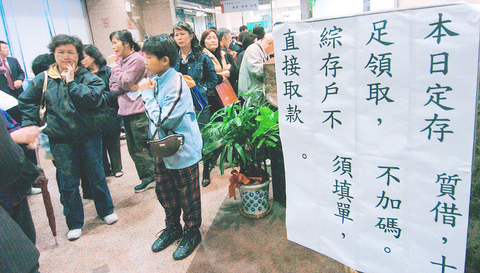
PHOTO: CHANG CHIA-MING, TAIPEI TIMES
After convening a board meeting last Friday at noon, China Rebar later decided to file for insolvency protection with the Taipei District Court at 4:30pm on the same day.
The weekends and the public holiday on Monday, however, meant that the stock regulator was not informed until Thursday morning, the company said.
The district court said on Thursday that it had approved the two companies' requests for asset protection, which will grant them a 90-day stopgap period during which their assets may not be seized by creditors.
In the meantime, the Taiwan Stock Exchange Corp also announced that shares of the two companies would be suspended from trading, taking effect immediately yesterday.
China Rebar yesterday responded to investors concerns as to why the company had bought 8.2 million shares of Asia Pacific Broadband Telecom Co (
The deal amounted to NT$73.4 million (US$2.3 million).
The company said that the shares it had purchased were meant to be pledged as collateral for loans.
The Rebar group has a wide variety of businesses that range from department stores, to the textile industry and construction operations.
But because of its poor corporate governance, the group has been facing financial problems for years.
Affected by the insolvency filed unexpectedly by Rebar group's subsidiaries, ProMOS Technologies Inc (茂德科技) -- Taiwan's third-largest computer memory chipmaker -- said yesterday that it would sustain losses, but did not specify the amount of losses it expected.
ProMOS owns a combined NT$9.5 billion (US$291 million) worth of corporate bonds in Chia Hsin and China Rebar, the chipmaker said in a statement filed to the Taiwan Stock Exchange.
ProMOS said it could not calculate specific losses from the investments until the court approved the companies' restructuring plans, the chipmaker said in a filing to the Taiwan Stock Exchange.
ProMOS shares declined 3.85 percent to NT$13.75 on the nation's over-the-counter GRETAI Securities Market yesterday after the statement was submitted in early trading hours.
Meanwhile, Idee Department Store (衣蝶百貨), part of the Rebar Group, assured its shoppers yesterday that it would maintain normal operations and that the corporate restructuring of its parent company would actually benefit Idee.
"Our business today is normal and our retail partners have been very supportive," said Sunny Liu (
But Idee's capital flow encountered problems in November last year and December 2005, triggering speculation that the department store might close its doors or that the management of some of its branches might change hands.
The company attributed its financial difficulties at that time to the difficulties experienced by its parent company.
As a result of China Rebar filing for insolvency protection, Idee's employee salaries and payments to retailers would be guaranteed, she said.
Idee's five branches nationwide booked sales of NT$9.63 billion (US$295 million) last year, declining by 10 percent from the previous year, but still pulling in profits.
The Rebar Group's other money-making subsidiary, Rebar Crowne Plaza Taipei, would not be affected either, public relations official Karen Lin (林淑娟) said.
The hotel declined to disclose revenue figures as it is not a listed company.
Mega Financial Holding Co (
Other creditor banks include Taiwan Cooperative Bank (
China Rebar and Chia Hsin have a total liability of NT$40.6 billion, according to the two companies.
"Corporate collapses can inflict damage to creditor banks," said Tracy Chen, who helps manage about US$2.3 billion at PC Securities Investment Trust Co in Taipei.
Shares of Mega Financial closed down 3.31 percent at NT$23.40. Taiwan Cooperative lost 2.6 percent to NT$24.50, Hua Nan went down 2.2 percent to NT$24.30, First inancial fell 1.2 percent to NT$24.95, and Chang Hwa slipped 0.9 percent to NT$23.
Additional reporting by Bloomberg

SECOND-RATE: Models distilled from US products do not perform the same as the original and undo measures that ensure the systems are neutral, the US’ cable said The US Department of State has ordered a global push to bring attention to what it said are widespread efforts by Chinese companies, including artificial intelligence (AI) start-up DeepSeek (深度求索), to steal intellectual property from US AI labs, according to a diplomatic cable. The cable, dated Friday and sent to diplomatic and consular posts around the world, instructs diplomatic staff to speak to their foreign counterparts about “concerns over adversaries’ extraction and distillation of US AI models.” Distillation is the process of training smaller AI models using output from larger, more expensive ones to lower the costs of training a powerful new
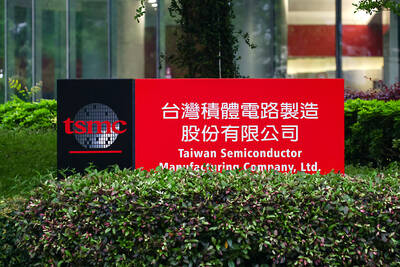
Shares of Taiwan Semiconductor Manufacturing Co (TSMC, 台積電) have repeatedly hit new highs, but an equity analyst said the stock’s valuation remains within a reasonable range and any pullback would likely be technical. The contract chipmaker’s historical price-to-earnings (P/E) ratio has ranged between 20 and 30, Cathay Futures Consultant Co (國泰證期) analyst Tsai Ming-han (蔡明翰) told Central News Agency. With market consensus projecting that TSMC would post earnings per share of about NT$100 (US$3.17) this year, supported by strong global demand for artificial intelligence (AI) applications, and the stock currently trading at a P/E ratio of below 25, Tsai said the valuation
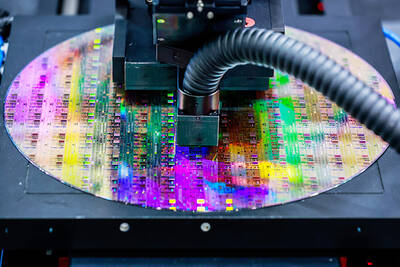
The artificial intelligence (AI) boom has triggered a seismic reshuffling of global equity markets, with Taiwan and South Korea muscling past European nations one by one. With its stock market now valued at nearly US$4.3 trillion, Taiwan surpassed the UK, Europe’s biggest market, earlier this month, data compiled by Bloomberg showed. South Korea is about US$140 billion away from doing the same. The tech-heavy Asian markets have shot past Germany and France in the past seven months. The shift is largely down to massive gains in shares of three companies that provide essential hardware for AI: Taiwan Semiconductor Manufacturing Co (TSMC, 台積電),
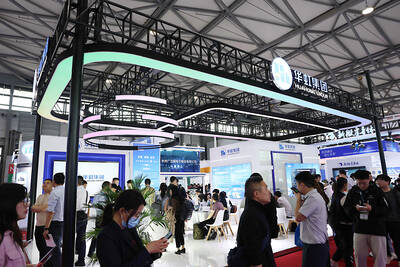
The US Department of Commerce last week ordered multiple chip equipment companies to halt shipments of certain tools to China’s second-largest chipmaker, Hua Hong Semiconductor Ltd (華虹半導體), its latest action to slow the country’s development of advanced chips, two people familiar with the matter said. The department sent letters to at least a handful of companies informing them of restrictions on tools and other materials destined for two Hua Hong facilities US officials believe make China’s most sophisticated chips, the people said. Top US chip equipment companies Lam Research Corp, Applied Materials Inc and KLA Corp, each of which has significant


 RSS
RSS