


The 2006 Taipei International Cycle Show opened in Taipei yesterday, drawing a record 650 exhibitors.
The show, the largest bicycle exhibition in Asia, runs until Saturday at the Taipei World Trade Center Exhibition Halls I and III. A total of 650 local and foreign bike manufacturers, up from last year's 620, are showing off their latest products, according to the organizers of the show, the Taiwan External Trade Development Council (TAITRA,
Taiwan gained the nickname "Kingdom of Bicycles" in the 1980s. In recent years, China and India have gradually replaced Taiwan as the leading manufacturers of low-priced bikes, while Taiwan has shifted its focus to making high-end bikes.
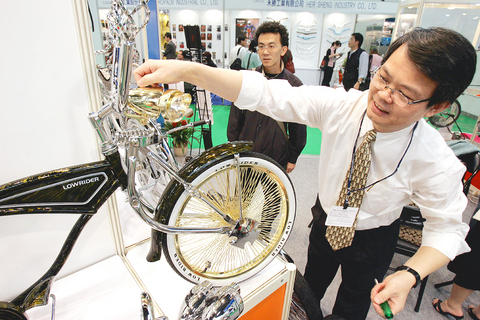
PHOTO: WALLY SANTANA, AP
Speaking at the opening ceremony, TBEA Chairman Yang Yin-ming (
Taiwan exported 4.6 million bicycles last year, up 220,000 from the figure for 2004, representing year-on-year growth of 5 percent, Yang said.
He added that the total export value hit US$918 million, a phenomenal increase of US$720 million, or 27.5 percent over the 2004 level.
In addition, the average unit price of Taiwan-made bikes has quadrupled from US$44 in 1989 to US$199 last year. Some 80-90 percent of Taiwan-made bikes are for export, mainly to Europe, the US and Japan.
These facts demonstrate that Taiwan's bike manufacturers have made remarkable progress in upgrading quality and productivity and that the domestic bicycle sector's efforts to develop and manufacture products with high added value and create their own brand names have borne fruit, Yang noted.
However, Yang also admitted that Taiwan's bike makers are facing tougher operating conditions, due to continuing increases in raw material costs, EU anti-dumping measures against Vietnam and China, as well as Canada's adoption of safeguard measures.
For his part, TAITRA Chairman Hsu Chih-jen (
Italian bicycle maker Atala S.P.A. and Halfords Group from the United Kingdom are expected to visit the cycle show to procure bicycles as well as parts and accessories totaling more than US$1 million, Hsu disclosed.
The show is expected to attract over 4,000 buyers from around the world, according to organizers.

SECOND-RATE: Models distilled from US products do not perform the same as the original and undo measures that ensure the systems are neutral, the US’ cable said The US Department of State has ordered a global push to bring attention to what it said are widespread efforts by Chinese companies, including artificial intelligence (AI) start-up DeepSeek (深度求索), to steal intellectual property from US AI labs, according to a diplomatic cable. The cable, dated Friday and sent to diplomatic and consular posts around the world, instructs diplomatic staff to speak to their foreign counterparts about “concerns over adversaries’ extraction and distillation of US AI models.” Distillation is the process of training smaller AI models using output from larger, more expensive ones to lower the costs of training a powerful new

Singapore-based ride-hailing and delivery giant Grab Holdings’ planned acquisition of Foodpanda’s Taiwan operations has yet to enter the formal review stage, as regulators await supplementary documents, the Fair Trade Commission (FTC) said yesterday. Acting FTC Chairman Chen Chih-min (陳志民) told the legislature’s Economics Committee that although Grab submitted its application on March 27, the case has not been officially accepted because required materials remain incomplete. Once the filing is finalized, the FTC would launch a formal probe into the deal, focusing on issues such as cross-shareholding and potential restrictions on market competition, Chen told lawmakers. Grab last month announced that it would acquire
Shares of Taiwan Semiconductor Manufacturing Co (TSMC, 台積電) have repeatedly hit new highs, but an equity analyst said the stock’s valuation remains within a reasonable range and any pullback would likely be technical. The contract chipmaker’s historical price-to-earnings (P/E) ratio has ranged between 20 and 30, Cathay Futures Consultant Co (國泰證期) analyst Tsai Ming-han (蔡明翰) told Central News Agency. With market consensus projecting that TSMC would post earnings per share of about NT$100 (US$3.17) this year, supported by strong global demand for artificial intelligence (AI) applications, and the stock currently trading at a P/E ratio of below 25, Tsai said the valuation
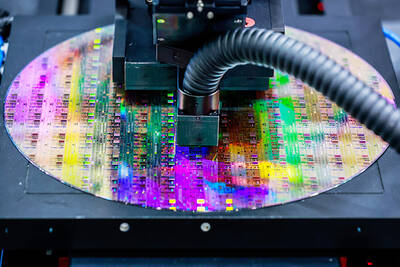
The artificial intelligence (AI) boom has triggered a seismic reshuffling of global equity markets, with Taiwan and South Korea muscling past European nations one by one. With its stock market now valued at nearly US$4.3 trillion, Taiwan surpassed the UK, Europe’s biggest market, earlier this month, data compiled by Bloomberg showed. South Korea is about US$140 billion away from doing the same. The tech-heavy Asian markets have shot past Germany and France in the past seven months. The shift is largely down to massive gains in shares of three companies that provide essential hardware for AI: Taiwan Semiconductor Manufacturing Co (TSMC, 台積電),


 RSS
RSS