


A bird in the hand, or two in the bush. That's the choice facing Unocal Corp, which agreed in April to be bought by Chevron Corp for US$16.6 billion, but is now considering a rival US$18.5 billion bid from China National Offshore Oil Corp (CNOOC,
The less lucrative Chevron offer cleared its final regulatory hurdle this week and Unocal shareholders are scheduled to vote on it next month. By comparison, the larger CNOOC proposal is not likely to receive such swift regulatory approval. It has already generated a minor political storm in Washington, where many in Congress have warned of a national security threat in selling a US oil company to a Chinese government-owned one.
The scale of CNOOC's task was underlined late Thursday when the House of Representatives voted 398-15 for a non-binding resolution that calls for the US government to block the Unocal bid.

PHOTO: EPA
"If we allow this takeover, we're supplying China with the technological expertise it needs to become a major player in international energy," said Peter Morici, professor of business at the University of Maryland.
"Coupled with their military buildup and authoritarian systems, China becomes a threat. There's enough to block it on national security grounds," he said.
House of Representatives Democratic leader Nancy Pelosi also said that if the CNOOC bid succeeds, China would gain access to "cavitation" technology to dig far deeper underground than it can now.
"That same technology can be used by the Chinese to do nuclear tests underground and to mask them so we would not ever be able to detect them," she argued.
Battle has been joined in the US Treasury's Committee on Foreign Investments in the United States (CFIUS), as CNOOC on Friday voluntarily filed a notice with the committee, providing information about how its operations and acquisition of Unocal might affect US national security.
The committee has since 1988 only barred one transaction out of the 1,500-odd it has examined. That was a year after the 1989 Tiananmen Square massacre when a Chinese company was blocked from taking over a US firm.
If Unocal intends to pursue a deal with CNOOC, it will make a similar filing and the review process will begin. If Unocal does not file papers with the committee, the secretive inter-agency group will assume CNOOC is attempting a hostile takeover.
Should the committee decide to intervene, it would have 45 days to conduct its probe and submit a recommendation to the president, who would have 15 days to act.
An exquisite dilemma
That would pose an exquisite dilemma to Bush. Should he placate Congress and US industry by blocking CNOOC, in the process teaching Beijing a lesson that its currency policies and runaway export growth will no longer be tolerated?
Or should he stay on-side with one of the most important trading partners of the US, a country where cheap goods and Treasury bond purchases have kept inflation down and growth up?
CNOOC says that Unocal accounts for only one percent of US oil and gas production, that most of that production is in Asia, and that in any case it will continue to sell the oil in the US.
"Despite the heated rhetoric, we firmly believe that the CFIUS process will be fair, thorough and not influenced by either emotion or politics," it said Friday after submitting an explanation of its bid to the committee.
But US critics suspect that Unocal will prove the thin end of the wedge as China seeks to extend its commercial might into a host of sectors in the US and elsewhere.
"This is going to be one of the more interesting deals to watch unfold," said Matthew Simmons, a Houston-based investment banker in the petroleum industry.
Unocal reiterated its support for the Chevron bid this week in a letter to shareholders and a Unocal spokesman said Friday there was no immediate plan for a CFIUS filing. But discussions between Unocal and CNOOC are ongoing in New York and analysts said it is tough to tell who will prevail. A bidding war is possible and a third suitor could even enter the competition.
If Unocal decides to pursue the CNOOC offer, however, Chevron has the right to bow out, pocket a US$500 million (euro414 million) breakup fee and look elsewhere for a strategic partnership.
"There are other assets for Chevron to buy," said oil analyst Gene Gillespie at Howard, Weil, Labouisse in New Orleans. "Unocal isn't so unique that it has infinite value."
Unocal has 1.75 billion barrels of proven reserves of oil and natural gas -- an amount that would boost Chevron's reserve base by roughly 15 percent and CNOOC's by about 80 percent.
Unocal's daily output of 169,000 barrels of oil and half a trillion cubic meters of natural gas amounts to less than 1 percent of US consumption, though both suitors have expressed interest in its assets because of their location. The majority of Unocal's activity is in Asia, particularly in Thailand and Indonesia, but also in the Caspian region.
Aside from the regulatory certainty surrounding Chevron's offer for Unocal, analysts pointed out that the deal, which is a combination of stock and cash, gives shareholders in the merged company something the CNOOC bid does not: an opportunity to see their investment grow even further if Chevron's stock price rises.
The all-cash CNOOC deal may look sweeter to Unocal shareholders on the surface but there is "the risk of getting nothing down the road" if regulators don't approve the merger, Gillespie said.
For its part, CNOOC believes the appeal of its offer for Unocal, the ninth-largest oil and gas producer in the US, is quite simple: It exceeds Chevron's bid by almost US$2 billion.
Also, Unocal workers might make out better under CNOOC, which has said it does not intend to slash jobs in El Segundo, California, where Unocal is based. Chevron, based in San Ramon, California, plans to shed workers to eliminate redundancies and meet cost-saving targets.
Raising the stakes
Since CNOOC raised the stakes, Chevron's stock price has fallen and Unocal's has risen. As a result, Chevron's offer is now about US$5 below Unocal's stock price, while CNOOC's offer remains about US$2 above it.
"Investors vote their pocketbook," said oil analyst Fadel Gheit at Oppenheimer & Co in New York. "There is no way that Unocal shareholders are going to give their stock to Chevron for US$60. But that is the value of the offer from Chevron as we speak."
On Friday, shares of Chevron closed at US$56.84 on the New York Stock Exchange, where Unocal's ended at US$65.65. Chevron offered Unocal shareholders a choice of accepting US$65 per share cash, 1.03 shares of Chevron stock or a combination of the two, though it said 75 percent of the transaction would be a stock swap.
Simmons cautioned that although the market is signaling that Unocal is worth more than Chevron's initial offer, "Chevron has got to be very careful of not getting into a bidding war."
CNOOC's parent company, the Chinese National Offshore Oil Company, is predominantly owned by the Chinese government, giving it very deep pockets with which to make acquisitions.
Indeed, a considerable amount of the opposition to the deal comes from members of Congress who say CNOOC, as a government-backed company, is not on a level playing field with Chevron.
CNOOC chairman Fu Chengyu (傅成玉) denies that his company is acting on behalf of China's government, which is in the midst of a multibillion-dollar campaign to secure foreign oil and gas supplies to help fuel its booming economy.
"This company is driven purely by economics," Fu told reporters.
One concern in Washington is that CNOOC's bid for Unocal is part of a broader strategy by communist China to hoard energy supplies before they run out. Another is that the US might regret handing over technology or assets that have military value.
For example, Unocal has a stake in the Colonial Pipeline, which delivers fuel from the Gulf Coast to the Northeast, and it owns oil terminals that feed into the nation's Strategic Petroleum Reserve. There is also fear that certain deepwater drilling technology could have applicability in submarine warfare.
Many energy and national security experts have said much of the outcry from Congress has been overblown, and CNOOC executives have publicly said they are willing to shed assets and take other steps necessary to address national security concerns.
Nonetheless, on Thursday, the House registered its discomfort with the prospect of a state-owned Chinese company taking over an American oil firm, voting 398-15 to ask the president for an immediate and thorough review if Unocal accepts CNOOC's offer.
However, even if Unocal's leadership walks away from the proposed CNOOC deal, analysts said it's possible Chevron will sweeten its offer.
"If Chevron doesn't up the price," Simmons said, "then Unocal directors are going to get sued for turning down a better offer."
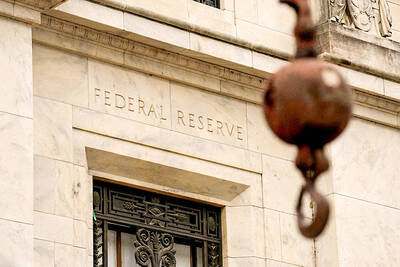
DAMAGE REPORT: Global central banks are assessing war-driven inflation risks as the law of unintended consequences careens around the world, spiking oil prices Central banks from Washington to London and from Jakarta to Taipei are about to make their first assessments of economic damage after more than two weeks of conflict between the US and Iran. Decisions this week encompassing every member of the G7 and eight of the world’s 10 most-traded currency jurisdictions are likely to confirm to investors that the specter of a new inflation shock is already worrying enough to prompt heightened caution. The US Federal Reserve is widely expected to do exactly what everyone anticipated weeks ahead of its March 17-18 policy gathering: hold rates steady. The narrative surrounding that

Taiwan Semiconductor Manufacturing Co’s (TSMC, 台積電) share of the global foundry market rose to almost 70 percent last year amid booming demand for artificial intelligence (AI), market information advisory firm TrendForce Corp (集邦科技) said on Thursday. The contract chipmaker posted US$122.54 billion in revenue, up 36.1 percent from a year earlier, accounting for 69.9 percent of the global market, TrendForce said. Its share was up from 64.4 percent in 2024, it said. TSMC’s closest rival, Samsung Electronics, was a distant second, posting US$12.63 billion in sales, down 3.9 percent from a year earlier, for a 7.2 percent share of the global market. In the
HEADWINDS: The company said it expects its computer business, as well as consumer electronics and communications segments to see revenue declines due to seasonality Pegatron Corp (和碩) yesterday said it aims to grow its artificial intelligence (AI) server revenue more than 10-fold this year from last year, driven by orders from neocloud solutions clients and large cloud service providers. The electronics manufacturing service provider said AI server revenue growth would be driven primarily by the Nvidia Corp GB300 server platform. Server shipments are expected to increase each quarter this year, with the second half likely to outperform the first half, it said. The AI server market is expected to broaden this year as more inference applications emerge, which would drive demand for system-on-chip, application-specific integrated circuits
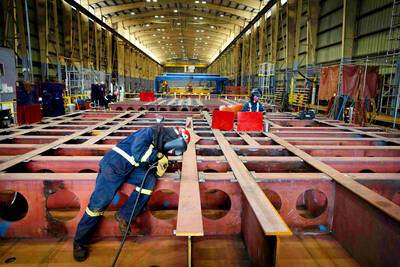
At a massive shipyard in North Vancouver, Canadian workers grind metal beams for a powerful new icebreaker crucial to cementing the country’s presence in the increasingly contested arctic. Icebreakers are specialized, expensive vessels able to navigate in the frozen far north. And “this is the crown jewel,” said Eddie Schehr, vice president of production at the Seaspan shipyard. For Canadian Prime Minister Mark Carney, who heads to Norway next Friday to observe arctic defense drills involving troops from 14 NATO states, Canada’s extreme north has emerged as a strategic priority. “Canada is and forever will be an Arctic nation,” he said ahead of


 RSS
RSS