


Among Taiwan's high-tech elite, Terry Gou (
Unlike most local tech executives with a strong technological background, Gou rose through the ranks on his personal qualities -- an iron self-discipline, quick wit and diligence.
Gou, 55, founder of the world's second-largest electronics manufacturing service (EMS) provider, has said with humor that "Hon Hai grows from numerous difficulties, like Taiwanese sweet potatoes that thrive on barren lands" -- referring to the company's self-sufficient rise.
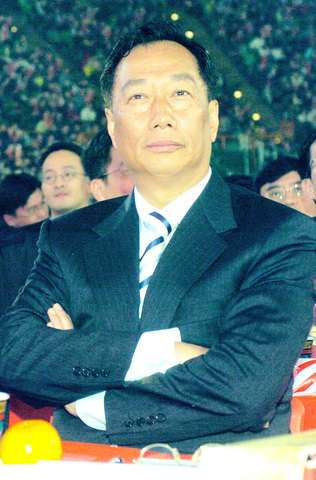
PHOTO: CHEN YI-CHUAN, TAIPEI TIMES
Back in 1947, Hon Hai started as a maker of plastic parts for black and white televisions in the Taipei suburb of Tucheng, with only a handful of employees. Now Hon Hai is making desktop computers for Hewlett-Packard Co, mobile phones for Nokia Oyj and game consoles for Sony Corp, and employs more than 130,000 workers around the globe.
Gou is known for a stringent work ethic that demands discipline, super-efficiency and accuracy. That has led to his military-style management of Hon Hai, which gives it a far different corporate culture than its larger rival, Singapore's Flextronics International Inc.
In an interview with the Chinese-language Business Today published last week, Flextronics executive Michael Marks said, "Terry and I have completely different characteristics. Flextronics is not an army that fights wars. We work to make more money, but I do take days off to be with my family."
But Gou's strict management style is seen by many as an important factor boosting Hon Hai's efficiency and its ability to control costs. Better cost-cutting ability allows Hon Hai to undercut its rivals to win orders and still stay profitable in selected areas.
Though Hon Hai is not as diversified in its manufacturing as most other top-tier EMS vendors, "it instead chooses to focus on select industry segments in which it has a cost and technology advantage," wrote Flint Pulskamp, an analyst with International Data Corp, in a report.
As a result, Hon Hai is expected to outrank Flextronics and become the world's top electronics manufacturing service firm this year in terms of revenues.
Hon Hai could post NT$700 billion (US$22.32 billion) in revenues this year if the company hits the target of having 30-percent annual growth set by Gou, compared to Flextronics' forecast of US$16.5 billion for its 2006 fiscal year.
Relentless mergers and vertical integration have rapidly driven up Hon Hai's revenues over the past few years. Within two years, Hon Hai's revenues have more than doubled to NT$541.6 billion last year, from NT$257.77 billion in 2002.
In 2003 alone, Hon Hai completed three acquisitions. It bought local wireless equipment maker Ambit Microsystem Corp (國電) in November after purchasing Motorola Inc's Mexican handset factory and Finland's mobile phone casing maker Eimo Oyj earlier.
Last month Hon Hai said it is planning to buy a Hewlett-Packard computer plant in Australia after earlier obtaining a controlling stake in Chi Mei Communication Systems Inc (奇美通訊), a local handset maker.
Gou expects to complete one or two acquisitions of component makers in the second half of this year.
But Gou has never thought it would be good idea to tap into the own-brand business through any approach including acquisition -- a hot topic in the industry after BenQ Corp's (
"Every commercial activity ultimately aims to make a profit. With Foxconn's name on a motherboard, we can make US$1, or US$2 more for each unit," he said, but added that doing consumer electronics brand business is a completely different thing, he said.
Foxconn is Hon Hai's registered trade name and the company sells motherboards and other products under that brand.
Go said it is too tough for most Taiwanese companies to run a brand, especially if they choose to do brand marketing, manufacturing and research and development all by themselves with limited resources, while an established global brand like Apple Computer Inc focuses on marketing.
More importantly, "there is no home market to support local firms' operations," Gou said. "What is the probability of running a successful brand for local firms? You do the math," he said.
BenQ Chairman Lee Kun-yao (
With his iron will, Gou has made Hon Hai a profit-making machine over the past 30 years. The challenge now is whether he can really steer the company toward better profitability in such a fickle industry.

The domestic unit of the Chinese-owned, Dutch-headquartered chipmaker Nexperia BV will soon be able to produce semiconductors locally within China, according to two company sources. Nexperia is at the center of a global tug-of-war over critical semiconductor technology, with a Dutch court in February ordering a probe into alleged mismanagement at the company. The geopolitical tussle has disrupted supply chains, with some carmakers reportedly forced to cut production due to chip shortages. Local production would allow Nexperia’s domestic arm, Nexperia Semiconductors (China) Ltd (安世半導體中國), to bypass restrictions in place since October on the supply of silicon wafers — etched with tiny components to

Singapore-based ride-hailing and delivery giant Grab Holdings Ltd has applied for regulatory approval to acquire the Taiwan operations of Germany-based Delivery Hero SE's Foodpanda in a deal valued at about US$600 million. Grab submitted the filing to the Fair Trade Commission on Friday last week, with the transaction subject to regulatory review and approval, the company said in a statement yesterday. Its independent governance structure would help foster a healthy and competitive market in Taiwan if the deal is approved, Grab said. Grab, which is listed on the NASDAQ, said in the filing that US-based Uber Technologies Inc holds about 13 percent of

Taiwan is open to joining a global liquefied natural gas (LNG) program if one is created, but on the condition that countries provide delivery even in a scenario where there is a conflict with China, an energy department official said yesterday. While Taiwan’s priority is to have enough LNG at home, the nation is open to exploring potential strategic reserves in other countries such as Japan or South Korea, Energy Administration Deputy Director-General Chen Chung-hsien (陳崇憲) said. While the LNG market does not have a global reserve for emergencies like that of oil, the concept has been raised a few times —

Taiwan Semiconductor Manufacturing Co (TSMC, 台積電) yesterday received government approval to deploy its advanced 3-nanometer (3nm) process at its second fab currently under construction in Japan, the Ministry of Economic Affairs said in a news release. The ministry green-lit the plan for the facility in Kumamoto, which is scheduled to start installing equipment and come online in 2028 with a monthly production capacity of 15,000 12-inch wafers, the ministry said. The Department of Investment Review in June 2024 authorized a US$5.26 billion investment for the facility, slated to manufacture 6- to 12nm chips, significantly less advanced than 3nm process. At a meeting with


 RSS
RSS