


Powerchip Semiconductor Corp (
With the second factory going into full operation, "Powerchip further proves that it is the most cost-effective DRAM [dynamic random access memory] maker among its peers," a local cable TV channel quoted chairman Frank Huang (黃崇仁) as saying at a launch ceremony held in Hsinchu yesterday.
Powerchip plans to spend a total of NT$60 billion (US$1.9 billion) at the plant, located in the Hsinchu Science-based Industrial Park (
To further trim costs, Powerchip will cooperate with its long-term partner Elpida Memory Inc of Japan in developing more advanced technologies to lower the line-width of its chips to under 110 nanometers per unit at the new fab, company president Brian Shieh (謝再居) said in the statement.
Shrinking the size of the chips allows manufacturers to fit more of them onto a single wafer, leading to a reduction in costs.
Huang said that his company will carry on with its original plan of investing another NT$20 billion to build more 12-inch fabs in Taiwan.
Powerchip told investors in April that it plans to build a new fab every two years until 2010. The company plans to spend US$1.3 billion on new facilities this year.
Construction of its third fab is scheduled to begin by the end of this year at the earliest in Hsinchu -- if the government overcomes the land-acquisition problem, Powerchip spokesman Eric Tang (譚仲民) told the Taipei Times yesterday.
Compared with its rapid expansion at home, the chipmaker's ambition to tap into the fast-growing Chinese semiconductor market has been frustrated by its failure to gain government approval to build a factory in China using less advanced technologies.
"We haven't heard any good news from the government [about the Chinese investment]. No progress has been made yet," Tang said.
Late last year, Powerchip and smaller rival ProMOS Technologies Inc (
The government has slowed efforts to ease the ban on new investments in China after Beijing enacted the controversial "Anti-Secession" Law in March.
Powerchip shares have fallen around 15 percent to NT$22.1 since the beginning of the year on the nation's over-the-counter market, or GRETAI Securities Market (櫃台買賣中心), due to falling chip prices.
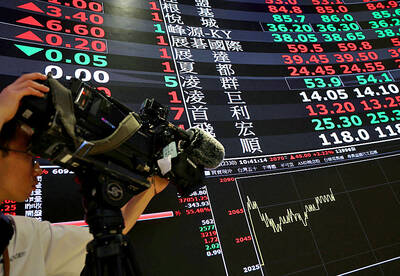
After several years flying high as Asia’s best Nvidia Corp proxy, Taiwan Semiconductor Manufacturing Co (TSMC, 台積電) is increasingly vying with other artificial intelligence (AI) stocks for investor attention. Stock traders are chasing a wider array of beneficiaries as mainstream usage of AI creates demand for hardware beyond the most-advanced chips TSMC makes for Nvidia. Subthemes from the deepening memory crunch to advances in robotics are also luring bids. At the same time, investment caps on single stocks are pushing funds to diversify, while retail investors long familiar with TSMC through its US depositary receipts are being offered a broader set of

Netherlands-based semiconductor equipment supplier ASML Holding NV yesterday said that it is planning to hire an additional 1,000 people in Taiwan this year in response to growing demand from clients. ASML had previously planned to recruit 600 people this year, but that the plan has been adjusted upward, ASML vice president and ASML Taiwan general manager Grace Wang (汪佳慧) told reporters. ASML has a workforce of more than 4,500 in Taiwan, accounting for about 10 percent of its global total, Wang said. This year’s recruitment campaign would focus on adding people in the customer support, manufacturing and supply chain domains to assist ASML

UNDER MICROSCOPE: Taiwan detained three people who allegedly conspired to buy servers in Taiwan and export them using fraudulent documentation, prosecutors said Nvidia Corp chief executive officer Jensen Huang (黃仁勳) on Saturday urged Super Micro Computer Inc to tighten up on compliance after Taiwan detained three people this week for allegedly making fraudulent declarations about artificial intelligence (AI) servers made by its US partner. The development marked the nation’s first crackdown on semiconductor smuggling, which grew after the US slapped restrictions on exports of high-end chips such as Nvidia AI accelerators to China. Nvidia is “rigorous” in explaining regulations to all of its partners, Huang told reporters after arriving in Taipei. “Ultimately Super Micro has to run their own company,” he said in response to

Nvidia Corp yesterday announced that CEO Jensen Huang (黃仁勳) would attend an employee meeting in Taipei tomorrow to celebrate the launch of the company’s Taiwan headquarters project. Huang would attend a gathering at the site of Nvidia’s planned headquarters in Beitou Shilin Technology Park (北投士林科技園區), the company said in a statement. After arriving in Taiwan on Saturday last week, Huang told reporters that he plans to meet with Quanta Computer Inc (廣達) chairman Barry Lam (林百里) and Taiwan Semiconductor Manufacturing Co (TSMC, 台積電) chairman C.C. Wei (魏哲家), and would attend the groundbreaking ceremony for Nvidia’s Taiwan headquarters tomorrow. Nvidia has not yet applied


 RSS
RSS