


Asian technology stocks, the region's worst performers in the past year, may rebound as forecasts by companies such as Taiwan Semiconductor Manufacturing Co (TSMC,
"The earnings have suggested that they will struggle for some time more, but we'll see a recovery toward the end of the year," said Tadayuki Osako, a fund manager at Maintrust KAGmbH in Frankfurt. "That makes now a good time to take the risk."
TSMC, the world's largest producer of made-to-order computer chips, said customers are reducing stockpiles built up after demand for personal computers, mobile phones and consumer electronics slowed. Elpida, Japan's largest memory-chip maker, projected that profit would surge 71 percent this year.
The Morgan Stanley Capital International (MSCI) Asia-Pacific Information Technology Index, a measure of 121 companies in the region, fell 8.8 percent during the past 12 months. The loss was the biggest among 10 industry groups in the MSCI Asia-Pacific Index, a regional benchmark that gained 6.6 percent in the same period.
Last week, the industry index dropped 0.6 percent amid a 0.3 percent advance in the MSCI Asia-Pacific. Two-fifths of the technology companies traded on the Tokyo Stock Exchange's first section reported results.
Technology stocks "are very cheap" when judged by their price-earnings ratios, said Khiem Do, head of Asian equities at Baring Asset Management (Asia) Ltd in Hong Kong.
The group's MSCI index is valued at 17.9 times earnings for the past 12 months, the lowest ratio since October 2001 and just 2.2 percent above the figure for the regional index.
Both the numbers are low by global standards. The MSCI World Information Technology Index is valued at 24.9 times earnings, a 36 percent premium to the MSCI World Index.
Global semiconductor inventories in the third quarter of last year reached a record US$1.6 billion, according to iSuppli Corp, a market researcher. Last week, iSuppli said stockpiles shrank 52 percent in this year's first quarter to US$500 million amid greater-than-expected sales of chips such as microprocessors.
"The semiconductor cycle is going to bottom out and we could be set for a recovery," said Chua Keng Hong, a fund manager at DBS Asset Management Ltd in Singapore.
TSMC gained 4.6 percent last week even though the Hsinchu, Taiwan-based company reported its first quarterly decline in profit in two years. Net income fell 11 percent to NT$16.8 billion (US$535 million), the company said on April 26.
"We expect the digestion of inventory to be near its end," Chief Financial Officer Lora Ho (
Companies such as South Korea's Samsung Electronics Co, the world's largest maker of computer-memory chips, and Nanya Technology Corp (
Elpida ended last week with a 1.9 percent gain, stemming a 12 percent drop in the prior two weeks. The company on April 25 forecast profit of ?14 billion (US$132 million) for the fiscal year ending next March, up from ?8.21 billion last year.
Some technology-stock analysts have become more optimistic.
Merrill Lynch & Co's Daniel Heyler raised ratings last week on Chartered Semiconductor Manufacturing Ltd (特許半導體), Singapore's largest supplier of made-to-order chips, and on Stats ChipPAC Ltd, the world's third-biggest chip tester.
Chartered has gained 1.6 percent since April 22, when the company reported its biggest loss in seven quarters. During the same period, Stats ChipPAC has added 1.5 percent.
Hideo Ueki, chief investment officer at UBS Global Asset Management in Tokyo, said counting on across-the-board gains in technology stocks may be unwise because the companies tend to be most vulnerable to economic trends.
Ueki said he's favoring makers of liquid crystal displays over chipmakers, and electronic-component producers over their customers, because their parts go into a range of technology products.
"There is a lot of disagreement as to where we are" in terms of spending, said Scott McGlashan, a fund manager at J O Hambro Capital Management Ltd in London.
Even so, many overseas investors anticipate that the weakness in technology stocks won't persist, McGlashan said.
"These stocks will react positively to any good news, and more vigorously than to bad news," he said.
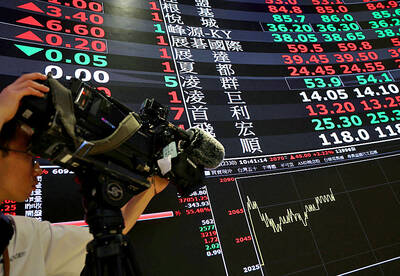
After several years flying high as Asia’s best Nvidia Corp proxy, Taiwan Semiconductor Manufacturing Co (TSMC, 台積電) is increasingly vying with other artificial intelligence (AI) stocks for investor attention. Stock traders are chasing a wider array of beneficiaries as mainstream usage of AI creates demand for hardware beyond the most-advanced chips TSMC makes for Nvidia. Subthemes from the deepening memory crunch to advances in robotics are also luring bids. At the same time, investment caps on single stocks are pushing funds to diversify, while retail investors long familiar with TSMC through its US depositary receipts are being offered a broader set of

UNDER MICROSCOPE: Taiwan detained three people who allegedly conspired to buy servers in Taiwan and export them using fraudulent documentation, prosecutors said Nvidia Corp chief executive officer Jensen Huang (黃仁勳) on Saturday urged Super Micro Computer Inc to tighten up on compliance after Taiwan detained three people this week for allegedly making fraudulent declarations about artificial intelligence (AI) servers made by its US partner. The development marked the nation’s first crackdown on semiconductor smuggling, which grew after the US slapped restrictions on exports of high-end chips such as Nvidia AI accelerators to China. Nvidia is “rigorous” in explaining regulations to all of its partners, Huang told reporters after arriving in Taipei. “Ultimately Super Micro has to run their own company,” he said in response to
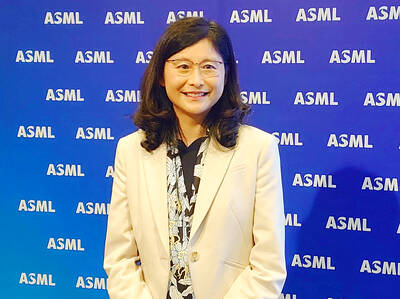
Netherlands-based semiconductor equipment supplier ASML Holding NV yesterday said that it is planning to hire an additional 1,000 people in Taiwan this year in response to growing demand from clients. ASML had previously planned to recruit 600 people this year, but that the plan has been adjusted upward, ASML vice president and ASML Taiwan general manager Grace Wang (汪佳慧) told reporters. ASML has a workforce of more than 4,500 in Taiwan, accounting for about 10 percent of its global total, Wang said. This year’s recruitment campaign would focus on adding people in the customer support, manufacturing and supply chain domains to assist ASML

Nvidia Corp yesterday announced that CEO Jensen Huang (黃仁勳) would attend an employee meeting in Taipei tomorrow to celebrate the launch of the company’s Taiwan headquarters project. Huang would attend a gathering at the site of Nvidia’s planned headquarters in Beitou Shilin Technology Park (北投士林科技園區), the company said in a statement. After arriving in Taiwan on Saturday last week, Huang told reporters that he plans to meet with Quanta Computer Inc (廣達) chairman Barry Lam (林百里) and Taiwan Semiconductor Manufacturing Co (TSMC, 台積電) chairman C.C. Wei (魏哲家), and would attend the groundbreaking ceremony for Nvidia’s Taiwan headquarters tomorrow. Nvidia has not yet applied


 RSS
RSS