


China is planning to hire foreign executives for its big state banks and invite in foreign investment in a sweeping overhaul of an industry struggling with chronic bad debts, the Financial Times reported yesterday.
Liu Mingkang (劉明康), chairman of the China Banking Regulatory Commission, said in an interview that the commission wants to turn around China's biggest banks -- several of which are technically insolvent -- within three to five years, the London-based newspaper said.
China set up the banking commission in March as a Cabinet-level watchdog for an industry struggling to adapt to market demands after decades of functioning as cash suppliers to inefficient state industries.
Beijing is under pressure to clean up its banks as it prepares to open the market to foreign competitors under commitments made to the WTO.
Last week, the commission gathered top international finance experts to solicit advice on its blueprint for banking reform. They included a former governor of the Bank of England, a former head of the New York Federal Reserve and a former general manager of the Bank of International Settlements.
Liu was quoted by the Financial Times as saying he would like to see foreign executives hired for key positions in state banks -- an unprecedented move.
Beijing also plans to inject capital into the big state banks and then have them sell shares on foreign stock markets, the newspaper quoted Vice Minister of Finance Lou Jiwei (
Official statistics put the amount of non-performing loans in the "big four" state banks -- China Construction Bank, Bank of China, Industrial & Commercial Bank of China and the Agricultural Bank of China -- at about 2 trillion yuan (US$250 billion), or about 23 percent of total assets. Some foreign experts put the figure at about twice that amount.
Liu said the main priority was to ensure that banks do not backslide once they have cut back on bad loans. He noted that a major challenge in regulating the banks was their vast size and vertical structure, which enables branch managers to hide irregular activities from their bosses in head offices.
"You can see a lot of time bombs binding together to become an atom bomb," he was quoted as saying.
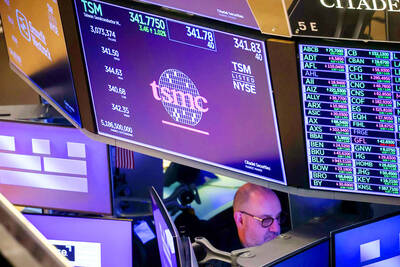
STRONG INTEREST: Analysts have pointed to optimism in TSMC’s growth prospects in the artificial intelligence era as the cause of the rising number of shareholders The number of people holding shares of chipmaker Taiwan Semiconductor Manufacturing Co (TSMC, 台積電) hit a new high last week despite a decline in its stock price, the Taiwan Depository and Clearing Corp (TDCC, 台灣集保) said. The number of TSMC shareholders rose to 2.46 million as of Friday, up 75,536 from a week earlier, TDCC data showed. The stock price fell 1.34 percent during the same week to close at NT$1,840 (US$57.55). The decline in TSMC’s share price resulted from volatility in global tech stocks, driven by rising international crude oil prices as the war against Iran continues. Dealers said
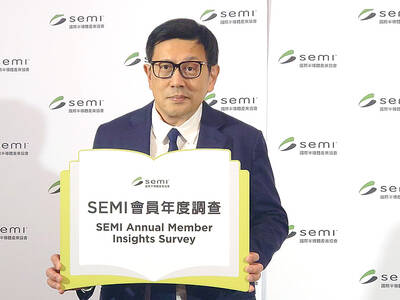
PRICE HIKES: The war in the Middle East would not significantly disrupt supply in the short term, but semiconductor companies are facing price surges for materials Taiwan’s semiconductor companies are not facing imminent supply disruptions of essential chemicals or raw materials due to the war in the Middle East, but surges in material costs loom large, industry association SEMI Taiwan said yesterday. The association’s comments came amid growing concerns that supplies of helium and other key raw materials used in semiconductor production could become a choke point after Qatar shut down its liquefied natural gas (LNG) production and helium output earlier this month due to the conflict. Qatar is the second-largest LNG supplier in the world and accounts for about 33 percent of global helium output. Helium is
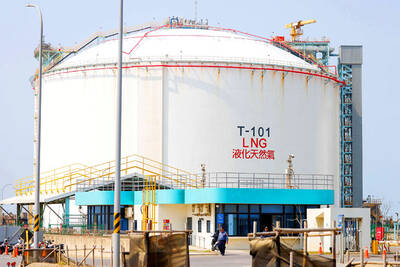
Taiwan’s natural gas supply remains stable through the end of May, despite rising concerns about potential disruptions to Qatari liquefied natural gas (LNG) supplies due to escalating conflicts in the Middle East, the Ministry of Economic Affairs said yesterday. The ministry in a statement said that Taiwan has completed preparations for natural gas supply and shipping schedules through the end of May. It has also made plans to increase natural gas imports from regions outside the Middle East in June to ensure a stable supply, it added. Taiwan sources natural gas from 14 countries and is not solely dependent on the Middle East,
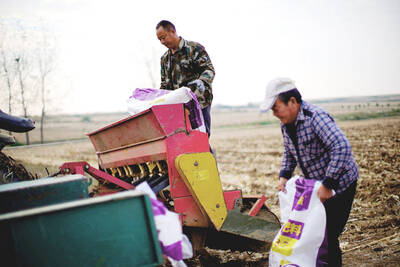
China is clamping down on fertilizer exports to protect its domestic market, industry sources said, putting an additional strain on global markets that were already grappling with shortages caused by the US-Israeli war on Iran. China is among the largest fertilizer exporters — shipping more than US$13 billion of it last year — and it has a history of controlling exports to keep prices low for farmers. Shipments through the war-blocked Strait of Hormuz account for about one-third of the sea-borne supply. This month, Beijing banned exports of nitrogen-potassium fertilizer blends and certain phosphate varieties, sources said. The ban, which has not


 RSS
RSS