


Taipei Times: What is Lone Star's view of the government's progress in financial reforms and its efforts in cleaning up non-performing loans (NPLs)?
Jay McLennan: We saw Taiwan as a great opportunity in this region because [the government] took a very proactive role and tried to solve the NPL problem. They did a really smart thing, that is, they looked to other countries that had NPL problems in the past and still have the problem, and took what I consider to be the best practices from those different countries to put a framework in place to reduce the NPL ratio.

PHOTO: CHIANG YING-YING, TAIPEI TIMES
They looked to [South] Korea, the US, maybe a little bit to Japan, at least from the framework standpoint. [South] Korea is probably one of the best models -- a framework which attracts foreign capital to reduce the NPL ratio.
Taiwan also adopted the right laws, such as the Financial Institutions Merger Law (金融機構合併法), part of which allowed the formation of asset-management companies (AMCs) and incentivized foreign investors to invest in Taiwan. It also incentivized banks to sell their NPLs because they can write off their losses over a period of time. And it got the market moving, showing the rest of the world that Taiwan was ready to face its NPL problems head on.
Admitting the problem is probably the biggest issue for most countries, and Taiwan just came right out and said we have this problem and we'll solve it.
TT: When did you start viewing Taiwan as a potential market for AMCs?
McLennan: We've been looking here for quite some time. I personally began coming here three years ago and have lived here over 20 months. When you look around the region, Japan and [South] Korea have been active in dealing with their issues for a long while, China has huge problems, and their market will begin to move soon, and you have Taiwan which is actively selling. Southeast Asian countries are either not selling proactively or straightforward laws are not in place. Or frankly, they are just not as attractive as Taiwan, which is a AA-rated country with a very sophisticated economy and high income levels.
TT: Other AMCs complained that the yet-to-be-computerized household registration system adds difficulty to their foreclosure of NPLs. What is your opinion?
McLennan: While the framework is in place, there's always the challenge of putting things into practice. The laws do work, it just takes longer than anticipated. A lot of the registration and court processes for foreclosure have taken longer because the courts are overloaded and the laws are oftentimes interpreted differently by different courts. The Taiwan Financial Asset Service Corp (TFASC, 台灣金服), which was set up to help courts, has been slow moving, but they are gaining ground. The timing of the process will get better and I have faith.
TT: Some look at your role in the NPL-cleanup process very positively, yet others regard AMCs negatively, as vulture funds that snap up profits and run. Is this a fair criticism?
McLennan: No, first of all, we don't snap up profits and we don't run. When Lone Star commits to a country, we're in that country for a long time. We've invested billions of US dollars, about 80 percent of our money, in Asia and so we're not going anywhere. We've been in Japan and [South] Korea for a very long time, and we plan to stay in Taiwan for a very long time.
What firms like ours do is bring liquidity to a market that so badly needs it. Without AMCs buying NPLs, banks can't resolve the NPLs themselves. They need to sell them in bulk. Banks find it difficult to work out loans individually, they simply do not have the expertise or manpower. What they really need to do is sell the NPLs, get it off their balance sheet and get back to their core business of banking, and leave the work to other professionals that know how to resolve NPLs.
I have heard people claimed that AMCs are real-estate value killers. Well then, tell me why the market is starting to move? It's starting to move because investors such as Lone Star have come in and invested in this country. I can't speak for our competitors, some of whom do come in, try to make a quick profit and leave very quickly. But that's not what Lone Star does.
TT: The Central Deposit Insurance Corp (CDIC) is scheduled to auction off a portion of Chung Shing Commercial Bank's (中興銀行) NT$35 billion-worth bad loans on Dec. 15. How confident is Lone Star, which is poised to enter the bidding, of winning?
McLennan: We never go into a bid and pay the money to join the bid unless we're interested. It's a waste of money and time because it's not cheap. Every time we bid, we bid the highest price we feel we can for that particular portfolio. Sometimes we win, sometimes we lose. It depends on that particular bid and how others view that portfolio.
TT: Is Lone Star interested in buying a whole bank in Taiwan? The CDIC also plans to auction off the Kaoshiung Business Bank (
McLennan: The government split Kaoshiung Bank into a good and a bad bank. By doing that, they created two different markets -- one is for the NPL buyers and the other is for local banks that perhaps want more branches. We don't need branches. If we were to buy a bank, we would be interested in buying the whole bank (with all the good and bad loans) that needs to be recapitalized.
TT: Has Lone Star had any experience in running banks, which is a requirement of Taiwanese financial authorities for potential buyers to be able to enter the bidding and take up a majority of shares in local banks?
McLennan: Lone Star has purchased two banks -- the Tokyo Sowa Bank a couple years ago, which was renamed as Tokyo Star Bank, and the Korean Exchange Bank in Seoul recently.
As a company, we look at all types of investment opportunities. We're not limited to NPLs. We buy corporate distressed debts, golf courses, real estate, banks, finance companies and credit-card portfolios as an example. We also buy companies as well as their debts. There will be opportunities to recapitalize certain corporations across many industries. We will look into banks here and golf courses -- if we can find one that doesn't have 16 different loans on 18 different holes (chuckling). You've seen a nice flow of NPL sales, but that is just the beginning of the recovery.
TT: What is your assessment of the local NPL market's size?
McLennan: The current published NPL ratio is 5.62 percent, but that doesn't include loans under surveillance and loans under watch. It also doesn't include any restructured loans that were formally NPLs. These restructures are not market restructures. [Borrowers'] paying a 1 percent interest rate for 20 years with no principal repayment is hardly a restructure. That's just a way to move a loan off the bank's NPL list. These restructures will come back into the NPL figures, which we estimate stand at about 10 percent.
We also estimate that the local NPL market is about US$40 billion to US$50 billion (NT$1.36 trillion to NT$1.7 trillion).
TT: How many NPLs have you purchased here and what do you do with those bad loans?
McLennan: Lone Star is regionalized into four hubs in Asia including Japan, [South] Korea, China and Taiwan for Asia-Pacific activities. We relocated our headquarters to Taipei from Singapore last April, so we've been in Taiwan 20 months. So far we have acquired a total of NT$100 billion of NPLs via bids and private negotiation, representing a 25 percent market share.
As a management company with expertise in this business, we take the asset and transform it to a productive asset. We either sit down and work it out with the borrower or take it through foreclosure and sell it at a market price to local Taiwanese investors. [Once] through foreclosure, we hold the title to that asset for a while until it's marketable and then sell it to a local Taiwanese investor.
TT: It's hotly-debated whether the size of the Financial Restructuring Fund (金融重建基金) should be expanded to include purchases of NPLs. What do you think?
McLennan: Taiwan doesn't need a traditional RTC [Resolution Trust Corp] fund such as the US and [South] Korea because organized capital is available to immediately invest in NPLs here. Taiwan is in a very fortunate position to have investors lined up to buy its distressed debt. Banks are selling NPLs directly to investors without employing the government as a middleman. The fund should be used for some of the very distressed banks that are insolvent.
TT: What is your view on the nation's economic outlook?
McLennan: Following the global economic recovery, the local economy, which is linked to the US, will also recover. I read a lot in the newspaper that people are saying how the real-estate market here is going to rebound next year. Well, wishful thinking. I think everyone is basing the rebound on the residential market uptick in northern Taiwan, specifically Taipei, which is largely due to low interest rates, and people being allowed to borrow 70 percent of their purchase price and a reduction in the land-value increment tax.
I believe the property market is at or close to the bottom but you need to look at how much commercial real estate has been built recently and how much is coming on line. Just because they build it doesn't mean they'll lease it up. You've got to have the demand, which is not here yet. In general, the market is going to level out next year. And you'll see an uptick in the two years to follow.

Taiwan Semiconductor Manufacturing Co (TSMC, 台積電) last week recorded an increase in the number of shareholders to the highest in almost eight months, despite its share price falling 3.38 percent from the previous week, Taiwan Stock Exchange data released on Saturday showed. As of Friday, TSMC had 1.88 million shareholders, the most since the week of April 25 and an increase of 31,870 from the previous week, the data showed. The number of shareholders jumped despite a drop of NT$50 (US$1.59), or 3.38 percent, in TSMC’s share price from a week earlier to NT$1,430, as investors took profits from their earlier gains
AI TALENT: No financial details were released about the deal, in which top Groq executives, including its CEO, would join Nvidia to help advance the technology Nvidia Corp has agreed to a licensing deal with artificial intelligence (AI) start-up Groq, furthering its investments in companies connected to the AI boom and gaining the right to add a new type of technology to its products. The world’s largest publicly traded company has paid for the right to use Groq’s technology and is to integrate its chip design into future products. Some of the start-up’s executives are leaving to join Nvidia to help with that effort, the companies said. Groq would continue as an independent company with a new chief executive, it said on Wednesday in a post on its Web

CHINA RIVAL: The chips are positioned to compete with Nvidia’s Hopper and Blackwell products and would enable clusters connecting more than 100,000 chips Moore Threads Technology Co (摩爾線程) introduced a new generation of chips aimed at reducing artificial intelligence (AI) developers’ dependence on Nvidia Corp’s hardware, just weeks after pulling off one of the most successful Chinese initial public offerings (IPOs) in years. “These products will significantly enhance world-class computing speed and capabilities that all developers aspire to,” Moore Threads CEO Zhang Jianzhong (張建中), a former Nvidia executive, said on Saturday at a company event in Beijing. “We hope they can meet the needs of more developers in China so that you no longer need to wait for advanced foreign products.” Chinese chipmakers are in
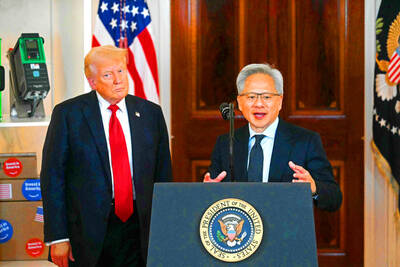
POLICY REVERSAL: The decision to allow sales of Nvidia’s H200 chips to China came after years of tightening controls and has drawn objections among some Republicans US House Republicans are calling for arms-sale-style congressional oversight of artificial intelligence (AI) chip exports as US President Donald Trump’s administration moves to approve licenses for Nvidia Corp to ship its H200 processor to China. US Representative Brian Mast, the Republican chairman of the US House Committee on Foreign Affairs, which oversees export controls, on Friday introduced a bill dubbed the AI Overwatch Act that would require the US Congress to be notified of AI chips sales to adversaries. Any processors equal to or higher in capabilities than Nvidia’s H20 would be subject to oversight, the draft bill says. Lawmakers would have


 RSS
RSS