


The Consumers' Foundation (
The yam-flour snacks known as Mini Fruit Jellys or Mini Fruit Cups have been blamed for the death of six children in the US and three in Taiwan who choked to death on the bite-size sweets over the last three years.
"The government should really do something to strictly regulate the gel snacks before more accidents happen," said Tsai Chai-ban (蔡萬本), chairman of the foundation.
Tsai made the remarks after learning that a US federal court in California on Wednesday ordered the destruction of US$500,000 worth of Taiwan-made conjac-gel candy.
The order was the latest move in a 15-month effort to get the candy off US store shelves.
Late last year, the US Food and Drug Administration announced a ban on the import of the gel candies.
Several European nations, as well as Canada and South Korea, have also banned them.
Tsai accused the government of being spineless when it comes to taking a tough stand against manufacturers.
"Three years ago we had held a public hearing urging authorities to require gel-candy makers to change the size of their product," he said.
"But the government didn't impose any strict regulation [to reduce size] and therefore makers have been reluctant to changes."
One health official said yesterday that the government had attempted to tackle the problem by encouraging manufacturers to change the size of the candy and include printed warnings with their products, but few have complied.
"More than 70 percent of conjac jelly distributed in Taiwan is still the small size," said Chen Shu-kong (
Chen said Taichung-based Sheng Hsiang Jen Foods Co (
Chen said the company began selling a larger heart-shaped candy this year but 50 percent of its production is still the small size.
However, a senior Sheng Hsiang Jen official told the Taipei Times that perhaps the consumer eating habits are to blame for the problem.
"Many foods such as sticky rice, dumplings or even hot dogs are hard to swallow and the public could choke on them too if they didn't exercise caution," said Lee Lien-yu (
"Besides, we have a warning on the packaging of our jelly candies stating the sweets are not for children under the age of five or for seniors and they shouldn't be eaten when walking or jumping," Lee said.
Tsai said such warnings are "not enough,"adding that the government should require manufacturers make the candy larger and set a deadline for the change.
"The government should punish candy makers or destroy their products if they don't follow such regulations," Tsai said.
The foundation is considering holding another public hearing soon on the issue.


The domestic unit of the Chinese-owned, Dutch-headquartered chipmaker Nexperia BV will soon be able to produce semiconductors locally within China, according to two company sources. Nexperia is at the center of a global tug-of-war over critical semiconductor technology, with a Dutch court in February ordering a probe into alleged mismanagement at the company. The geopolitical tussle has disrupted supply chains, with some carmakers reportedly forced to cut production due to chip shortages. Local production would allow Nexperia’s domestic arm, Nexperia Semiconductors (China) Ltd (安世半導體中國), to bypass restrictions in place since October on the supply of silicon wafers — etched with tiny components to
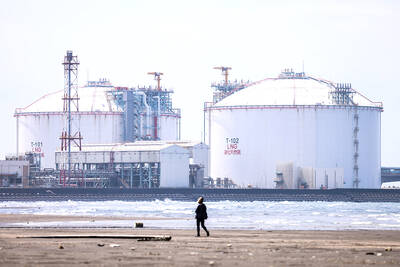
Taiwan is open to joining a global liquefied natural gas (LNG) program if one is created, but on the condition that countries provide delivery even in a scenario where there is a conflict with China, an energy department official said yesterday. While Taiwan’s priority is to have enough LNG at home, the nation is open to exploring potential strategic reserves in other countries such as Japan or South Korea, Energy Administration Deputy Director-General Chen Chung-hsien (陳崇憲) said. While the LNG market does not have a global reserve for emergencies like that of oil, the concept has been raised a few times —

Taiwan Semiconductor Manufacturing Co (TSMC, 台積電) yesterday received government approval to deploy its advanced 3-nanometer (3nm) process at its second fab currently under construction in Japan, the Ministry of Economic Affairs said in a news release. The ministry green-lit the plan for the facility in Kumamoto, which is scheduled to start installing equipment and come online in 2028 with a monthly production capacity of 15,000 12-inch wafers, the ministry said. The Department of Investment Review in June 2024 authorized a US$5.26 billion investment for the facility, slated to manufacture 6- to 12nm chips, significantly less advanced than 3nm process. At a meeting with
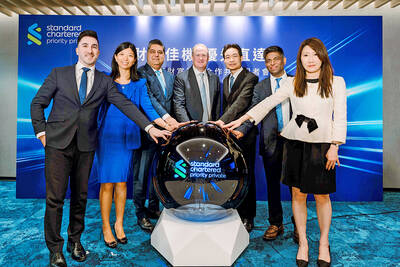
Standard Chartered Taiwan on March 26 announced that it has partnered with international fintech firm FinIQ to build an “Automated Structured Products Pricing Platform.” The bank is also introducing products from global issuers including Goldman Sachs Group Inc, Barclays PLC and BNP Paribas SA. The new platform enables an end-to-end process whereby it finds the most competitive pricing across multiple issuers in a matter of minutes, followed by automated documentation and transaction execution, which significantly shortens time-to-market and delivers a superior wealth management experience. Standard Chartered Bank Taiwan CEO Anthony Yu (游天立) said: “Standard Chartered is increasingly leveraging its wealth management


 RSS
RSS