


Clad only in shorts, a man with shaved head precariously balances on two large, irregularly shaped wooden balls. As he lurches forward with demented baby steps, he struggles to stay upright; he can barely make his way across the room.
For Hong Kong artist Ho Siu-Kee, this act illustrates the precarious situation Hong Kong artists face today, a time of change and uncertainty. For Ho, the frustrating attempt simply to cross the room symbolizes the awkwardness and powerlessness Hong Kong residents are feeling during their transition to Chinese rule.
Walking on Two Balls is part of Ho's solo exhibition, Connotative Body. A combination of computer manipulated photographs, video installations and sculpture, the exhibition is on display at IT Park until Dec. 11.
COURTESY OF IT PARK
Walking on Two Balls, also indicates the degree to which Ho's art is about the body's direct relationship to space and time. Even though most of his work is documented by photographs or video, in them the artist is a performer and uses his body as an instrument.
According to media guru Marshall McLuhan, a machine or tool becomes an extension of its user's body. The wheel acts as an extension of the feet, a book an extension of the eyes, electricity of the nerves. Ho captures this notion by attaching prostheses to his head, back, arms and feet and photographing himself.
Like a post-modern Da Vinci, Ho constructs scientific contraptions that act as extensions of the body. In Flying Machine, for example, Ho, with bandaged hands, holds a hand-made flying machine that is nearly his size. In the first photo, his arms are outstretched to his sides while the propeller blades jut straight up into the air. In the second, his arms jut straight up and the blades move perpendicular to the ground. The body imitates the movement of the blades and vice versa. Does the machine control the man or the man control the machine?
COURTESY OF IT PARK
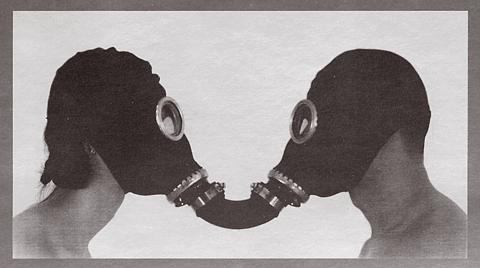
In The Third Eye photo series (1997), a double portrait of the artist, Ho wears a metal-pipe fitting as headgear. It holds a small glass ball in front of his eyes that extends his vision; yet the glass ball operates much like the eye's retina, inverting the image and thus incapacitating the vision.
The actual headgear is installed on a large glass jar shaped like the artist's head. Viewers can look through the glass ball to see the portraits on the wall -- also inverted. The piece raises issues about how vision distorts perception: you can't always trust what you see.
The comical video installation Contact Point (1996) further toys with issues of perception. Two monitors face each other. In the left monitor, Ho throws a ball off-screen to his counterpart self in the right monitor, who catches the ball and throws it back to his left.
This back-and-forth interplay creates a dialogue in the space between the two monitors. Viewers feel as if they can almost interrupt the two monitor-bound characters and catch the ball themselves.
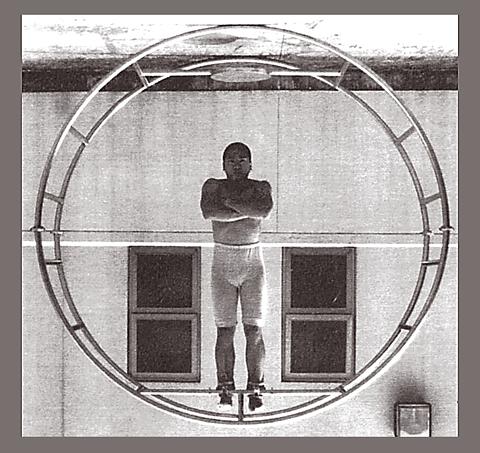
In Gravity Hoop (1997), a frontal and side view both show the artist hanging upside down, motionless, in his large metallic circular ladder. He remains deep in concentration, like a Hindu fakir or an astronaut in intensive training; the work hints at the body's endurance, the passage of time.
Yet the piece also seems like some form of protest or challenge, and in many ways it best illustrates the essence of Ho's message. His gesture is defiant. He seems to be testing the body's limitations against the machine; the images are reminiscent of Brave New World. Or maybe it's simply the life for an artist in today's Hong Kong.
Ho Siu-Kee Connotative Body Until Dec. 11
IT Park, 41, 2F Yitung St.

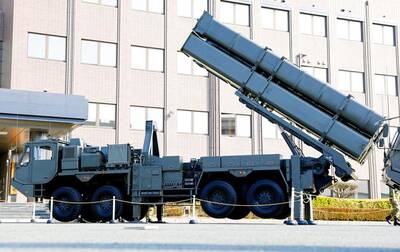
Japan has deployed long-range missiles in a southwestern region near China, the Japanese defense minister said yesterday, at a time when ties with Beijing are at their lowest in recent years. The missiles were installed in Kumamoto in the southern region of Kyushu, as Japan is attempting to shore up its military capacity as China steps up naval activity in the East China Sea. “Standoff defense capabilities enable us to counter the threat of enemy forces attempting to invade our country ... while ensuring the safety of our personnel,” Japanese Minister of Defense Shinjiro Koizumi said. “This is an extremely important initiative for

MORE POPULAR: Taiwan Pass sales increased by 59 percent during the first quarter compared with the same period last year, the Tourism Administration said The Tourism Administration yesterday said that it has streamlined the Taiwan Pass, with two versions available for purchase beginning today. The tourism agency has made the pass available to international tourists since 2024, allowing them to access the high-speed rail, Taiwan Railway Corp services, four MRT systems and four Taiwan Tourist Shuttles. Previously, five types of Taiwan Pass were available, but some tourists have said that the offerings were too complicated. The agency said only two types of Taiwan Pass would be available, starting from a three-day pass with the high-speed rail and a three-day pass with Taiwan Railway Corp. The former costs NT$2,800

NEW LOW: The council in 2024 based predictions on a pessimistic estimate for the nation’s total fertility rate of 0.84, but last year that rate was 0.69, 17 percent lower An expected National Development Council (NDC) report expects the nation’s population to drop below 12 million by 2065, with the old-age dependency ratio to top 100 percent sooner than 2070, sources said yesterday. The council is slated to release its latest population projections in August, using an ultra-low fertility model, the sources said. The previous report projected that Taiwan’s population would fall to 14.37 million by 2070, but based on a new estimate of the total fertility rate (TFR) — the average number of children born to a woman over her lifetime — the population is expected to reach 12 million by

COUNTERING HOSTILITY: The draft bill would require the US to increase diplomatic pressure on China and would impose sanctions on those who sabotage undersea cable networks US lawmakers on Thursday introduced a bipartisan bill to bolster the resilience of Taiwan’s submarine cables to counter China’s hostile activities. The proposal, titled the critical undersea infrastructure resilience initiative act, was cosponsored by Republican representatives Mike Lawler and Greg Stanton, and Democratic Representative Dave Min. US Senators John Curtis and Jacky Rosen also introduced a companion bill in the US Senate, which has passed markup at the chamber’s Committee on Foreign Relations. The House’s version of the bill would prioritize the deployment of sensors to detect disruptions or potential sabotage in real-time and enhance early warning capabilities through global intelligence sharing frameworks,


 RSS
RSS