


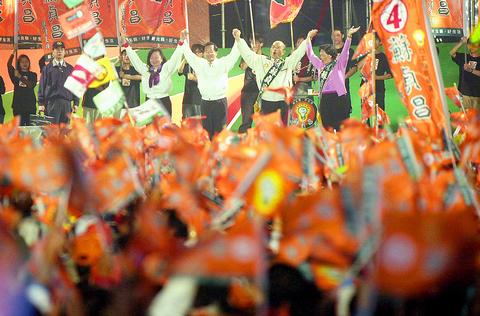
Ending 50 years of KMT dominance in the Legislative Yuan, the DPP gained the most seats in the Dec. 1 legislative elections, dealing a second blow to the former ruling party.
The year-end polls, which also decided mayoral and county commissioner posts in 23 counties and cities, ushered in a dramatic reshaping of the nation's political landscape.
TAIPEI TIMES FILE PHOTO
Swept from its long grip on power last year, the KMT finished a distant second with 68 seats, down from 123 in the previous legislative elections in 1998.
TAIPEI TIMES FILE PHOTO
The DPP captured 87 seats, while the People First Party (PFP) stood third with 46 seats, doubling its presence in the Legislative Yuan.
The newly-formed Taiwan Solidarity Union (TSU) emerged as a big winner, capturing 13 seats.
The New Party was undoubtedly the biggest loser in the legislative races. The pro-unification party retained only one seat, representing Kinmen, down from 11 in the 1998 polls.
Meanwhile, the local government elections seemed to increase the nation's political polarization.
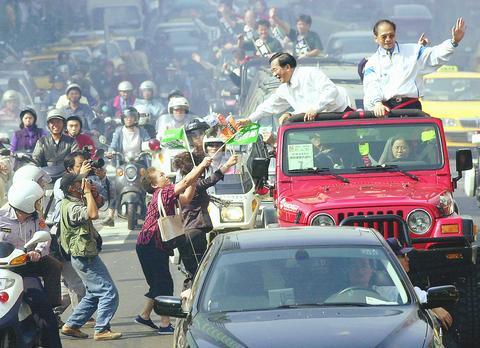
The DPP, while suffering some setbacks, maintained its influence in southern Taiwan, while the KMT dominated the north. The DPP, which had ruled 12 of the 23 contested districts since 1997, won only nine.
The KMT, which previously controlled eight counties, was victorious in nine cities and counties. Independent candidates and the PFP captured two districts each, while the New Party took only Kinmen County.
In northern Taiwan, the KMT seized control from the DPP in six districts -- Keelung City, Taoyuan County, Hsinchu City, Hsinchu County, Taichung City and Taichung County.
From Nantou County to the southern tip of the country, the DPP racked up victories in all localities except Taichung City, Taichung County and Yunlin County.

‘NO SECURITY RISK’: The Railway Bureau reassured the public that the technicians’ activities were limited to technical guidance and did not involve sensitive systems The Railway Bureau yesterday said it had invited eight Chinese technicians to assist with an airport MRT construction project. The bureau issued the confirmation after an Internet user said Chinese nationals had entered the construction zone of Taiwan Taoyuan International Airport’s Terminal 3 project. They asked why “individuals from an enemy state” were allowed access to such a major national infrastructure project, which raised serious concerns over Taiwan’s industrial safety, sensitive systems and information security. The bureau’s Northern Region Engineering Branch Office said subcontractor Taiwan Handle Industrial Co (台灣手把工業) of the Taoyuan airport MRT’s “Contract No. CU05 Project A14 Station Civil, MEP &

The National Chungshan Institute of Science and Technology yesterday showcased its locally developed variants of the Vision 60 robotic patrol dog, which it plans to deploy on the nation’s outlying territories in the South China Sea. The variants were produced under the Joint Lab project — created by the institute and domestic companies — and assembled with domestically produced motors, lenses and artificial intelligence (AI) systems alongside licensed tech from the US, Missile and Rocket Systems Research Division deputy director Jen Kuo-kang (任國光) told the media event at a military base in Taipei’s Dazhi (大直) area. Taiwan has built up its strengths
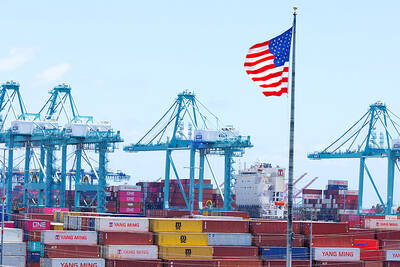
NOT IMMEDIATE: Taiwan has a chance to appeal the proposed 10 percent tariff before it starts, while other countries face a 12.5 percent tariff from the trade office Taiwan is among 60 economies determined by the US to have failed to impose or enforce a ban on the importation of goods produced with forced labor, according to a notice released on Tuesday by the Office of the US Trade Representative (USTR), which proposed imposing an additional 10 percent or more tariff on them. The USTR in a statement said that following an investigation, it had determined under Section 301 of the Trade Act of 1974 that the failure of the 60 economies to impose and effectively enforce a prohibition on the importation of goods produced with forced labor is

TIT-FOR-TAT: The US allegedly revoked the visa of a Chinese national working at Xinhua News Agency in the US in response to Beijing’s expulsion of Vivian Wang The Presidential Office yesterday condemned China for expelling a New York Times correspondent from Beijing following the newspaper’s interview with President William Lai (賴清德), saying the move highlighted Beijing’s suppression of press freedom and its threat to international news media. Taiwan has noted a series of recent incidents in which Beijing used similar tactics to “threaten and pressure international media outlets and journalists,” Presidential Office spokeswoman Karen Kuo (郭雅慧) said in a statement. “This concerns not only press freedom and freedom of expression, but also the safety of journalists, and Taiwan and relevant partners are paying close attention to the situation,” she


 RSS
RSS