


Tawian is poised to join the WTO this Sunday, finalizing an almost 12-year battle to get a fair shake on the world stage.
"By joining WTO we can get fairer treatment from all the world's countries," said Chen Po-chih (陳博志), chairman of the Cabinet's Council for Economic Planning and Development (CEPD).
PHOTO: AFP
Equally important is getting the voice of Taiwan -- one of the largest trading economies in the world -- heard.
"With WTO membership Taiwan should be able to use its experience and economic size to better understand and have a voice in implementing evolving trade rules," said Richard Henson, president of the American Chamber of Commerce in Taipei.
Speaking for Taiwan at the current WTO ministerial meeting -- which starts today and runs through November 13 in Qatar -- is Economic Minister Lin Hsin-yi (
Lin represents a nation that has systematically been shut out of the world body since exiting the United Nations and being booted out of GATT, both in 1971.
Isolated diplomatically, the nation has only a few allies, most of them small, impoverished countries in Africa and Latin America.
Currently mired in recession, Taiwan hopes to use WTO membership to access new investment opportunities, improve corporate efficiency and reduce its dependency on Japan and the US.
But hopes for WTO to overcome the array of economic hurdles facing the nation may be wishful thinking.
"Actual accession itself won't bring some `big bang' of change," Henson said.
As for Taiwan businesses, WTO entry will provide greater access to more markets worldwide.
"It will also force them to become more productive and transparent, and thereby make them better companies," Henson said.
Also set to profit from entry are Taiwan consumers, who will see better prices for a wide range of goods and products that today are protected by high tariffs or prohibitive barriers. Foreign multinationals will also reap benefits from the easing of investment restrictions in sectors of the Taiwan economy that are currently closed or difficult to invest in.
Taiwan must open its doors further to "global companies to bring more resources into the Taiwan market and thereby raise production or service standards in certain inefficient market segments," Henson said.
CEPD head Chen admitted that raising the bar is an administrative priority as well.
"In the globalized economy, if we cannot offer satisfactory infrastructure, laws and regulations, government efficiency and a quality living environment, resources will move to other countries," Chen said.
Spencer White, the head of research at Merrill Lynch Taiwan Ltd, also argues that the trade club offers "no quick fix" for the state of the domestic economy.
Instead, "The combination of US corporate and consumer spending, will be much more influential in Taiwan being hauled out of the current economic malaise," White said.
While further deregulation and reform should be high on the government's agenda, the best advice White had for the government was to stay out of the way.
"Governments are notoriously poor at managing the allocation of capital. Risk is unquestionably much better managed by the private sector," he said.
In the short term, WTO may make government bureaucrats' job more arduous. "Taiwan is in urgent need of addressing a number of structural issues -- rising unemployment, inadequate infrastructure and various regulatory impediments -- and WTO will, initially, aggravate these stresses in the economy," White said.
But veteran economist and Minister Without Portfolio Hu Sheng-cheng (
"The government has worked hard to increase the competitiveness of our economy ... through this transformation, our economy will be stronger and will be able to meet the challenges of increased world competition as a result of our entry into WTO," Hu said.
Nevertheless, Taiwan may still have to break the mold and turn words into action.
"What is critically different now is that the opportunities will come from less capital intensive industries -- and that requires a very different mindset and approach," White said.
"The bottom line? The old formulae cannot be applied to these new problems. We have to hope that a more creative and proactive approach is enacted rather than just discussed."

The National Chungshan Institute of Science and Technology yesterday showcased its locally developed variants of the Vision 60 robotic patrol dog, which it plans to deploy on the nation’s outlying territories in the South China Sea. The variants were produced under the Joint Lab project — created by the institute and domestic companies — and assembled with domestically produced motors, lenses and artificial intelligence (AI) systems alongside licensed tech from the US, Missile and Rocket Systems Research Division deputy director Jen Kuo-kang (任國光) told the media event at a military base in Taipei’s Dazhi (大直) area. Taiwan has built up its strengths
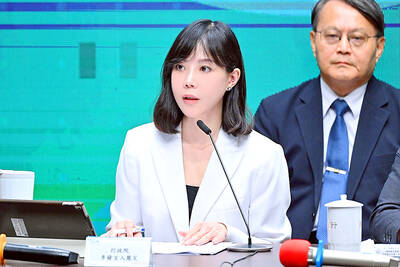
RIGHT DIRECTION: Taiwan’s efforts to prevent forced labor include a proposal to ‘fully prohibit’ employers from withholding workers’ documents, an official said Taiwan is to establish a mechanism to restrict imports of goods linked to forced labor, the Executive Yuan said yesterday, after the US proposed imposing additional tariffs on Taiwanese goods over labor concerns. “The Ministry of Labor and the Ministry of Economic Affairs are to establish an interministerial review procedure,” Executive Yuan spokesperson Michelle Lee (李慧芝) said at a news briefing in Taipei. “The government is to use the Foreign Trade Act [貿易法] as the legal basis to restrict imports of goods produced with forced labor” and bring its supply chain governance more in line with international standards on human rights, resilience

NOT IMMEDIATE: Taiwan has a chance to appeal the proposed 10 percent tariff before it starts, while other countries face a 12.5 percent tariff from the trade office Taiwan is among 60 economies determined by the US to have failed to impose or enforce a ban on the importation of goods produced with forced labor, according to a notice released on Tuesday by the Office of the US Trade Representative (USTR), which proposed imposing an additional 10 percent or more tariff on them. The USTR in a statement said that following an investigation, it had determined under Section 301 of the Trade Act of 1974 that the failure of the 60 economies to impose and effectively enforce a prohibition on the importation of goods produced with forced labor is

TIT-FOR-TAT: The US allegedly revoked the visa of a Chinese national working at Xinhua News Agency in the US in response to Beijing’s expulsion of Vivian Wang The Presidential Office yesterday condemned China for expelling a New York Times correspondent from Beijing following the newspaper’s interview with President William Lai (賴清德), saying the move highlighted Beijing’s suppression of press freedom and its threat to international news media. Taiwan has noted a series of recent incidents in which Beijing used similar tactics to “threaten and pressure international media outlets and journalists,” Presidential Office spokeswoman Karen Kuo (郭雅慧) said in a statement. “This concerns not only press freedom and freedom of expression, but also the safety of journalists, and Taiwan and relevant partners are paying close attention to the situation,” she


 RSS
RSS