


A US federal jury ordered software giant Microsoft on Wednesday to pay US$388 million to Uniloc for infringing on an anti-piracy software patent held by the Singapore and US-based company.
The award was made by a jury hearing the case in a district court in the US state of Rhode Island. The jury ordered Microsoft to compensate Uniloc for infringing on a patent for a security algorithm held by Uniloc.
The complaint against Microsoft was filed by Uniloc Singapore Private Ltd and Uniloc USA Inc in October 2003. Uniloc had accused Microsoft of infringing on its patent in its Windows operating systems, which power most of the world’s personal computers, and in Office programs.
Microsoft said it would seek to have the verdict overturned.
Microsoft had previously won the case, but Uniloc convinced an appeals court to overturn the judge’s ruling, arguing that the case was influenced by the testimony of an expert witness who had conflicts of interest.
Meanwhile, Germany’s main competition agency, the Federal Cartel Office, fined Microsoft 9 million euros (US$12 million) on Wednesday for imposing a retail price for its Office Home & Student 2007 software.
Microsoft said it would pay the fine to avoid a lengthy legal dispute and was reviewing its internal processes in Germany to ensure they complied with German law in future.
The Bonn-based agency said Microsoft had harmed free competition by exerting improper influence on the selling price of the software through a major chain, which was not identified in the announcement.

CALL FOR SUPPORT: President William Lai called on lawmakers across party lines to ensure the livelihood of Taiwanese and that national security is protected President William Lai (賴清德) yesterday called for bipartisan support for Taiwan’s investment in self-defense capabilities at the christening and launch of two coast guard vessels at CSBC Corp, Taiwan’s (台灣國際造船) shipyard in Kaohsiung. The Taipei (台北) is the fourth and final ship of the Chiayi-class offshore patrol vessels, and the Siraya (西拉雅) is the Coast Guard Administration’s (CGA) first-ever ocean patrol vessel, the government said. The Taipei is the fourth and final ship of the Chiayi-class offshore patrol vessels with a displacement of about 4,000 tonnes, Lai said. This ship class was ordered as a result of former president Tsai Ing-wen’s (蔡英文) 2018
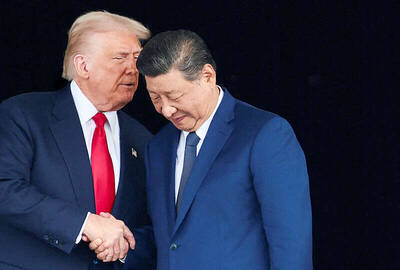
‘SECRETS’: While saying China would not attack during his presidency, Donald Trump declined to say how Washington would respond if Beijing were to take military action US President Donald Trump said that China would not take military action against Taiwan while he is president, as the Chinese leaders “know the consequences.” Trump made the statement during an interview on CBS’ 60 Minutes program that aired on Sunday, a few days after his meeting with Chinese President Xi Jinping (習近平) in South Korea. “He [Xi] has openly said, and his people have openly said at meetings, ‘we would never do anything while President Trump is president,’ because they know the consequences,” Trump said in the interview. However, he repeatedly declined to say exactly how Washington would respond in
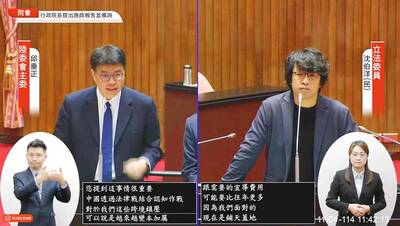
WARFARE: All sectors of society should recognize, unite, and collectively resist and condemn Beijing’s cross-border suppression, MAC Minister Chiu Chui-cheng said The number of Taiwanese detained because of legal affairs by Chinese authorities has tripled this year, as Beijing intensified its intimidation and division of Taiwanese by combining lawfare and cognitive warfare, the Mainland Affairs Council (MAC) said yesterday. MAC Minister Chiu Chui-cheng (邱垂正) made the statement in response to questions by Democratic Progressive Party (DPP) Legislator Puma Shen (沈柏洋) about the government’s response to counter Chinese public opinion warfare, lawfare and psychological warfare. Shen said he is also being investigated by China for promoting “Taiwanese independence.” He was referring to a report published on Tuesday last week by China’s state-run Xinhua news agency,

‘ADDITIONAL CONDITION’: Taiwan will work with like-minded countries to protect its right to participate in next year’s meeting, the foreign ministry said The US will “continue to press China for security arrangements and protocols that safeguard all participants when attending APEC meetings in China,” a US Department of State spokesperson said yesterday, after Beijing suggested that members must adhere to its “one China principle” to participate. “The United States insists on the full and equal participation of all APEC member economies — including Taiwan — consistent with APEC’s guidelines, rules and established practice, as affirmed by China in its offer to host in 2026,” the unnamed spokesperson said in response to media queries about China putting a “one China” principle condition on Taiwan’s


 RSS
RSS