


FedEx began winding down its Asian hub in the Philippines and shedding 800 staff yesterday as the US courier giant started full operation of a new regional facility in China, an official said.
Arman Areza, administrator of the Subic Bay economic and tourism zone where FedEx has been based for nearly 14 years, said the company would for now keep a skeleton operation in Subic as a back up to the US$150 million hub in Guangzhou, China.
FedEx has said the Subic facility may finally close in April after which it has the option to renew its lease on a monthly basis, he said.
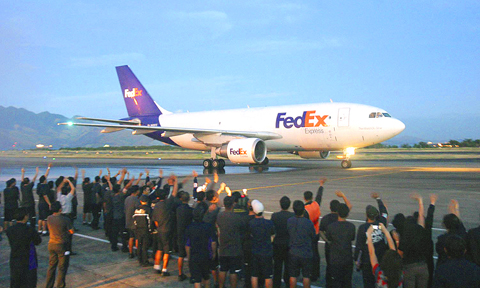
PHOTO: AP
The closure of FedEx’s operation comes in the wake of an announcement by Intel Corp last month that it will let go 1,800 workers later this year when the company shuts down its 35-year-old operation in the Philippines amid waning global demand for computers.
Areza said the decision to shift the hub to China was made in 2005 and was based on “market reality” — the large cargo volume in China — not on Subic being unable to meet the requirements of FedEx or the current global slump.
“The move has nothing to do with the financial crisis,” Areza said.
“The volume and market conditions favored China because the volume in China dwarfed those in Southeast Asia, and China has opened the domestic market to FedEx,” he said.
Subic, 80km west of Manila, was converted from a sprawling US naval base into an economic zone after US forces left in 1992.
The Philippine government will lose between 150 million pesos and 160 million pesos (US$3.15 million to US$3.37 million) annually in landing, parking and warehousing fees it has been collecting from FedEx since it started operating the Subic hub in September 1995, Areza said.
He said about 800 workers of FedEx and its subcontractors would be affected, but added that he expected the highly skilled workers could easily find jobs elsewhere in the economic zone.
Dozens of workers showed up before dawn yesterday at the former hub to wave goodbye to one of the last FedEx planes to fly out of Subic.
“Even if the economy is doing well ... it’s never a good time if a company as big as FedEx [leaves]. We are sorry to see them go,” Areza said.
FedEx officials were not immediately available for comment.

A signaling system malfunction disrupted high-speed rail (HSR) services beginning at 8am today, with trains temporarily reduced to three northbound and three southbound trains per hour as authorities conduct inspections. The malfunction occurred on a section of track in Miaoli County during pre-operation checks early this morning, forcing northbound and southbound trains to use a single track, the HSR operator said. The regular schedule has been replaced with three hourly trains offering only nonreserved seating in each direction, stopping at every station, it said, adding that business class cars would still have reserved seating. Departures from terminal stations are scheduled at the top

Taiwan is still in the process of assessing the possibility of recruiting workers from Eswatini, the Ministry of Foreign Affairs said yesterday, adding that its goal is to help Eswatini upgrade its vocational training centers. If there are plans to recruit workers from Eswatini, safeguarding national security, protecting public health and ensuring the employment rights of Taiwanese would be prerequisites, Department of West Asian and African Affairs Director-General Yen Chia-liang (顏嘉良) told a news conference. Key considerations would also include filling labor shortages in specific industries, and fostering bilateral professional and technical exchanges, he said. Yen was asked about the progress of labor

A US uncrewed surface vessel (USV) encountered multiple Chinese warships during an autonomous transit of the Taiwan Strait, US defense company Seasats said in a statement on Wednesday. Seasats announced that a Lightfish USV had completed the first autonomous transit of the Taiwan Strait. Over five days, the USV traversed the entire length of the Strait while constantly monitoring surface vessel traffic, the company said. The Lightfish encountered multiple Chinese warships, one of which was a Chinese People’s Liberation Army Navy (PLAN) Type 056 corvette, it said. The Chinese vessels were operating “well within Taiwan’s exclusive economic zone without transmitting their identity via the

VERBOSE VESSELS: A CGA cutter and a China Coast Guard exchanged verbal barbs for more than a day in Taiwanese-controlled waters before the Chinese vessel left The Taiwanese and Chinese coast guards had a standoff near the strategically located Pratas Islands (Dongsha Islands, 東沙群島) in the north of the South China Sea, the Coast Guard Administration (CGA) said yesterday. The two sides engaged in intense radio exchanges over sovereignty claims during the 33-hour standoff. China Coast Guard vessel 3501 eventually left the restricted waters, 26.6 nautical miles (49.2km) west of the Pratas Islands, at 5pm yesterday, the CGA said. Lying approximately between southern Taiwan and Hong Kong, the Taiwan-controlled Pratas are seen by some security experts as vulnerable to Chinese attack due to their distance — more than


 RSS
RSS