


American International Group Inc (AIG) said on Tuesday it was limiting how much it pays its top executives, including granting a US$1 salary for this year and the same for next year to chief executive Edward Liddy.
The decision is one of many broader moves made by the troubled New York-based insurer, which has been under pressure to restrict executive pay since accepting billions in government assistance to save it from collapse. AIG has received about US$150 billion so far, more than any other company.
It was once the world’s largest insurer with customers around the globe and regulators feared the possible effect an AIG collapse would have had on the world’s financial system.
The company said there would be no annual bonuses and no salary increases through next year for AIG’s top seven officers and no salary increases through next year for the 50 next-highest AIG executives.
“We believe these actions demonstrate that we are focused on overcoming our financial challenges so AIG can return value to taxpayers and shareholders,” Liddy said in a statement.
AIG shares fell US$0.09, or 5 percent, to US$1.68 in midday trading.
The announcement comes after New York Attorney General Andrew Cuomo sent a letter to Liddy earlier this month saying AIG should be “completely transparent” about its compensation plans for this year.
In the middle of September, the US Federal Reserve said it would offer two loans totaling US$123 billion to AIG to help the insurer stave off bankruptcy. AIG was later allowed to access another US$20.9 billion through the Fed’s “commercial paper” program. And earlier this month, the government announced new financial assistance to the company.
In a letter to Cuomo on Tuesday, Liddy said AIG was “extremely grateful” for the support it had received from US taxpayers and said the company did “recognize the obligation we have to use that support to help AIG recover, contribute to the economy and repay taxpayers.”
AIG also said no taxpayer dollars would be used for any annual bonuses or future cash performance awards for AIG’s top management positions.
Liddy, who joined the company in the middle of September, will not receive an annual bonus this year or next, although he may be eligible for a special bonus for “extraordinary performance” payable in 2010, the company said.
Earlier this month, AIG ended 14 voluntary deferred compensation programs, resulting in US$500 million of payouts due in the first quarter of next year.
The company said it made the move to prevent employees from having to leave to collect deferred pay. The old plans had been set up so that employees could defer pay voluntarily and collect it when they left AIG, no matter the reason.
Several struggling financial institutions have announced in recent weeks that they are canceling bonuses for top executives, including Goldman Sachs, the Swiss bank UBS and the British bank Barclays.

Japan has deployed long-range missiles in a southwestern region near China, the Japanese defense minister said yesterday, at a time when ties with Beijing are at their lowest in recent years. The missiles were installed in Kumamoto in the southern region of Kyushu, as Japan is attempting to shore up its military capacity as China steps up naval activity in the East China Sea. “Standoff defense capabilities enable us to counter the threat of enemy forces attempting to invade our country ... while ensuring the safety of our personnel,” Japanese Minister of Defense Shinjiro Koizumi said. “This is an extremely important initiative for

Chinese Nationalist Party (KMT) Chairwoman Cheng Li-wun (鄭麗文) today accepted an invitation from Chinese President Xi Jinping (習近平) to lead a delegation to China next month, saying she hopes to promote the peaceful development of cross-strait relations and bring stability to the Taiwan Strait. “I am grateful and happy to accept this invitation,” Cheng said in a statement from the KMT chairperson’s office. Cheng said she hopes both sides can work together to promote the peaceful development of cross-strait relations, enhance exchange and cooperation, bring stability to the Taiwan Strait and improve people’s livelihoods. At today's news conference, Cheng said any efforts to
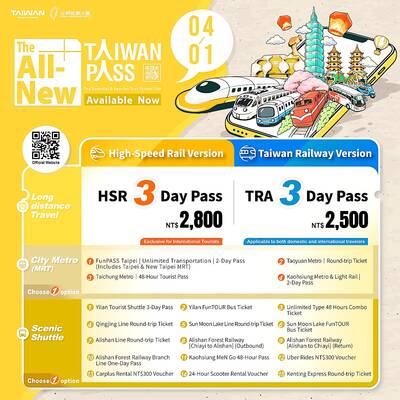
MORE POPULAR: Taiwan Pass sales increased by 59 percent during the first quarter compared with the same period last year, the Tourism Administration said The Tourism Administration yesterday said that it has streamlined the Taiwan Pass, with two versions available for purchase beginning today. The tourism agency has made the pass available to international tourists since 2024, allowing them to access the high-speed rail, Taiwan Railway Corp services, four MRT systems and four Taiwan Tourist Shuttles. Previously, five types of Taiwan Pass were available, but some tourists have said that the offerings were too complicated. The agency said only two types of Taiwan Pass would be available, starting from a three-day pass with the high-speed rail and a three-day pass with Taiwan Railway Corp. The former costs NT$2,800

The nation’s fastest supercomputer, Nano 4 (晶創26), is scheduled to be launched in the third quarter, and would be used to train large language models in finance and national defense sectors, the National Center for High-Performance Computing (NCHC) said. The supercomputer, which would operate at about 86.05 petaflops, is being tested at a new cloud computing center in the Southern Taiwan Science Park in Tainan. The exterior of the server cabinet features chip circuitry patterns overlaid with a map of Taiwan, highlighting the nation’s central position in the semiconductor industry. The center also houses Taiwania 2, Taiwania 3, Forerunner 1 and


 RSS
RSS