


The notion of wardrobe androgyny was the fitting theme of Yves Saint-Laurent’s (YSL) men’s collection, the house that kicked off the just-ended Paris men’s shows where men’s fashion won a feminine touch.
At YSL, designer Stefano Pilati used quotations from Plato to explain why he combined female detailing with a masculine silhouette.
“The original human nature was not like the present … the sexes were not two as they are now.”
Pilati underscored the union of genders with a line for men made in fabrics normally worn by women — crepe de chine, organza, shantung and silk voile, all fabrics which float rather than fall.
In an era obsessed with global warming and sustainable development, the 44 spring/summer 2009 collections displayed at the four-day men’s fashion shows ending on Sunday featured light airy see-through linens, silks and soft feathery cottons.
Bright colors, more often the domain of women’s wear, also figured strong.
As Gay Pride marches took place across Europe, pink was popular in Paris.
Louis Vuitton, a house with a predominantly masculine view of the world, chose pink for shorts, pants and waistcoat, and even shoes.
A huge pink sail served as the backdrop for an otherwise frankly male take on fashion from Emmanuel Ungaro designer Franck Boclet, who said fuschia was simply one of the house’s signature colors.
“I wanted a gay fresh style,” Boclet said of what he considered “a Paris 60s look” of hip-hugging tight-thighed pants, checkered suits and the odd item in day-glo orange, bright blue or purple.
Making his menswear debut for Givenchy, the house women’s designer Ricardo Tisci too went for shocking pink, throwing out a suit with socks, shirt and shoes in pink in a gothic-cum-romantic collection mingling masculine and feminine — lace shirts over tattooed skin, kinky leather shorts worn with cropped leggings.
At the house of Lanvin, designer Lucas Ossendrijver won a standing ovation from fashionistas in Paris’ ethnological museum for light-looking, almost insubstantial suits that seemed crumpled all over.
At Dior, one of the most awaited shows, Belgian designer Kris Van Asche broke with the brand’s iconic black, splashing deep gold, cobalt blue, fuschia and day-glo orange, shown on a gravel runway running between a line of tall trees.
His masculine touch saw the return of the leg-hugging straight pants first designed by his style-setting predecessor Hedi Slimane, as well as harsh laser-slashing in shirts and jackets, and minimalist small collars and tiny lapels.
For his own collection, Kris Van Asche too went for feminine detailing, with suits made in the light cottons normally used for shirts.
Some of the smaller more outlandish designers went further in blurring gender codes in fashion.
A newcomer to the Paris scene, Japanese designer Tatsuro Horikawa and his Julius brand put his very-manly men in biker boots, aviator hats and adventurer-style pants, while adding almost dress-length tunics and see-through shirts.
His models strutted the catwalk with long shawls rolled around shoulders and veil-like shawls draped over their heads. See-through shirts showed a black band around the chest, almost like a woman’s bra.
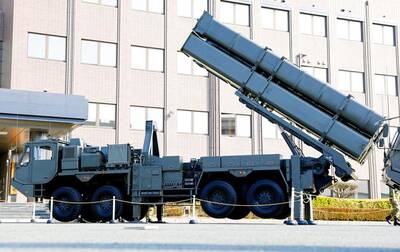
Japan has deployed long-range missiles in a southwestern region near China, the Japanese defense minister said yesterday, at a time when ties with Beijing are at their lowest in recent years. The missiles were installed in Kumamoto in the southern region of Kyushu, as Japan is attempting to shore up its military capacity as China steps up naval activity in the East China Sea. “Standoff defense capabilities enable us to counter the threat of enemy forces attempting to invade our country ... while ensuring the safety of our personnel,” Japanese Minister of Defense Shinjiro Koizumi said. “This is an extremely important initiative for
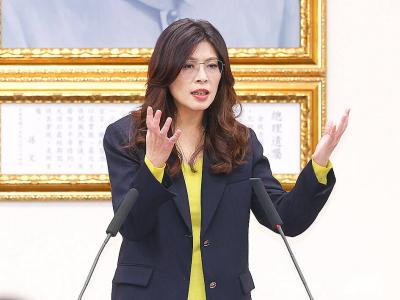
Chinese Nationalist Party (KMT) Chairwoman Cheng Li-wun (鄭麗文) today accepted an invitation from Chinese President Xi Jinping (習近平) to lead a delegation to China next month, saying she hopes to promote the peaceful development of cross-strait relations and bring stability to the Taiwan Strait. “I am grateful and happy to accept this invitation,” Cheng said in a statement from the KMT chairperson’s office. Cheng said she hopes both sides can work together to promote the peaceful development of cross-strait relations, enhance exchange and cooperation, bring stability to the Taiwan Strait and improve people’s livelihoods. At today's news conference, Cheng said any efforts to
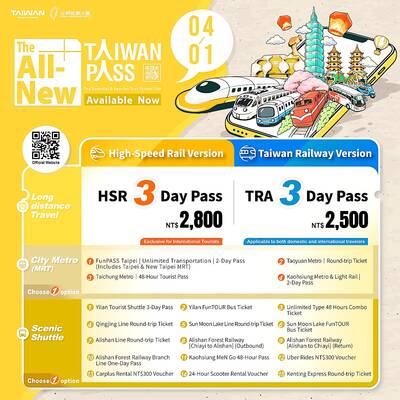
MORE POPULAR: Taiwan Pass sales increased by 59 percent during the first quarter compared with the same period last year, the Tourism Administration said The Tourism Administration yesterday said that it has streamlined the Taiwan Pass, with two versions available for purchase beginning today. The tourism agency has made the pass available to international tourists since 2024, allowing them to access the high-speed rail, Taiwan Railway Corp services, four MRT systems and four Taiwan Tourist Shuttles. Previously, five types of Taiwan Pass were available, but some tourists have said that the offerings were too complicated. The agency said only two types of Taiwan Pass would be available, starting from a three-day pass with the high-speed rail and a three-day pass with Taiwan Railway Corp. The former costs NT$2,800

The nation’s fastest supercomputer, Nano 4 (晶創26), is scheduled to be launched in the third quarter, and would be used to train large language models in finance and national defense sectors, the National Center for High-Performance Computing (NCHC) said. The supercomputer, which would operate at about 86.05 petaflops, is being tested at a new cloud computing center in the Southern Taiwan Science Park in Tainan. The exterior of the server cabinet features chip circuitry patterns overlaid with a map of Taiwan, highlighting the nation’s central position in the semiconductor industry. The center also houses Taiwania 2, Taiwania 3, Forerunner 1 and


 RSS
RSS