


EU newcomers Cyprus and Malta adopted the euro yesterday, bringing to 15 the number of countries using the currency with increasing clout over the slumping US dollar.
The Mediterranean islands, both former British colonies, scrapped the Cyprus pound and Maltese lira at midnight.
The Prime Minister of Malta Lawrence Gonzi had to wait a little before getting his hands on the new currency. An automated teller machine did not work when Gonzi tried to withdraw euros, and he was obliged to use a different ATM.
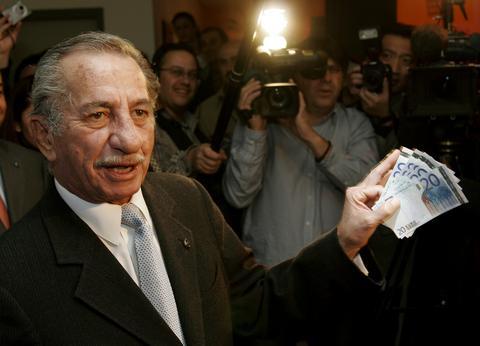
PHOTO: AP
"We are the smallest member state of the European Union, but we are proud," he said.
Both countries welcomed the euro with outdoor celebrations, including a fireworks display in Malta's rainy capital Valletta.
The euro has risen more than 11 percent against the dollar during the year and nine East European countries are waiting to convert.
The euro's strong exchange rate of US$1.4599 on Monday -- up 79 percent from its lowest point of US$0.82 in 2000 -- has given more pocket power to European tourists in the US, while curtailing the movements and spending of many American tourists and workers abroad.
"We are in a region that could have some geopolitical surprises," Cyprus Finance Minister Michalis Sarris said.
"Although the pound has been a loyal and faithful servant of the Cyprus economy, we felt that things could happen that could destabilize a small open economy, so it was to our benefit to join the euro zone as soon as possible."
Only the southern, Greek-speaking part of Cyprus will use the euro. The government in the north is recognized only by Turkey, but many Turkish Cypriot merchants will also accept euros along with Turkish lira.
Cyprus' euro coins will be inscribed in both Greek and Turkish, with designs that include the mouflon, or wild sheep, a national symbol. Malta's 1 euro and 2 euro coins will bear the Maltese cross.
"We're sorry to say goodbye to our pound but happy to welcome the euro," Cyprus President Tassos Papadopoulos said moments after midnight on the island.
Combined, the economies of Cyprus and Malta account for less than 0.3 percent of the euro zone's gross domestic product. Both easily met the requirements for limiting deficits and inflation, but euro adoption has also brought public skepticism.
A EU poll found 74 percent of Cypriots and 65 percent of Maltese believe the euro will drive prices upward. The September survey also found 44 percent of people in Cyprus and 33 percent in Malta would be sorry to see their national currencies being replaced.
"This makes us complete Europeans," Maltese hotel worker Mark Ferench said as the celebrations started. "This is the culmination of our European Union membership."
The 12 countries that have joined the EU since 2004 are obliged to convert to the euro eventually. Slovenia was the first to meet the targets and joined on Jan. 1 last year. Of the nine remaining countries, only four have linked their currencies to the euro in an exchange rate trading band, a key step toward membership.
Current members of the euro zone include Austria, Belgium, the Netherlands, Finland, France, Germany, Ireland, Italy, Luxembourg, Portugal, Spain, Greece and Slovenia.
New EU members Slovakia, Estonia, Latvia and Lithuania have joined the zone; others that have yet to adopt the euro are Bulgaria, Hungary, the Czech Republic, Poland and Romania.

‘NO SECURITY RISK’: The Railway Bureau reassured the public that the technicians’ activities were limited to technical guidance and did not involve sensitive systems The Railway Bureau yesterday said it had invited eight Chinese technicians to assist with an airport MRT construction project. The bureau issued the confirmation after an Internet user said Chinese nationals had entered the construction zone of Taiwan Taoyuan International Airport’s Terminal 3 project. They asked why “individuals from an enemy state” were allowed access to such a major national infrastructure project, which raised serious concerns over Taiwan’s industrial safety, sensitive systems and information security. The bureau’s Northern Region Engineering Branch Office said subcontractor Taiwan Handle Industrial Co (台灣手把工業) of the Taoyuan airport MRT’s “Contract No. CU05 Project A14 Station Civil, MEP &

The National Chungshan Institute of Science and Technology yesterday showcased its locally developed variants of the Vision 60 robotic patrol dog, which it plans to deploy on the nation’s outlying territories in the South China Sea. The variants were produced under the Joint Lab project — created by the institute and domestic companies — and assembled with domestically produced motors, lenses and artificial intelligence (AI) systems alongside licensed tech from the US, Missile and Rocket Systems Research Division deputy director Jen Kuo-kang (任國光) told the media event at a military base in Taipei’s Dazhi (大直) area. Taiwan has built up its strengths
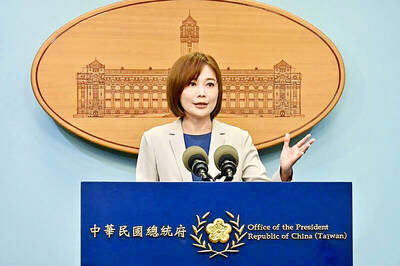
TIT-FOR-TAT: The US allegedly revoked the visa of a Chinese national working at Xinhua News Agency in the US in response to Beijing’s expulsion of Vivian Wang The Presidential Office yesterday condemned China for expelling a New York Times correspondent from Beijing following the newspaper’s interview with President William Lai (賴清德), saying the move highlighted Beijing’s suppression of press freedom and its threat to international news media. Taiwan has noted a series of recent incidents in which Beijing used similar tactics to “threaten and pressure international media outlets and journalists,” Presidential Office spokeswoman Karen Kuo (郭雅慧) said in a statement. “This concerns not only press freedom and freedom of expression, but also the safety of journalists, and Taiwan and relevant partners are paying close attention to the situation,” she
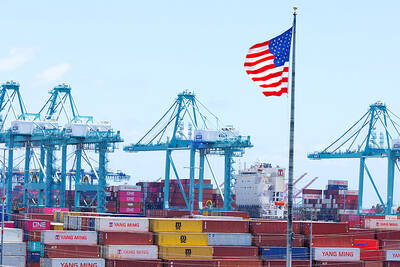
NOT IMMEDIATE: Taiwan has a chance to appeal the proposed 10 percent tariff before it starts, while other countries face a 12.5 percent tariff from the trade office Taiwan is among 60 economies determined by the US to have failed to impose or enforce a ban on the importation of goods produced with forced labor, according to a notice released on Tuesday by the Office of the US Trade Representative (USTR), which proposed imposing an additional 10 percent or more tariff on them. The USTR in a statement said that following an investigation, it had determined under Section 301 of the Trade Act of 1974 that the failure of the 60 economies to impose and effectively enforce a prohibition on the importation of goods produced with forced labor is


 RSS
RSS