


Sim Jae-duck was born in a restroom and now he plans to live and die in one -- a US$1.6 million toilet-shaped house designed to promote his tireless campaign for cleaner loos worldwide.
Sim will open what is billed as the world's one and only toilet house on Nov. 11 to mark the launch of his World Toilet Association.
The 419m2 concrete and glass structure is rising on the site of Sim's former home in his native city of Suweon, 40km south of Seoul. Before he moves in, anyone who is flush with funds can rent it for US$50,000 a day -- with proceeds going to his campaign to provide poor countries with proper sanitary facilities.
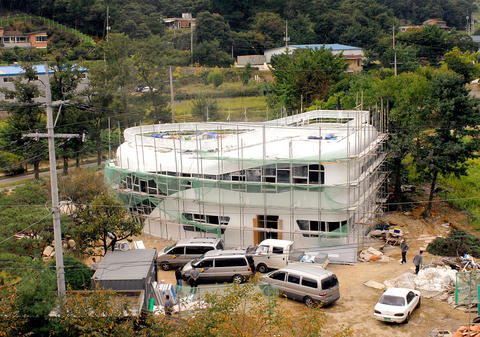
PHOTO: AFP
Apart from two bedrooms, two guestrooms and other rooms, the two-story house -- of course -- features three deluxe toilets. Unlike the giant "toilet" in which they are located, they will not be see-through affairs.
"A showcase bathroom screened by a glass wall is located in its center, while other toilets have elegant fittings or water conservation devices," Sim said.
The showcase loo will feature a device producing a mist to make users feel secure. An electronic sensor will raise the lid automatically when people enter, and there will also be music for patrons.
The house, complete with a stream and small garden in front, is named Haewoojae, meaning "a place of sanctuary where one can solve one's worries."
Sim's birth in a restroom was in line with traditional beliefs.
"It was intentional. My mother followed advice from my grandmother that people born in restrooms will enjoy long lives," the 74-year-old said.
Sim's campaign began during his term as Suweon mayor from 1995 to 2002. His drive to transform toilets into "clean and beautiful resting places imbued with culture" earned him the nickname "Mayor Toilet."
Public restrooms in the city were jazzed up with paintings, fresh flowers or even small gardens. His achievements prompted Sim to launch the Korea Toilet Association in 1999, in time for South Korea's cohosting with Japan of the soccer World Cup three years later.
Then he decided to take his clean toilets drive worldwide. The proposed World Toilet Association might be seen to rival squeaky-clean Singapore, where the World Toilet Organization is based, but Sim has said the work of the two bodies will not overlap.
Indeed, he hopes his toilet house will highlight the global need for better sanitation.
"My family has already agreed to preserve this house as a symbol of South Korea's new toilet culture after my death," he said. "The house will be remembered as an example of saving mankind from diseases and protecting the environment."
Sim, a member of parliament, will host the World Toilet Association's inaugural meeting which he hopes will attract 300 representatives from 70 countries.
On the final day he plans to invite all participants to his house, which he said "envisions a new concept to place toilets in the centre of our life."
Sim said his campaign will focus on setting international standards for clean public toilets, adding that countries such as Mongolia, Indonesia, Turkey and Brazil are actively supporting it.
Epidemics caused by poor sanitation worldwide cost 2 million lives a year, he said. Worldwide, 2.6 billion people live without toilets. Elsewhere, poorly designed flush toilets waste vast amounts of potential drinking water, he said.
A future project in his active mind is IT-based toilets, where people can check their health or surf the Internet.
"Toilets were once regarded as stinking and dirty places. Not any more. They must be treated as the sanctuary that protects human health," Sim said.

‘NO SECURITY RISK’: The Railway Bureau reassured the public that the technicians’ activities were limited to technical guidance and did not involve sensitive systems The Railway Bureau yesterday said it had invited eight Chinese technicians to assist with an airport MRT construction project. The bureau issued the confirmation after an Internet user said Chinese nationals had entered the construction zone of Taiwan Taoyuan International Airport’s Terminal 3 project. They asked why “individuals from an enemy state” were allowed access to such a major national infrastructure project, which raised serious concerns over Taiwan’s industrial safety, sensitive systems and information security. The bureau’s Northern Region Engineering Branch Office said subcontractor Taiwan Handle Industrial Co (台灣手把工業) of the Taoyuan airport MRT’s “Contract No. CU05 Project A14 Station Civil, MEP &

The National Chungshan Institute of Science and Technology yesterday showcased its locally developed variants of the Vision 60 robotic patrol dog, which it plans to deploy on the nation’s outlying territories in the South China Sea. The variants were produced under the Joint Lab project — created by the institute and domestic companies — and assembled with domestically produced motors, lenses and artificial intelligence (AI) systems alongside licensed tech from the US, Missile and Rocket Systems Research Division deputy director Jen Kuo-kang (任國光) told the media event at a military base in Taipei’s Dazhi (大直) area. Taiwan has built up its strengths
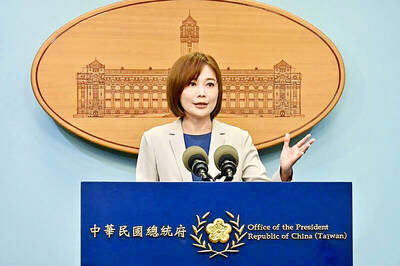
TIT-FOR-TAT: The US allegedly revoked the visa of a Chinese national working at Xinhua News Agency in the US in response to Beijing’s expulsion of Vivian Wang The Presidential Office yesterday condemned China for expelling a New York Times correspondent from Beijing following the newspaper’s interview with President William Lai (賴清德), saying the move highlighted Beijing’s suppression of press freedom and its threat to international news media. Taiwan has noted a series of recent incidents in which Beijing used similar tactics to “threaten and pressure international media outlets and journalists,” Presidential Office spokeswoman Karen Kuo (郭雅慧) said in a statement. “This concerns not only press freedom and freedom of expression, but also the safety of journalists, and Taiwan and relevant partners are paying close attention to the situation,” she
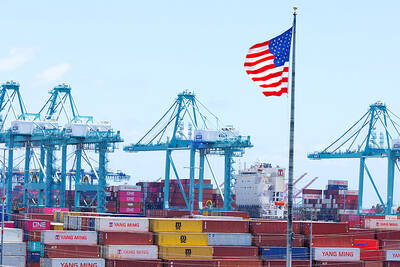
NOT IMMEDIATE: Taiwan has a chance to appeal the proposed 10 percent tariff before it starts, while other countries face a 12.5 percent tariff from the trade office Taiwan is among 60 economies determined by the US to have failed to impose or enforce a ban on the importation of goods produced with forced labor, according to a notice released on Tuesday by the Office of the US Trade Representative (USTR), which proposed imposing an additional 10 percent or more tariff on them. The USTR in a statement said that following an investigation, it had determined under Section 301 of the Trade Act of 1974 that the failure of the 60 economies to impose and effectively enforce a prohibition on the importation of goods produced with forced labor is


 RSS
RSS