


A powerful computer system that simulates the assembly of Boeing Co's new 787 Dreamliner cut typical costs by about 20 percent and trimmed a full year from production, officials said.
Leaders of Boeing's 787 program showed off the digital assembly line on Wednesday in a "virtual rollout" of the airliner, which is scheduled for its first test flight next summer and for delivery to airlines in 2008.
The fuel-efficient new jet has given Boeing an advantage over troubled European rival Airbus SAS, which just this week formally launched a wide-bodied jet designed to compete with the 787.
Boeing has 435 firm orders for the new 787, and deliveries are booked until late 2013. Mike Bair, the 787 program chief, said Boeing is surprised demand has stayed so strong.
"We kind of anticipated that people would start losing interest as the delivery dates get out there to 2013, and 14 and 15," Bair said. "But the activity in the marketplace just continues unabated."
The digital assembly system, designed by French company Dassault Systemes, allows Boeing engineers and contractors to make sure their products will fit together nearly perfectly before any parts are even shipped to Boeing's assembly plants.
It has even helped improve worker safety, revealing such details as how far a mechanic would have to stretch to reach a particular bolt.
Such an advanced computer system is a first for Boeing. The company has done digital design before, but the new assembly mock-ups have prevented thousands of errors in the 787 manufacturing process.
The two-engine 787 will deliver better fuel economy than older four-engine jets in the same size category. As fuel prices rise, the fuel-efficiency sales pitch has grown more persuasive.
The 787 has been struggling to reach its target weight, and Boeing is pushing to trim extra pounds. The company still expects to have the 787 at its target weight in time for the first delivery.
Bair said engineers are evaluating individual parts for extra pounds, and continuing to switch some aluminum components to titanium.
The company has been looking for ways to speed up production starting in 2010, but Bair said it won't be clear precisely how to speed up the pace until workers get experience assembling the planes.
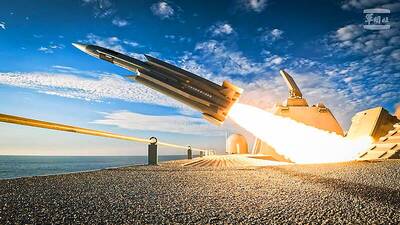
DETERRENCE: With 1,000 indigenous Hsiung Feng II and III missiles and 400 Harpoon missiles, the nation would boast the highest anti-ship missile density in the world With Taiwan wrapping up mass production of Hsiung Feng II and III missiles by December and an influx of Harpoon missiles from the US, Taiwan would have the highest density of anti-ship missiles in the world, a source said yesterday. Taiwan is to wrap up mass production of the indigenous anti-ship missiles by the end of year, as the Chungshan Institute of Science and Technology has been meeting production targets ahead of schedule, a defense official with knowledge of the matter said. Combined with the 400 Harpoon anti-ship missiles Taiwan expects to receive from the US by 2028, the nation would have
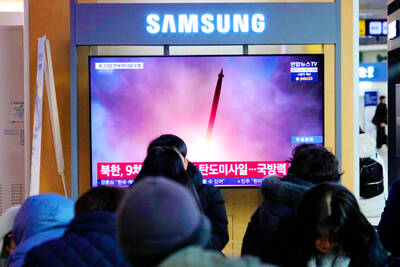
North Korea yesterday fired about 10 ballistic missiles to the sea toward Japan, the South Korean Joint Chiefs of Staff (JCS) said, days after Pyongyang warned of “terrible consequences” over ongoing South Korea-US military drills. Pyongyang recently dashed hopes of a diplomatic thaw with Seoul, Washington’s security ally, describing its latest peace efforts as a “clumsy, deceptive farce.” Seoul’s military detected “around 10 ballistic missiles launched from the Sunan area in North Korea toward the East Sea [Sea of Japan] at around 1:20pm,” JCS said in a statement, referring to South Korea’s name for the body of water. The missiles

‘UNWAVERING FRIENDSHIP’: A representative of a Japanese group that co-organized a memorial, said he hopes Japanese never forget Taiwan’s kindness President William Lai (賴清德) yesterday marked the 15th anniversary of the Tohoku earthquake and tsunami, urging continued cooperation between Taiwan and Japan on disaster prevention and humanitarian assistance. Lai wrote on social media that Taiwan and Japan have always helped each other in the aftermath of major disasters. The magnitude 9 earthquake struck northeastern Japan on March 11, 2011, triggering a massive tsunami that claimed more than 19,000 lives, according to data from Japanese authorities. Following the disaster, Taiwan donated more than US$240 million in aid, making it one of the largest contributors of financial assistance to Japan. In addition to cash donations and
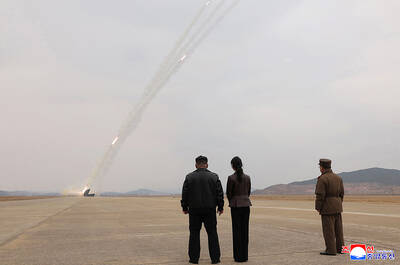
North Korea tested nuclear-capable rocket launchers, state media reported yesterday, a day after Seoul detected the launch of about 10 ballistic missiles. The test comes after South Korean and US forces launched their springtime military drills, due to run until Thursday. North Korean leader Kim Jong-un on Saturday oversaw the testing of the multiple rocket launcher system (MRLS), the Korean Central News Agency (KCNA) said. The test involved 12 600mm-caliber ultra-precision multiple rocket launchers and two artillery companies, it said. Kim said the drill gave Pyongyang’s enemies, within the 420km striking range, a sense of “uneasiness” and “a deep understanding


 RSS
RSS