


A 37-year-old appliance merchant topped a list of China's richest businesspeople released yesterday by the business magazine Forbes, leading a group of young entrepreneurs who have profited from the country's economic boom.
Wong Kwong-yu (黃光裕), founder of Gome Appliances (國美電器), saw his wealth expand to US$2.3 billion, driven by a jump in homebuying by China's newly prosperous middle class, according to Forbes.
The release of the 400-person Forbes China Rich List comes at a time when some of China's richest businesspeople are ensnared in scandals. A real estate tycoon ranked 16th on last year's list was arrested last month in a corruption investigation.
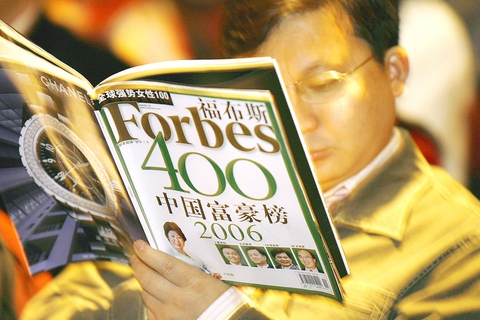
PHOTO: AFP
Wong is also caught up in a high profile bank fraud case. Chinese media have reported that he is under investigation over US$165 million in loans extended by the Bank of China between 1997 and 2004.
Trading of Gome shares in Hong Kong was suspended on Tuesday following the report but later resumed, and Gome said it had received no notice of such a probe.
The probe reportedly centers on Wong's older brother, a real estate developer. Wong's name also is spelled Huang Guangyu.
The combined wealth of China's 400 richest people jumped 51 percent to US$110 billion since Forbes' list last year.
YOUNG WEALTH
The number of US dollar billionaires also increased to 15 from 10 last year and just three the year before.
Nearly one-quarter of those on this year's list are under age 40, reflecting the fact that most of China's fortunes have been made in the past decade as retail, Internet and real estate companies sprang up to serve a booming consumer market.
"China's richest are a lot younger than America's richest," said Russell Flannery, Forbes' Shanghai bureau chief and compiler of the list, at a news conference.
"A big reason for the jump in wealth is the success they have had in listing their companies overseas," Flannery said.
"For Chinese private sector companies that have long been overshadowed by state-owned enterprises, access to capital markets is going to improve their competitiveness at home and abroad. That's very good news for them," he said.
No. 2 on the list was property developer Xu Rongnao (許榮茂), with a fortune of US$2.1 billion, followed by Larry Yung (
SELF-MADE WOMAN
The richest woman was No. 5 Zhang Yin (張茵), who built a business recycling paper into Nine Dragons Paper Co (玖龍紙業), China's biggest maker of paperboard for packaging, at US$1.5 billion.
Zhang was No. 1 on a list of China's richest released Oct. 11 by journalist Rupert Hoogewerf, who used to compile Forbes' rankings.
Flannery said Forbes calculated Zhang's wealth separately from the stakes that her husband and brother own in Nine Dragons. If their holdings were added together, the family would be No. 1 on the Forbes list.
The magazine noted that No. 16 on last year's list, Shanghai developer Zhang Rongkun (張榮坤), was dropped this year after he was arrested in a corruption investigation and his company's share price plunged.
The Shanghai Communist Party secretary has been dismissed in the scandal over allegations that government pension funds were improperly invested in real estate. Other officials are being questioned.
SMALLER FORTUNES
Forbes noted that the average age of businesspeople on its China list was 46.5, compared with 65.7 for the comparable US list.
But their fortunes also were smaller, averaging US$950 million for China's 400, versus US$13.2 billion for the US list, Forbes said. The minimum net worth required to make China's 400 rose this year to US$100 million, up from US$62 million last year.
China's top 40 richest include six women, compared with seven in the US top 40, but the Chinese include self-made millionaires such as Zhang, while the US women inherited their wealth, Forbes said.
Guangdong Province was home to most of the super-rich, with 66 of the top 400, followed by Zhejiang Province at 47, Shanghai with 44 and Beijing with 41.
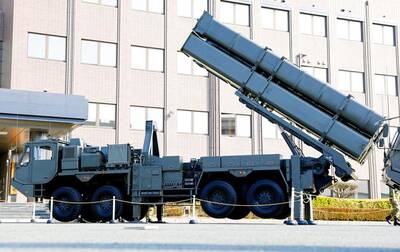
Japan has deployed long-range missiles in a southwestern region near China, the Japanese defense minister said yesterday, at a time when ties with Beijing are at their lowest in recent years. The missiles were installed in Kumamoto in the southern region of Kyushu, as Japan is attempting to shore up its military capacity as China steps up naval activity in the East China Sea. “Standoff defense capabilities enable us to counter the threat of enemy forces attempting to invade our country ... while ensuring the safety of our personnel,” Japanese Minister of Defense Shinjiro Koizumi said. “This is an extremely important initiative for
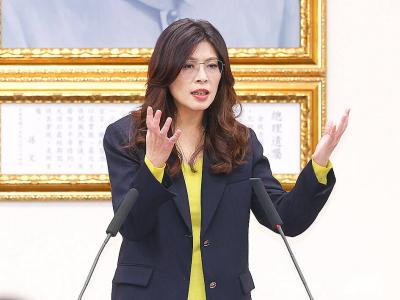
Chinese Nationalist Party (KMT) Chairwoman Cheng Li-wun (鄭麗文) today accepted an invitation from Chinese President Xi Jinping (習近平) to lead a delegation to China next month, saying she hopes to promote the peaceful development of cross-strait relations and bring stability to the Taiwan Strait. “I am grateful and happy to accept this invitation,” Cheng said in a statement from the KMT chairperson’s office. Cheng said she hopes both sides can work together to promote the peaceful development of cross-strait relations, enhance exchange and cooperation, bring stability to the Taiwan Strait and improve people’s livelihoods. At today's news conference, Cheng said any efforts to
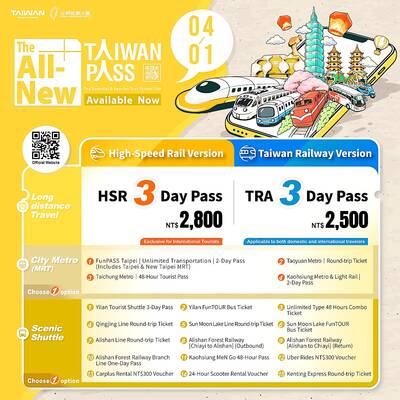
MORE POPULAR: Taiwan Pass sales increased by 59 percent during the first quarter compared with the same period last year, the Tourism Administration said The Tourism Administration yesterday said that it has streamlined the Taiwan Pass, with two versions available for purchase beginning today. The tourism agency has made the pass available to international tourists since 2024, allowing them to access the high-speed rail, Taiwan Railway Corp services, four MRT systems and four Taiwan Tourist Shuttles. Previously, five types of Taiwan Pass were available, but some tourists have said that the offerings were too complicated. The agency said only two types of Taiwan Pass would be available, starting from a three-day pass with the high-speed rail and a three-day pass with Taiwan Railway Corp. The former costs NT$2,800

The nation’s fastest supercomputer, Nano 4 (晶創26), is scheduled to be launched in the third quarter, and would be used to train large language models in finance and national defense sectors, the National Center for High-Performance Computing (NCHC) said. The supercomputer, which would operate at about 86.05 petaflops, is being tested at a new cloud computing center in the Southern Taiwan Science Park in Tainan. The exterior of the server cabinet features chip circuitry patterns overlaid with a map of Taiwan, highlighting the nation’s central position in the semiconductor industry. The center also houses Taiwania 2, Taiwania 3, Forerunner 1 and


 RSS
RSS