


■ Airline industry
Hit-and-run steward jailed
A Singapore Airlines steward who survived a plane crash but left an elderly pedestrian dead in a hit-and-run car accident has been jailed for six weeks, news reports said on Friday. Shahrin Shah Kamarshah, 29, was also disqualified from driving for seven years and fined S$8,000 (US$4,968). Shahrin's lawyer, Irving Choh, cited a report from a psychiatrist that said Shahrin was still suffering from post-traumatic stress from the crash of flight SQ006, which exploded after ploughing into construction equipment on a runway at Taipei's CKS International Airport six years ago. The steward had earlier admitted causing the death of Abdullah Buang, 68, as the retiree was crossing a road on Aug. 6 last year. The accident triggered an "acute flashback" of the plane crash, Choh said.
■ Patent rights
Nike sues Adidas-Salomon
Nike Inc filed a patent infringement lawsuit against Adidas-Salomon AG, claiming its archrival makes shoes using elements of Nike's SHOX cushioning technology. Beaverton-based Nike alleges the new Kevin Garnett signature shoe by Adidas and its A3 shoes are among the footwear that violate the Nike patent. "Despite Nike's patent protection, Adidas has built shoes that use Nike's technology," Nike spokesman Vada Manager said on Thursday. Adidas officials at the German company's US headquarters in Portland were not immediately available for comment. The complaint was filed in US District Court in Lufkin, Texas, because the court has "expertise in complex intellectual property cases" and can resolve it more quickly, Manager said. Nike, now the world's largest athletic shoe and clothing manufacturer, began developing the cushioning technology almost 20 years ago when it trailed Reebok International Ltd as the No. 2 shoe maker.
■ Hospitality
Ice bar opens in Tokyo
Japan may be shivering from its coldest winter in two decades, but Sweden's Icehotel is betting Tokyoites love alcohol so much they will drink surrounded by ice. Sweden's Absolut Vodka and Icehotel -- the hotel made of ice -- teamed up to open a bar made of ice blocks in a stylish district of Tokyo's Nishi-Azabu. The Icebar opening yesterday is the first outside of Europe, but the fourth in the world, joining London, Milan and the original in Stockholm. The operator shipped ice blocks to Tokyo directly from Sweden's Torne River, the same method used for the Stockholm bar, and keeps the room at a freezing minus 5?C. Customers are allowed to stay in the ice room only for 45 minutes. About 15 waiters will take turns every two hours to serve drinks. Warning: Drinking may be harmful to your health.
■ Credit
MasterCard postpones IPO
MasterCard Inc, the second-largest US credit card brand, on Thursday said it will postpone its initial public offering until the second quarter as its chief executive recovers from prostate cancer surgery. The company had been expected to list on the New York Stock Exchange during the first quarter. However, MasterCard said president and CEO Bob Selander was recently diagnosed with the cancer, which would have made touting the IPO in an investor road show more difficult. The IPO was expected to raise about US$2.5 billion for Purchase, New York-based MasterCard.
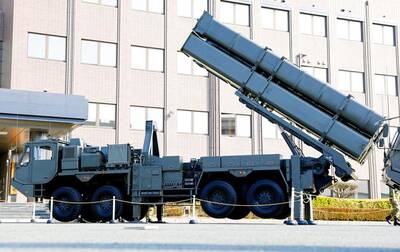
Japan has deployed long-range missiles in a southwestern region near China, the Japanese defense minister said yesterday, at a time when ties with Beijing are at their lowest in recent years. The missiles were installed in Kumamoto in the southern region of Kyushu, as Japan is attempting to shore up its military capacity as China steps up naval activity in the East China Sea. “Standoff defense capabilities enable us to counter the threat of enemy forces attempting to invade our country ... while ensuring the safety of our personnel,” Japanese Minister of Defense Shinjiro Koizumi said. “This is an extremely important initiative for

Chinese Nationalist Party (KMT) Chairwoman Cheng Li-wun (鄭麗文) today accepted an invitation from Chinese President Xi Jinping (習近平) to lead a delegation to China next month, saying she hopes to promote the peaceful development of cross-strait relations and bring stability to the Taiwan Strait. “I am grateful and happy to accept this invitation,” Cheng said in a statement from the KMT chairperson’s office. Cheng said she hopes both sides can work together to promote the peaceful development of cross-strait relations, enhance exchange and cooperation, bring stability to the Taiwan Strait and improve people’s livelihoods. At today's news conference, Cheng said any efforts to
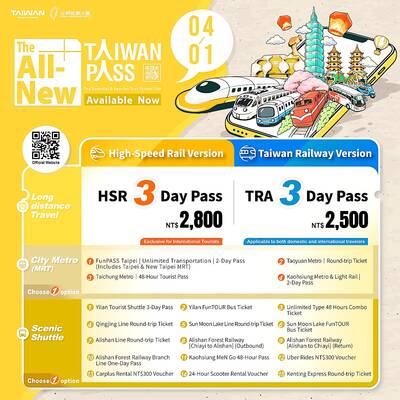
MORE POPULAR: Taiwan Pass sales increased by 59 percent during the first quarter compared with the same period last year, the Tourism Administration said The Tourism Administration yesterday said that it has streamlined the Taiwan Pass, with two versions available for purchase beginning today. The tourism agency has made the pass available to international tourists since 2024, allowing them to access the high-speed rail, Taiwan Railway Corp services, four MRT systems and four Taiwan Tourist Shuttles. Previously, five types of Taiwan Pass were available, but some tourists have said that the offerings were too complicated. The agency said only two types of Taiwan Pass would be available, starting from a three-day pass with the high-speed rail and a three-day pass with Taiwan Railway Corp. The former costs NT$2,800

The nation’s fastest supercomputer, Nano 4 (晶創26), is scheduled to be launched in the third quarter, and would be used to train large language models in finance and national defense sectors, the National Center for High-Performance Computing (NCHC) said. The supercomputer, which would operate at about 86.05 petaflops, is being tested at a new cloud computing center in the Southern Taiwan Science Park in Tainan. The exterior of the server cabinet features chip circuitry patterns overlaid with a map of Taiwan, highlighting the nation’s central position in the semiconductor industry. The center also houses Taiwania 2, Taiwania 3, Forerunner 1 and


 RSS
RSS