


At the recent international robotics exhibition in Japan, Joe Engelberger blasted the Japanese robotics industry for wasting time and money making humanlike robots. He saw "nothing serious. Just stunts. There are dogs, dolls, faces that contort and are supposed to express emotion on a robot. They are just toys."
Engelberger is considered by many to be the father of robotics. His company, Unimation, installed the first robot in the General Motors car plant in 1961. Along with other robotics experts, he believed then that by the early 2000s, robots would have taken over many jobs. They haven't.
Engelberger is critical of efforts by Japanese companies to create humanoid robots. He sees such efforts as a distraction from developing robots with a specific function. He believes companies such as Honda spend money making walking, talking robots as a way of demonstrating technical competence.
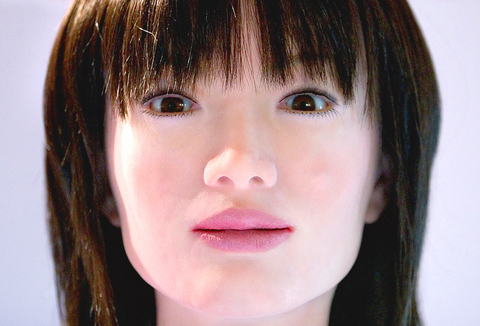
PHOTO: AP
But not everyone shares Engelberger's view. John Gray, a robotics expert based at Salford University, thinks that trying to create a humanoid robot is as useful as trying to get a man on the moon.
"It was by taking on such an enormously difficult scientific challenge that a lot of spin-off technologies were created," he said.
Gray said that the drive to get a man to the moon also had critics, who demanded the money be spent on more directly beneficial research. But Gray believes it was the US' commitment to the space race that resulted in its becoming "paramount in technology."
Engelberger also argues that the Japanese interest in humanoid robots is partly cultural. Takuya Fukuda, senior manager at Kawasaki Robots UK, agrees. He thinks the Japanese fascination with robots starts at a very young age.
"A lot of us grew up reading Atom Boy manga comics. Now we are the ones developing the robots," he said.
But part of Engelberger's argument is that robots don't have to look human to be useful. The average industrial robot looks nothing like a human, but has transformed manufacturing. His company, Helpmate, has developed a robot that delivers medicines in hospitals.
"It looks like a fridge on wheels, but people still talk to it," he said.
Engelberger wants to see more service robots, and is keen that technology be used to create robots to help care for older people.
For Japan, along with all the other industrialized nations, faces a demographic time bomb: By 2050 more than a third of its population will be over 65. Engelberger said that the market for such robots is worth about US$10 billion a year.
But it seems the Japanese are already on to this. George Bekey, of the University of Southern California, led a team of US robotics researchers on a tour of robotics laboratories in Japan and Korea. They visited 25 labs and "about 90 percent were involved in some way with the design of robots for the elderly."
Bekey believes that such work has led to "great advances in sensors, actuators, controllers, stability and software," which will find their way into this new generation of service robots.
He insists that "human-robot interaction, including the ability to express and interpret emotions, will be a significant component of future systems."
So will robots step out of the factory floor and into the home to look after ageing parents -- or our ageing selves? Ken Young, chairman of the British Robotics Association, is not convinced.
"The British will not be satisfied with the idea of robots looking after the elderly. It would seem like a factory to maintain old people and what kind of existence is that? I'd rather be shot," he said.
But the Japanese vision is of robots working alongside humans. Honda has just announced that from April, it will have a robot working as a receptionist, while in Tokyo recently, the latest "female android" was paraded. Young recognizes that the Japanese "don't feel any ethical dilemmas about these things."
But it is clear from the latest UN survey that the use of robots is continuing to grow. In 2003, about 400,000 "domestic" robots were bought; by 2007 that is expected to reach 4.1 million. They are also present in electrical appliances, security systems, medicine, defense systems, and cleaning equipment to name a few.
But the growth in robots is the fastest in Asia: Their number grew by 57 percent in the region in 2004, but doubled in Korea.
When Engelberger introduced robots into industry, people were soon talking of factories run solely by robots. This hasn't happened everywhere; but it's clear that the rise of the robot is continuing. Who knows, one day they may even be looking after you.
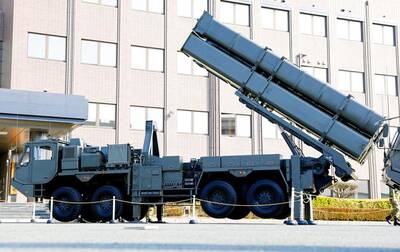
Japan has deployed long-range missiles in a southwestern region near China, the Japanese defense minister said yesterday, at a time when ties with Beijing are at their lowest in recent years. The missiles were installed in Kumamoto in the southern region of Kyushu, as Japan is attempting to shore up its military capacity as China steps up naval activity in the East China Sea. “Standoff defense capabilities enable us to counter the threat of enemy forces attempting to invade our country ... while ensuring the safety of our personnel,” Japanese Minister of Defense Shinjiro Koizumi said. “This is an extremely important initiative for

Chinese Nationalist Party (KMT) Chairwoman Cheng Li-wun (鄭麗文) today accepted an invitation from Chinese President Xi Jinping (習近平) to lead a delegation to China next month, saying she hopes to promote the peaceful development of cross-strait relations and bring stability to the Taiwan Strait. “I am grateful and happy to accept this invitation,” Cheng said in a statement from the KMT chairperson’s office. Cheng said she hopes both sides can work together to promote the peaceful development of cross-strait relations, enhance exchange and cooperation, bring stability to the Taiwan Strait and improve people’s livelihoods. At today's news conference, Cheng said any efforts to

MORE POPULAR: Taiwan Pass sales increased by 59 percent during the first quarter compared with the same period last year, the Tourism Administration said The Tourism Administration yesterday said that it has streamlined the Taiwan Pass, with two versions available for purchase beginning today. The tourism agency has made the pass available to international tourists since 2024, allowing them to access the high-speed rail, Taiwan Railway Corp services, four MRT systems and four Taiwan Tourist Shuttles. Previously, five types of Taiwan Pass were available, but some tourists have said that the offerings were too complicated. The agency said only two types of Taiwan Pass would be available, starting from a three-day pass with the high-speed rail and a three-day pass with Taiwan Railway Corp. The former costs NT$2,800

The nation’s fastest supercomputer, Nano 4 (晶創26), is scheduled to be launched in the third quarter, and would be used to train large language models in finance and national defense sectors, the National Center for High-Performance Computing (NCHC) said. The supercomputer, which would operate at about 86.05 petaflops, is being tested at a new cloud computing center in the Southern Taiwan Science Park in Tainan. The exterior of the server cabinet features chip circuitry patterns overlaid with a map of Taiwan, highlighting the nation’s central position in the semiconductor industry. The center also houses Taiwania 2, Taiwania 3, Forerunner 1 and


 RSS
RSS