


A new soft drink made in Colombia may not be cola, but it's definitely coca.
A Nasa Indian company in southern Colombia has created a golden, carbonated drink made from coca leaf extract, and they plan to market it as an alternative to Coca-Cola.
Coca Sek goes on sale this week in parts of Colombia, but its makers say they probably won't be able to export to the US or most other countries due to rules blocking the entry of raw coca, the plant from which cocaine is refined.
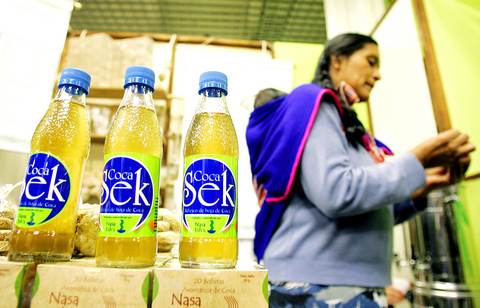
PHOTO: AP
"Six years ago we took on the job of trying to re-establish the good name of the coca leaf, which is a plant with enormous medicinal properties," said David Curtidor, a Nasa who heads the community company that produces the drink in the tiny southwestern town of Calderas.
The soda looks like apple cider, has a tea-like fragrance and tastes vaguely like a cross between 7-Up and ginger ale. The physical effect of drinking it -- even after several bottles -- is minimal.
"It's an energizing drink," Curtidor said. "It's like coffee since it is lightly stimulating."
Curtidor says the drink also is a political statement against transnational companies such as the Coca-Cola Co, which "symbolizes imperialist domination."
Coca-Cola spokeswoman Kirsten Watt, in Atlanta, Georgia, said such competitors are welcome.
"They are entitled to create beverages as they see fit," she said.
As for its own ingredients, Coca-Cola is tight-lipped.
"Cocaine has never been an ingredient," Watt said, though she declined to say whether cocaine-free coca extract is part of the drink's secret recipe, as has been widely reported.
"We just can't talk about the ingredients, the specific flavor composition," she said.
Coca Sek's makers say raw coca leaf extract is a key ingredient in their soda.
The company, which has 12 to 15 employees at a small bottling plant, does not have the funds needed to carry out tests to pinpoint how much naturally occurring cocaine alkaloid makes its way into the drink, Curtidor said.
But the company has done tests showing all alkaloids -- which include cocaine and other substances -- make up less than half of 1 percent of the drink.
"The traces that can remain are minimal because the formula we have is one with a very low level of cocaine," he said.
A group of Nasa Indians started selling coca tea, which is common in the Andes, to Colombian supermarkets several years ago. A year and a half ago, they began experimenting by adding ingredients and cooling the drink, Curtidor said.
They decided to call it Coca Sek, which in their Indian language means "Coca of the Sun."
Their firm, Empresa Colombiana de la Coca, aims to benefit small coca farmers, Curtidor said.
Similar drinks have appeared in Peru using a formula based on coca leaves. But such products are banned in most nations outside the Andean region.
Curtidor said his group has sold small amounts of coca tea in Canada, France and the US. But he said it would probably be impossible to export the soda on a larger scale due to import restrictions.
For now, Coca Sek remains a very local product.
"One of the first goals we have is to obtain a distribution truck," Curtidor said.
In the meantime, the company rents space on other companies' trucks.
The clear, small bottles with blue plastic caps went on display at a crafts fair in Bogota this month. The drink is scheduled to hit supermarkets starting tomorrow in the southern Colombian states of Cauca and Valle, and Curtidor said he hopes to eventually roll it out nationwide.
Colombia is the world's No. 1 producer of cocaine, and the US is the top buyer. But the coca leaf has many other uses. For centuries, Indians in the region have chewed the plant's leaves to ward off hunger and fatigue. Some Nasa Indians are now trying out the leaf in wines, cookies and even soaps.
Curtidor say the drink already has been sampled by many Colombians and has won wide approval.
"We have a very big market," Curtidor said. "People are going to prefer it out of solidarity and for the delicious flavor it has."

‘NO SECURITY RISK’: The Railway Bureau reassured the public that the technicians’ activities were limited to technical guidance and did not involve sensitive systems The Railway Bureau yesterday said it had invited eight Chinese technicians to assist with an airport MRT construction project. The bureau issued the confirmation after an Internet user said Chinese nationals had entered the construction zone of Taiwan Taoyuan International Airport’s Terminal 3 project. They asked why “individuals from an enemy state” were allowed access to such a major national infrastructure project, which raised serious concerns over Taiwan’s industrial safety, sensitive systems and information security. The bureau’s Northern Region Engineering Branch Office said subcontractor Taiwan Handle Industrial Co (台灣手把工業) of the Taoyuan airport MRT’s “Contract No. CU05 Project A14 Station Civil, MEP &

A US uncrewed surface vessel (USV) encountered multiple Chinese warships during an autonomous transit of the Taiwan Strait, US defense company Seasats said in a statement on Wednesday. Seasats announced that a Lightfish USV had completed the first autonomous transit of the Taiwan Strait. Over five days, the USV traversed the entire length of the Strait while constantly monitoring surface vessel traffic, the company said. The Lightfish encountered multiple Chinese warships, one of which was a Chinese People’s Liberation Army Navy (PLAN) Type 056 corvette, it said. The Chinese vessels were operating “well within Taiwan’s exclusive economic zone without transmitting their identity via the
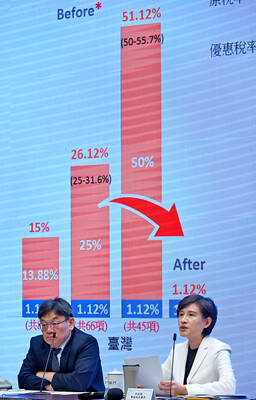
GREATER REACH? Auto parts and wood products would face tariffs of up to 15%, matching those targeting the EU, Japan and South Korea, Vice Premier said The US has announced that preferential tariff treatment for Taiwan’s non-semiconductor Section 232 goods would take effect retroactively from May 1, the Executive Yuan said yesterday. The US government yesterday posted a notice on the Federal Register’s public inspection Web site previewing tariff concessions for Taiwan under a memorandum of understanding (MOU) on Taiwan-US investment after two months of negotiations. The MOU signed on Jan. 15 stipulated three major preferential tariff arrangements: a 15 percent “reciprocal” tariff rate for Taiwan without stacking most-favored nation (MFN) rates; preferential Section 232 treatment for semiconductors and related products; and preferential Section 232 treatment for non-semiconductor

The National Chungshan Institute of Science and Technology yesterday showcased its locally developed variants of the Vision 60 robotic patrol dog, which it plans to deploy on the nation’s outlying territories in the South China Sea. The variants were produced under the Joint Lab project — created by the institute and domestic companies — and assembled with domestically produced motors, lenses and artificial intelligence (AI) systems alongside licensed tech from the US, Missile and Rocket Systems Research Division deputy director Jen Kuo-kang (任國光) told the media event at a military base in Taipei’s Dazhi (大直) area. Taiwan has built up its strengths


 RSS
RSS