


Struggling Japanese electronics maker Pioneer said yesterday both its chairman and president would step down to take the blame for mounting losses, promising drastic reform to revive the business.
Pioneer said president Kaneo Ito and chairman Kanya Matsumoto, son of the company's founder, would leave their posts to take responsibility for the recent poor sales of DVD recorders and plasma televisions amid a price war.
Vice president Tamihiko Sudo was appointed the new president, effective from Jan. 1, by the board of directors.
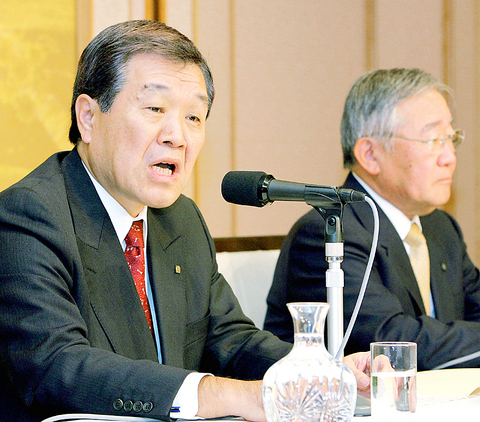
PHOTO: AFP
"Business has worsened on an unprecedented scale since the company was set up [in 1947]," said Ito, expressing responsibility for failing to successfully steer the company through developments in digital products.
He said Pioneer would unveil "a drastic structural reform plan" on Dec. 8 and apologized to shareholders, employees and client companies.
Incoming president Sudo, 58, said that in order to boost its profitability the group would focus more on car audio and navigation systems, a division he has previously headed.
Pioneer, like many other Japanese electronics goods makers, is streamlining its operations in response to rapidly falling prices of DVD recorders, flat-panel televisions and other home digital products.
The firm was literally a pioneer in home-use digital electronics, launching the first plasma-display TVs in 1997 and DVD recorders in 1999.
The prospect of further restructuring boosted the company's stock price, which ended up ¥50 or 3.07 percent at ¥1,678. At one point it was more than eight percent higher.
The firm is believed to be planning to cut more jobs and scale down its DVD recorder operations after falling to an interim net loss of ¥12.26 billion US$105 million from a profit of ¥4.81 billion a year earlier.
The Nihon Keizai Shimbun business daily said Pioneer planned to cut 1,000 jobs or 10 percent of its domestic workforce, in addition to a plan announced in March to reduce payrolls by 2,000, mostly overseas.
The Mainichi Shimbun daily said Pioneer would further reduce production capacity of plasma displays, having already halted two of its six lines.
Pioneer recently warned it expects a net loss of ¥24 billion in the year to March but newspapers are saying the company could sink deeper into the red because of the restructuring measures.
Sudo said that Pioneer "will go back to its starting point."
"We started with [audio] speakers and expanded our business domain to home audio devices, car audios, car navigation systems and then visual products.
"But our confidence on whether we are providing products customers really appreciate has recently been wavering," he said.
Sudo said it was only natural for the company to "drastically review" plasma display and DVD recorder operations as they are the main cause of its recent business deterioration.
Pioneer had made large investments in plasma TVs but has not got enough returns yet and appeared not to be making the most of the group's strength.
The company would focus more on car electronics, which it believes has significant growth potential overseas, he said, adding that Pioneer would also consider joint ventures with other companies.
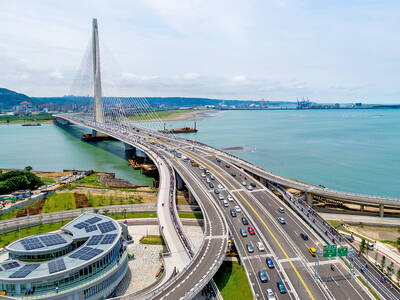
The Ministry of Transportation and Communications yesterday inaugurated the Danjiang Bridge across the Tamsui River in New Taipei City, saying that the structure would be an architectural icon and traffic artery for Taiwan. Feted as a major engineering achievement, the Danjiang Bridge is 920m long, 211m tall at the top of its pylon, and is the longest single-pylon asymmetric cable-stayed bridge in the world, the government’s Web site for the structure said. It was designed by late Iraqi-British architect Zaha Hadid. The structure, with a maximum deck of 70m, accommodates road and light rail traffic, and affords a 200m navigation channel for boats,
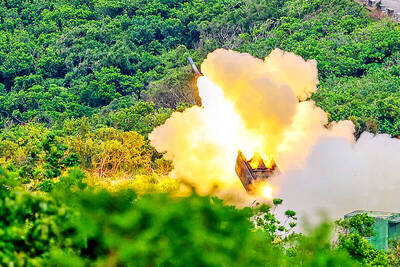
PRECISION STRIKES: The most significant reason to deploy HIMARS to outlying islands is to establish a ‘dead zone’ that the PLA would not dare enter, a source said A High Mobility Artillery Rocket System (HIMARS) would be deployed to Penghu County and Dongyin Island (東引) in Lienchiang County (Matsu) to force the Chinese military to retreat at least 100km from the coastline, a military source said yesterday. Taiwan has been procuring HIMARS and Army Tactical Missile Systems (ATACMS) from the US in batches. Once all batches have been delivered, Taiwan would possess 111 HIMARS units and 504 ATACMS, which have a range of 300km. Considering that “offense is the best defense,” the military plans to forward-deploy the systems to outlying islands such as Penghu and Dongyin so that

WHAT WAS ALL THAT FOR? Jaw Shaw-kong said that Cheng Li-wen had pushed for more drastic cuts and attacked him, just for the outcome to be nearly identical to his bill The legislature yesterday passed a supplementary budget bill to fund the purchase of separate packages of US military equipment, with the combined amount of spending capped at NT$780 billion (US$24.8 billion). The Chinese Nationalist Party (KMT) and Taiwan People’s Party (TPP) used their legislative majority to pass the bill, which runs until 2033 and has two main funding provisions. One was for NT$300 billion of arms sales already approved by the US for Taiwan on Dec. 17 last year, the other was for NT$480 billion for another arms package expected to be announced by Washington. The bill, which fell short of the NT$1.25

‘CLEAR MESSAGE’: The bill would set up an interagency ‘tiger team’ to review sanctions tools and other economic options to help deter any Chinese aggression toward Taiwan US Representative Young Kim has introduced a bill to deter Chinese aggression against Taiwan, calling for an interagency “tiger team” to preplan coordinated sanctions and economic measures in response to possible Chinese military or political action against Taiwan. “[Chinese President] Xi Jinping [習近平] has directed the People’s Liberation Army to be ready to invade Taiwan by 2027. China has a plan. America should have one too,” Kim said in a news release on Thursday last week. She introduced the “Deter PRC [People’s Republic of China] aggression against Taiwan act” to “ensure the US has a coordinated sanctions strategy ready should


 RSS
RSS