


■ Electronics
BlackBerry to use Intel chips
Research in Motion Ltd said yesterday it will use Intel Corp's cellular microprocessors in upcoming BlackBerry devices as it tries to boost performance without sacrificing battery life. The widely expected move is expected to improve the BlackBerry's ability to handle multimedia and Internet applications. The gadget is best known for its thumb keyboard and wireless messaging and some models also have phone and handheld computer capabilities. Waterloo, Ontario-based RIM has chosen the Intel PXA9xx cellular processor, code named "Hermon." The first BlackBerry products with the new technology would be available later this year, RIM president Mike Lazaridis said. No pricing was announced.
■ Media
Album released on `Gruvi'
Virgin Records said it would release the Rolling Stones' latest album on a new encrypted flash memory card that will allow users to preview and buy locked tracks from four of the veteran rockers' previous albums. The memory card, dubbed Gruvi, is manufactured by SanDisk Corp, and will be available in November at select US stores for US$39.95, SanDisk and the label said in a statement. By comparison, the Stones' latest album, A Bigger Bang, costs about US$14 on CD. SanDisk spokesman Ken Castle said the value for consumers is in being able to use the thumbnail-sized memory card to move music and other media between compatible mobile phones, electronic organizers, computers and other devices. To keep that content from ending up on Internet file-swapping sites or otherwise distributed without permission, the card comes with copy-protection technology built in.
■ Management
Samsung in hot water
Samsung Group was in hot water yesterday after its patriarch was told to appear before parliament and the president attacked South Korea's top conglomerate for its controversial corporate governance record. In a rare move, the National Assembly's Finance and Economy Committee decided late Tuesday to summon Samsung Group chairman Lee Kun-Hee on Wednesday next week and question him over debts left unpaid by the group's bankrupt Samsung Motors. The parliamentary move coincided with an attack from South Korean President Roh Moo-Hyun, who charged the group was seeking to sidestep a government drive for corporate governance reform. It is unknown whether the 64-year-old tycoon, currently in the US for a medical check-up, will respond to the summons.
■ Electronics
Sanyo expects bigger loss
Ailing Japanese electronics maker Sanyo said yesterday it expects to post a net loss of ¥140 billion (US$1.24 billion) in the financial year to March and will accelerate job cuts. Sanyo blamed a rapid decline in prices of its digital home appliances for the decision to raise its net loss forecast from ¥92 billion previously. The Osaka-based group said it would achieve two-thirds of its planned 14,000 job cuts by the end of January and exit from the loss-making traditional DVD player business and from video cassette recorders. Instead it will focus on making high-definition DVD players and rear-projection type and cathode-ray tube televisions. The Sanyo group posted a loss of ¥171.5 billion for the year to March as weak digital camera sales hit its bottom line.
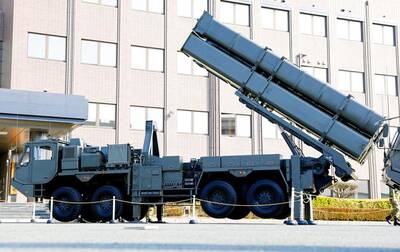
Japan has deployed long-range missiles in a southwestern region near China, the Japanese defense minister said yesterday, at a time when ties with Beijing are at their lowest in recent years. The missiles were installed in Kumamoto in the southern region of Kyushu, as Japan is attempting to shore up its military capacity as China steps up naval activity in the East China Sea. “Standoff defense capabilities enable us to counter the threat of enemy forces attempting to invade our country ... while ensuring the safety of our personnel,” Japanese Minister of Defense Shinjiro Koizumi said. “This is an extremely important initiative for

Chinese Nationalist Party (KMT) Chairwoman Cheng Li-wun (鄭麗文) today accepted an invitation from Chinese President Xi Jinping (習近平) to lead a delegation to China next month, saying she hopes to promote the peaceful development of cross-strait relations and bring stability to the Taiwan Strait. “I am grateful and happy to accept this invitation,” Cheng said in a statement from the KMT chairperson’s office. Cheng said she hopes both sides can work together to promote the peaceful development of cross-strait relations, enhance exchange and cooperation, bring stability to the Taiwan Strait and improve people’s livelihoods. At today's news conference, Cheng said any efforts to

MORE POPULAR: Taiwan Pass sales increased by 59 percent during the first quarter compared with the same period last year, the Tourism Administration said The Tourism Administration yesterday said that it has streamlined the Taiwan Pass, with two versions available for purchase beginning today. The tourism agency has made the pass available to international tourists since 2024, allowing them to access the high-speed rail, Taiwan Railway Corp services, four MRT systems and four Taiwan Tourist Shuttles. Previously, five types of Taiwan Pass were available, but some tourists have said that the offerings were too complicated. The agency said only two types of Taiwan Pass would be available, starting from a three-day pass with the high-speed rail and a three-day pass with Taiwan Railway Corp. The former costs NT$2,800

The nation’s fastest supercomputer, Nano 4 (晶創26), is scheduled to be launched in the third quarter, and would be used to train large language models in finance and national defense sectors, the National Center for High-Performance Computing (NCHC) said. The supercomputer, which would operate at about 86.05 petaflops, is being tested at a new cloud computing center in the Southern Taiwan Science Park in Tainan. The exterior of the server cabinet features chip circuitry patterns overlaid with a map of Taiwan, highlighting the nation’s central position in the semiconductor industry. The center also houses Taiwania 2, Taiwania 3, Forerunner 1 and


 RSS
RSS