


As officials in Washington warily consider a Chinese offer to buy a big US oil and gas company, the reaction in Japan to the swelling economic muscle of China provides an early warning sign of the mixed emotions that China evokes as it rises on the global stage.
After a five-year boom, Japan's export growth to China stalled in May. Recent polls of Japanese investors show a growing reluctance to make further investments in China.
The immediate catalyst for the changed attitude was a wave of anti-Japanese protests in Chinese cities in April. But those protests, countenanced by China's leaders, sent out a broader message: China would not object if its people, or its business executives, demonstrated a sense of nationalism on the streets or in corporate boardrooms.
It was a stark reminder to investors and politicians around the world of China's willingness to play the nationalist card. And it amounted to a bucket of cold water for many Japanese investors who had assumed that they were secure in China because they were providing jobs and quality products.
The protests involving the two Asian powers had been fueled by deep disputes over World War II narratives in Japanese textbooks, territorial arguments and Prime Minister Junichiro Koizumi's visits to a shrine to Japanese war dead.
"People are scared -- they don't know where the Chinese are going with this," said Robert Feldman, managing director of Morgan Stanley Japan, echoing fears that executives of Japanese companies rarely express publicly.
The Japanese "don't see a way out of the political mess," he said. "They are looking for alternatives."
In two surveys, separated by six months, the percentage of Japanese companies planning to expand operations in China dropped sharply, to just under 55 percent in late May, from 86 percent last December, according to the Japan External Trade Organization, the country's trade and investment promotion agency. The agency polled 414 Japanese companies operating in China last month, and a similar number late last year.
Although only 10 percent of the companies said that business had suffered from the protests, largely in reduced sales and tarnished brands, 36 percent said they were worried about future effects, and 45 percent said the business risk of operating in China had increased.
"The psychological impact the anti-Japan movement had on Japanese firms was far from small," Osamu Watanabe, chairman of the agency, said at a recent China-Japan investment conference in Beijing.
Reassuring Japanese investors will be crucial for China to invigorate the economy and create jobs in less prosperous areas that are inland from the booming coastline.
As China grows, Japan, the world's second-largest economy, will need powerful friends. In 2050, according to a new Goldman Sachs forecast, the Japanese economy will not be much larger than it is today, but China's is expected to be 30 times as large as now, or six times the size of Japan's. The world ranking of economies in 2050 would start with China, followed by the US, then India.
For some Japanese investors, the anti-Japanese protests catalyzed sentiment to diversify away from China to Southeast Asia.
"It was a trigger," said Hiroyuki Maeda, executive vice president of the Uniden Corp, a leading maker of cordless phones.
In the US, the unsolicited bid last Wednesday by the China National Offshore Oil Corp (
In Japan, though, some say that it is only the small fish who are nervous. "Most big companies are not worried about this situation," said Hiroshi Kadota, China director for the Keidanren, Japan's powerful business association.
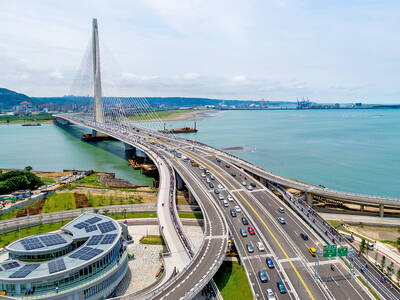
The Ministry of Transportation and Communications yesterday inaugurated the Danjiang Bridge across the Tamsui River in New Taipei City, saying that the structure would be an architectural icon and traffic artery for Taiwan. Feted as a major engineering achievement, the Danjiang Bridge is 920m long, 211m tall at the top of its pylon, and is the longest single-pylon asymmetric cable-stayed bridge in the world, the government’s Web site for the structure said. It was designed by late Iraqi-British architect Zaha Hadid. The structure, with a maximum deck of 70m, accommodates road and light rail traffic, and affords a 200m navigation channel for boats,
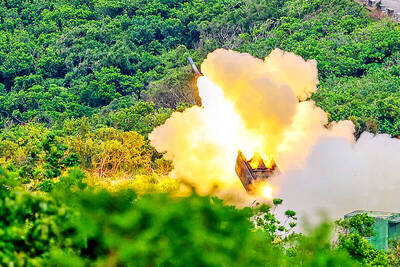
PRECISION STRIKES: The most significant reason to deploy HIMARS to outlying islands is to establish a ‘dead zone’ that the PLA would not dare enter, a source said A High Mobility Artillery Rocket System (HIMARS) would be deployed to Penghu County and Dongyin Island (東引) in Lienchiang County (Matsu) to force the Chinese military to retreat at least 100km from the coastline, a military source said yesterday. Taiwan has been procuring HIMARS and Army Tactical Missile Systems (ATACMS) from the US in batches. Once all batches have been delivered, Taiwan would possess 111 HIMARS units and 504 ATACMS, which have a range of 300km. Considering that “offense is the best defense,” the military plans to forward-deploy the systems to outlying islands such as Penghu and Dongyin so that
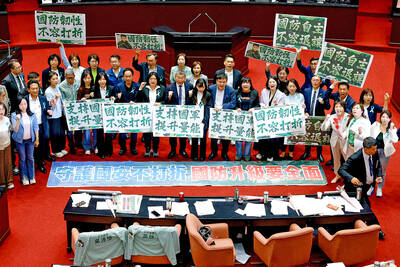
WHAT WAS ALL THAT FOR? Jaw Shaw-kong said that Cheng Li-wen had pushed for more drastic cuts and attacked him, just for the outcome to be nearly identical to his bill The legislature yesterday passed a supplementary budget bill to fund the purchase of separate packages of US military equipment, with the combined amount of spending capped at NT$780 billion (US$24.8 billion). The Chinese Nationalist Party (KMT) and Taiwan People’s Party (TPP) used their legislative majority to pass the bill, which runs until 2033 and has two main funding provisions. One was for NT$300 billion of arms sales already approved by the US for Taiwan on Dec. 17 last year, the other was for NT$480 billion for another arms package expected to be announced by Washington. The bill, which fell short of the NT$1.25
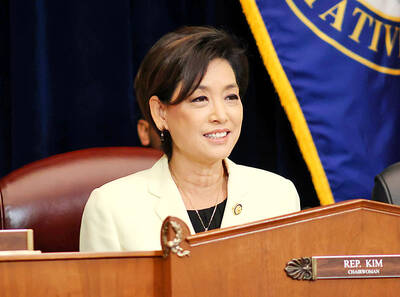
‘CLEAR MESSAGE’: The bill would set up an interagency ‘tiger team’ to review sanctions tools and other economic options to help deter any Chinese aggression toward Taiwan US Representative Young Kim has introduced a bill to deter Chinese aggression against Taiwan, calling for an interagency “tiger team” to preplan coordinated sanctions and economic measures in response to possible Chinese military or political action against Taiwan. “[Chinese President] Xi Jinping [習近平] has directed the People’s Liberation Army to be ready to invade Taiwan by 2027. China has a plan. America should have one too,” Kim said in a news release on Thursday last week. She introduced the “Deter PRC [People’s Republic of China] aggression against Taiwan act” to “ensure the US has a coordinated sanctions strategy ready should


 RSS
RSS