


You can be whatever you want to be on the Internet -- even if you want to be Citibank.
A recent flood of fake Citibank e-mail messages demonstrates the growing arsenal of technical and psychological tricks that online tricksters, called phishers, are using to get people to divulge personal information.
Hackers first coined the term "phishing" in the mid-1990s to refer to the art of stealing America Online accounts. But e-mail messages collected by the Anti-Phishing Working Group, an industry association, show that phishers are now going where the money is. In the group's June report, the most recent available, it said it had seen 492 different mass-mailings intended to fool Citibank customers. That compared with 285 aimed at eBay users.
The messages, and the fake Web sites they direct recipients to, are loaded with tricks that in some cases circumvent the tips once given to consumers about how to avoid online fraud. For example, one trick masks the address bar in the Web browser to conceal the true address of the site. And in the past year or so, senders have learned a new technique: Proper spelling and grammar.
"It's survival of the fittest," said Jon Oliver, chief messaging security officer at MailFrontier, a maker of spam- and fraud-fighting software.
One fake Citibank message managed to impress a specialist in online marketing. "From a marketer's point of view -- and I'm pretty brand-conscious -- it struck me as being realistic," said Lawrence Hefler, vice president of e-business and strategic alliances at Hilton Grand Vacations and the chairman of the Direct Marketing Association's Internet committee.
"The hot buttons are there," he added. "Clearly people are very conscious of privacy, but because of that consciousness they're aware of the identity theft issue, and that's the first thing they talk about in the e-mail."
A Citibank spokesman listed a number of steps the bank is taking to fight the scams, including educating customers, but he declined to discuss how much damage the scams had done.
Big Internet companies are trying to plug some of the larger security holes exploited by phishers and spammers -- for example, the ease with which the return address on a message can be faked. Microsoft has been trying to win support for a Sender ID system that could spot messages sent from machines that were not authorized to use a domain name like citibank.com in return addresses.

PROVOCATIVE: Chinese Deputy Ambassador to the UN Sun Lei accused Japan of sending military vessels to deliberately provoke tensions in the Taiwan Strait China denounced remarks by Japan and the EU about the South China Sea at a UN Security Council meeting on Monday, and accused Tokyo of provocative behavior in the Taiwan Strait and planning military expansion. Ayano Kunimitsu, a Japanese vice foreign minister, told the Council meeting on maritime security that Tokyo was seriously concerned about the situation in the East China and South China seas, and reiterated Japan’s opposition to any attempt to change the “status quo” by force, and obstruction of freedom of navigation and overflight. Stavros Lambrinidis, head of the EU delegation to the UN, also highlighted South China Sea

The final batch of 28 M1A2T Abrams tanks purchased from the US arrived at Taipei Port last night and were transported to the Armor Training Command in Hsinchu County’s Hukou Township (湖口), completing the military’s multi-year procurement of 108 of the tanks. Starting at 12:10am today, reporters observed more than a dozen civilian flatbed trailers departing from Taipei Port, each carrying an M1A2T tank covered with black waterproof tarps. Escorted by military vehicles, the convoy traveled via the West Coast Expressway to the Armor Training Command, with police implementing traffic control. The army operates about 1,000 tanks, including CM-11 Brave Tiger
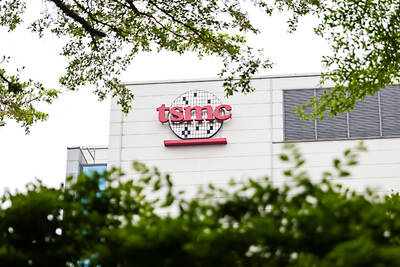
Taiwan Semiconductor Manufacturing Co (TSMC, 台積電), the world’s largest contract chipmaker, said it expects its 2-nanometer (2nm) chip capacity to grow at a compound annual rate of 70 percent from this year to 2028. The projection comes as five fabs begin volume production of 2-nanometer chips this year — two in Hsinchu and three in Kaohsiung — TSMC senior vice president and deputy cochief operating officer Cliff Hou (侯永清) said at the company’s annual technology symposium in Silicon Valley, California, last week. Output in the first year of 2-nanometer production, which began in the fourth quarter of last year, is expected to

Taiwan’s drone exports surged past US$100 million in the first quarter, exceeding last year’s full-year total, with the Czech Republic emerging as the largest buyer, the Ministry of Economic Affairs said. Exports of complete drones reached US$115.85 million in the period, about 1.2 times the total recorded for all of last year, the ministry said in a report. Exports to the Czech Republic accounted for about US$100 million, far outpacing other markets. Poland, last year’s top destination, recorded about US$11.75 million in the first quarter. Taiwan’s drone exports have expanded rapidly in the past few years, with last year’s total


 RSS
RSS