


The iPod may finally have a serious competitor.
The company that brought us the Walkman is entering the hard disk music player arena now dominated by its trendsetting-rival Apple Computer Inc.
Sony Corp unveiled its newest Walkman yesterday, a palm-sized, aluminum-encased player that can store up to 13,000 songs on its 20-gigabyte, 4.6cm hard drive, and promises 30 hours of playback on a rechargeable battery.

PHOTO: AFP
Weighing 107.7g, the device is smaller and lighter than the iPod's 15-, 20- and 40-gigabyte models, and just slightly larger than the 4-gigabyte iPod Mini. Sony claims the portable player is the smallest of its class.
Dubbed the Network Walkman NW-HD1, it marks a major upgrade to the legendary Walkman brand and the announcement comes on the 25th anniversary of the introduction of Sony's groundbreaking portable music player -- July 1, 1979.
It is expected to sell for around ?53,000 (US$487) in Japan and less than US$400 in the US, Sony said, undercutting Apple's 40-gigabyte device, which sells for US$499 and can hold up to 10,000 songs.
The NW-HD1 will be launched on July 10 in Japan, by the middle of next month in the US and in September in Europe.
Then the face-off will begin.
"I'd call it an iPod challenger, and one that will keep Apple on its toes," said Richard Doherty, an industry analyst with The Envisioneering Group.
Apple was not the first to introduce a high-capacity hard-disk portable music player, but its October 2001 launch of the iPod defined the market. The product's runaway success -- with an estimated 3 million units sold -- has since drawn other rivals, including Dell and Samsung.
Still, Apple leads with about a 60 percent share of the hard-disk drive player segment in the US, and about 30 percent of all portable music players, according to Michael Goodman, an analyst at The Yankee Group market research firm.
Sony's new Walkman is a highly-anticipated and belated entry but will likely be Apple's fiercest competitor yet, Doherty predicts.
"These are two aging entre-preneurs who are incredibly well-driven internally to exceed what they did just the month before," he said.
"It'll be great to finally have these two in the same playing field," Doherty said.
Of course, portable music isn't new to Sony. But in the past few years, analysts say Sony lost some of its luster as it aggressively pushed mini disc-based music players, and sales -- except for Japan -- fell short of expectations.
"Apple's iPod came out, and it was so successful, it really forced Sony's hand," Goodman said.
Because Sony uses the same 20-gigabyte hard drives across many of its product lines, including computers, it stands to benefit from massive price discounts for buying these devices in volume.
"Prices could fall by as much as 50 percent in the next 12 to 18 months," Dougherty said.
Sony declined to comment on sales targets. It has sold 340 million units of the Walkman over the past 25 years, including CD- and MD-based models.
Sony views a high-capacity, hard-drive player as a crucial addition to its range of products in boosting usage of its online music store Sony Connect. It is hoping the cachet of the Walkman name will help it close the gap on the iPod and Apple's iTunes download service.

The Ministry of Transportation and Communications yesterday inaugurated the Danjiang Bridge across the Tamsui River in New Taipei City, saying that the structure would be an architectural icon and traffic artery for Taiwan. Feted as a major engineering achievement, the Danjiang Bridge is 920m long, 211m tall at the top of its pylon, and is the longest single-pylon asymmetric cable-stayed bridge in the world, the government’s Web site for the structure said. It was designed by late Iraqi-British architect Zaha Hadid. The structure, with a maximum deck of 70m, accommodates road and light rail traffic, and affords a 200m navigation channel for boats,
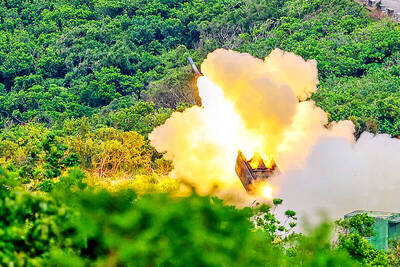
PRECISION STRIKES: The most significant reason to deploy HIMARS to outlying islands is to establish a ‘dead zone’ that the PLA would not dare enter, a source said A High Mobility Artillery Rocket System (HIMARS) would be deployed to Penghu County and Dongyin Island (東引) in Lienchiang County (Matsu) to force the Chinese military to retreat at least 100km from the coastline, a military source said yesterday. Taiwan has been procuring HIMARS and Army Tactical Missile Systems (ATACMS) from the US in batches. Once all batches have been delivered, Taiwan would possess 111 HIMARS units and 504 ATACMS, which have a range of 300km. Considering that “offense is the best defense,” the military plans to forward-deploy the systems to outlying islands such as Penghu and Dongyin so that

WHAT WAS ALL THAT FOR? Jaw Shaw-kong said that Cheng Li-wen had pushed for more drastic cuts and attacked him, just for the outcome to be nearly identical to his bill The legislature yesterday passed a supplementary budget bill to fund the purchase of separate packages of US military equipment, with the combined amount of spending capped at NT$780 billion (US$24.8 billion). The Chinese Nationalist Party (KMT) and Taiwan People’s Party (TPP) used their legislative majority to pass the bill, which runs until 2033 and has two main funding provisions. One was for NT$300 billion of arms sales already approved by the US for Taiwan on Dec. 17 last year, the other was for NT$480 billion for another arms package expected to be announced by Washington. The bill, which fell short of the NT$1.25

‘CLEAR MESSAGE’: The bill would set up an interagency ‘tiger team’ to review sanctions tools and other economic options to help deter any Chinese aggression toward Taiwan US Representative Young Kim has introduced a bill to deter Chinese aggression against Taiwan, calling for an interagency “tiger team” to preplan coordinated sanctions and economic measures in response to possible Chinese military or political action against Taiwan. “[Chinese President] Xi Jinping [習近平] has directed the People’s Liberation Army to be ready to invade Taiwan by 2027. China has a plan. America should have one too,” Kim said in a news release on Thursday last week. She introduced the “Deter PRC [People’s Republic of China] aggression against Taiwan act” to “ensure the US has a coordinated sanctions strategy ready should


 RSS
RSS