


The bankruptcy of the Parmalat dairy giant has put a sharp edge on questions about how companies are regulated in Italy, where weak traditions of independent oversight have long combined with a tendency for even big business to be a family affair dominated by insiders.
The government has proposed giving new powers to its toothless securities watchdog to better police the behavior of public companies. But the Parmalat scandal -- with allegations of crudely forged bank documents and losses hidden offshore in the Cayman Islands -- is a sign, some say, that Italy's family capitalism needs even tougher controls.
"In my view, what happened at Parmalat would not have happened if there were even one or two outside directors," said Francesco Giavazzi, an economist at Bocconi University in Milan. "There was no one sitting at the table who was truly independent of the family."
"The family" is the Tanzis, who controlled 51 percent of the listed company. Calisto Tanzi, who built the company from a small salami and preserves company to a global powerhouse with 36,000 employees and over 7 billion in 2002 sales, sits in a Milan prison after undergoing questioning from prosecutors trying to sort out where the money went.
The company went into bankruptcy protection after it was revealed that a subsidiary in the offshore financial refuge of the Cayman Islands didn't actually have the (US$5 billion) in the bank that it claimed. The Parmalat case raises broad comparisons with the collapse of US energy trader Enron, which used a complex web of partnerships to inflate the company's earnings. In the end, Parmalat shareholders saw their holdings become worthless.
The case comes on top of last year's spectacular default on billion in bonds by canned food holding Cirio; founder Sergio Cragnotti resigned and the company went bankrupt.
The Parmalat case has given new impetus to attempts by Economy Minister Giulio Tremonti to get parliament to strengthen Consob, the country's securities watchdog, analogous to the US Securities and Exchange Commission. Consob currently can't impose fines, investigate insider trading, or even bring criminal charges on its own.
Prospects for deeper change are questionable, however. The government has even moved in the opposite direction, by partly decriminalizing false accounting and cutting the statue of limitations to three years from four-and-a-half. Supporters of Prime Minister Silvio Berlusconi -- himself a business magnate who controls Mediaset, the country's No. 1 private broadcaster -- pushed the law through after he was accused of the offense, helping win his acquittal in 2002.
Specialists in corporate governance say the government should consider deeper changes, such as requiring that outsiders sit on board of directors. Another problem: Minority shareholders can't sue unless they hold 5 percent of a company -- a huge stake in most cases.
"I think Italy has a problem of culture," said Luca Enriques, a professor of corporate law at the University of Bologna who has written extensively on governance issues. The biggest blue-chip companies are usually well run, he said, "but outside this circle of blue chips there is not a culture of respect for minority shareholders."
One indication of the cultural attitudes is the case of Emilio Gnutti, Italy's first major executive to be convicted of insider trading. While free appealing an eight-month sentence, in May he was named chief executive of the privately held holding company that controls Telecom Italia SpA.
For years after World War II, the Italian economy was dominated by the twin pillars of state-owned companies and large family companies such as automaker Fiat, long dominated by the Agnelli family that still owns some 30 percent.
The government carried out a major shakeup in the 1990s, selling off many state companies and laying the foundations of an economy that relied more on mass ownership of firms through stock markets. But family capitalism not only survived the shakeup, in some cases it entrenched itself deeper.
"These people were aware that the reputation of the system depended on their behavior," said Pagano. "It was not a good system and I don't defend it because it was closed."
"But we have really just gone halfway," Pagano said. "We have not created the institutions that are complementary for the new type of capitalism. To move to a new system we need new institutions."
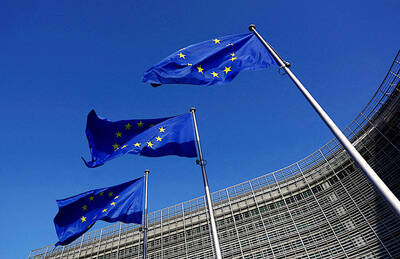
LEVERAGE: China did not ‘need to fire a shot’ to deny Taiwan airspace over Africa when it owns ‘half the continent’s debt,’ a US official said, calling it economic warfare The EU has raised concerns about overflight rights following the delay of President William Lai’s (賴清德) planned state visit to the Kingdom of Eswatini after three African nations denied overflight clearance for his charter at the last minute. Taiwanese allies Paraguay and Saint Kitts and Nevis, as well as several US lawmakers and the Inter-Parliamentary Alliance on China (IPAC) condemned China for allegedly pressuring the countries. Lai was scheduled to fly directly to Taiwan’s only African ally from yesterday to Sunday to celebrate the 40th anniversary of King Mswati III’s accession and his 58th birthday, but Seychelles, Mauritius and Madagascar suddenly revoked
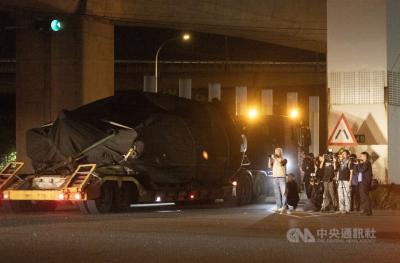
The final batch of 28 M1A2T Abrams tanks purchased from the US arrived at Taipei Port last night and were transported to the Armor Training Command in Hsinchu County’s Hukou Township (湖口), completing the military’s multi-year procurement of 108 of the tanks. Starting at 12:10am today, reporters observed more than a dozen civilian flatbed trailers departing from Taipei Port, each carrying an M1A2T tank covered with black waterproof tarps. Escorted by military vehicles, the convoy traveled via the West Coast Expressway to the Armor Training Command, with police implementing traffic control. The army operates about 1,000 tanks, including CM-11 Brave Tiger
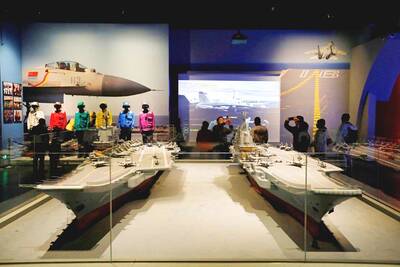
China on Wednesday teased in a video an aircraft carrier that could be its fourth, and the first using nuclear power, while making an allusion to Taiwan and vowing to further build up its islands, as it looks to boost maritime power, secure resources and bolster territorial claims. The video, issued on the eve of the 77th founding anniversary of the Chinese People’s Liberation Army Navy, featured fictional officers with names that are homophones of three commissioned aircraft carriers, the Liaoning (遼寧), Shandong (山東) and Fujian (福建). Titled Into the Deep, it showed a 19-year-old named “Hejian” (何劍) joining the group, sparking
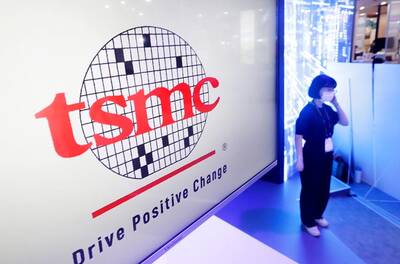
BIG YEAR: The company said it would also release its A12 chip the same year to keep a ‘reliable stream of new silicon technologies’ flowing to its customers Taiwan Semiconductor Manufacturing Co (TSMC, 台積電) yesterday said its newest A13 chip is to enter volume production in 2029 as the chipmaker seeks to hold onto its tech leadership and demand for next-generation chips used in artificial intelligence (AI), high-performance-computing (HPC) and mobile applications. TSMC, the world’s biggest contract chipmaker, also unveiled its A12 chip at its annual technology symposium in Santa Clara, California. The A12 chip, which features TSMC’s super-power-rail technology to provide backside power delivery for AI and HPC applications, is also to enter volume production in 2029, a year after the scheduled release of the A14 chip. The technology moves


 RSS
RSS