


War clouds loom over the WTO as a peace clause, which has protected farm subsidizers like the US, is due to expire at the start of next year, experts said.
Such an event would further complicate efforts to liberalize trade after the collapse of global trade liberalization talks earlier this month in the Mexican resort of Cancun amid bitter divisions between rich and poor nations, they warned.
The abrupt end to the Cancun meeting spoiled plans to discuss extending the nine-year peace clause, borne from the 1994 Uruguay Round agreement, which prevents countries from complaining to a Dispute Settlement Body (DSB) about agriculture subsidies by other WTO member states.
A WTO meeting in Geneva in mid-December is the last chance of an extension, but developing nations that suffer most from heavily-subsidized exports are unlikely to agree without concessions from key subsidizing culprits such as the EU and Japan, experts said.
"As we speak today, the peace clause will come and go," predicted Canada's WTO ambassador, Sergio Marchi.
"In the aftermath of Cancun, I hope that people don't use the DSB vindictively ... to get even or settle scores," he cautioned.
A trade official from the EU predicted that failure to negotiate a deal by December would result in "quite a lot" of disputes.
The combative "G-22" alliance of developing countries, which includes Brazil and other members of the 17-nation Cairns Group of agricultural exporters, is most likely to use the powers unleashed as the clause expires.
However the EU official warned: "In this sort of atmosphere, everyone might start throwing things at each other."
A Brazilian source from the WTO in Geneva insisted his country did not have a hit list of member states it would target on the morning of Jan. 2, when the peace clause expires.
"At the same time, if we feel that a country is using trade-distorting subsidies then we would make a complaint," he conceded.
There is a slim possibility the peace clause may be extended at the ambassador-level WTO meeting on December 15, said the EU trade official.
"It would be a rolling thing that would be a threat hanging over people that subsidize agriculture," he explained.
Omar Hilale, the Moroccan ambassador disagreed, arguing that such a compromise was unlikely as many Latin American and Asian countries held very different views to those by nations such as the US.
"I remain pessimistic," he said.
A sharp rise in trade disputes would further prolong the Doha round of talks aimed at freeing up global trade, which already appears likely to miss its January 2005 deadline, according to trade experts.

‘NO SECURITY RISK’: The Railway Bureau reassured the public that the technicians’ activities were limited to technical guidance and did not involve sensitive systems The Railway Bureau yesterday said it had invited eight Chinese technicians to assist with an airport MRT construction project. The bureau issued the confirmation after an Internet user said Chinese nationals had entered the construction zone of Taiwan Taoyuan International Airport’s Terminal 3 project. They asked why “individuals from an enemy state” were allowed access to such a major national infrastructure project, which raised serious concerns over Taiwan’s industrial safety, sensitive systems and information security. The bureau’s Northern Region Engineering Branch Office said subcontractor Taiwan Handle Industrial Co (台灣手把工業) of the Taoyuan airport MRT’s “Contract No. CU05 Project A14 Station Civil, MEP &

A US uncrewed surface vessel (USV) encountered multiple Chinese warships during an autonomous transit of the Taiwan Strait, US defense company Seasats said in a statement on Wednesday. Seasats announced that a Lightfish USV had completed the first autonomous transit of the Taiwan Strait. Over five days, the USV traversed the entire length of the Strait while constantly monitoring surface vessel traffic, the company said. The Lightfish encountered multiple Chinese warships, one of which was a Chinese People’s Liberation Army Navy (PLAN) Type 056 corvette, it said. The Chinese vessels were operating “well within Taiwan’s exclusive economic zone without transmitting their identity via the
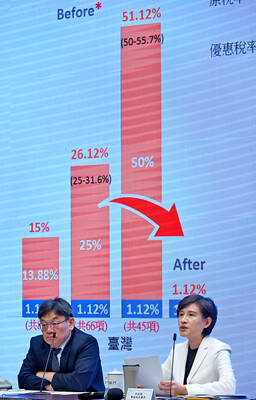
GREATER REACH? Auto parts and wood products would face tariffs of up to 15%, matching those targeting the EU, Japan and South Korea, Vice Premier said The US has announced that preferential tariff treatment for Taiwan’s non-semiconductor Section 232 goods would take effect retroactively from May 1, the Executive Yuan said yesterday. The US government yesterday posted a notice on the Federal Register’s public inspection Web site previewing tariff concessions for Taiwan under a memorandum of understanding (MOU) on Taiwan-US investment after two months of negotiations. The MOU signed on Jan. 15 stipulated three major preferential tariff arrangements: a 15 percent “reciprocal” tariff rate for Taiwan without stacking most-favored nation (MFN) rates; preferential Section 232 treatment for semiconductors and related products; and preferential Section 232 treatment for non-semiconductor

The National Chungshan Institute of Science and Technology yesterday showcased its locally developed variants of the Vision 60 robotic patrol dog, which it plans to deploy on the nation’s outlying territories in the South China Sea. The variants were produced under the Joint Lab project — created by the institute and domestic companies — and assembled with domestically produced motors, lenses and artificial intelligence (AI) systems alongside licensed tech from the US, Missile and Rocket Systems Research Division deputy director Jen Kuo-kang (任國光) told the media event at a military base in Taipei’s Dazhi (大直) area. Taiwan has built up its strengths


 RSS
RSS